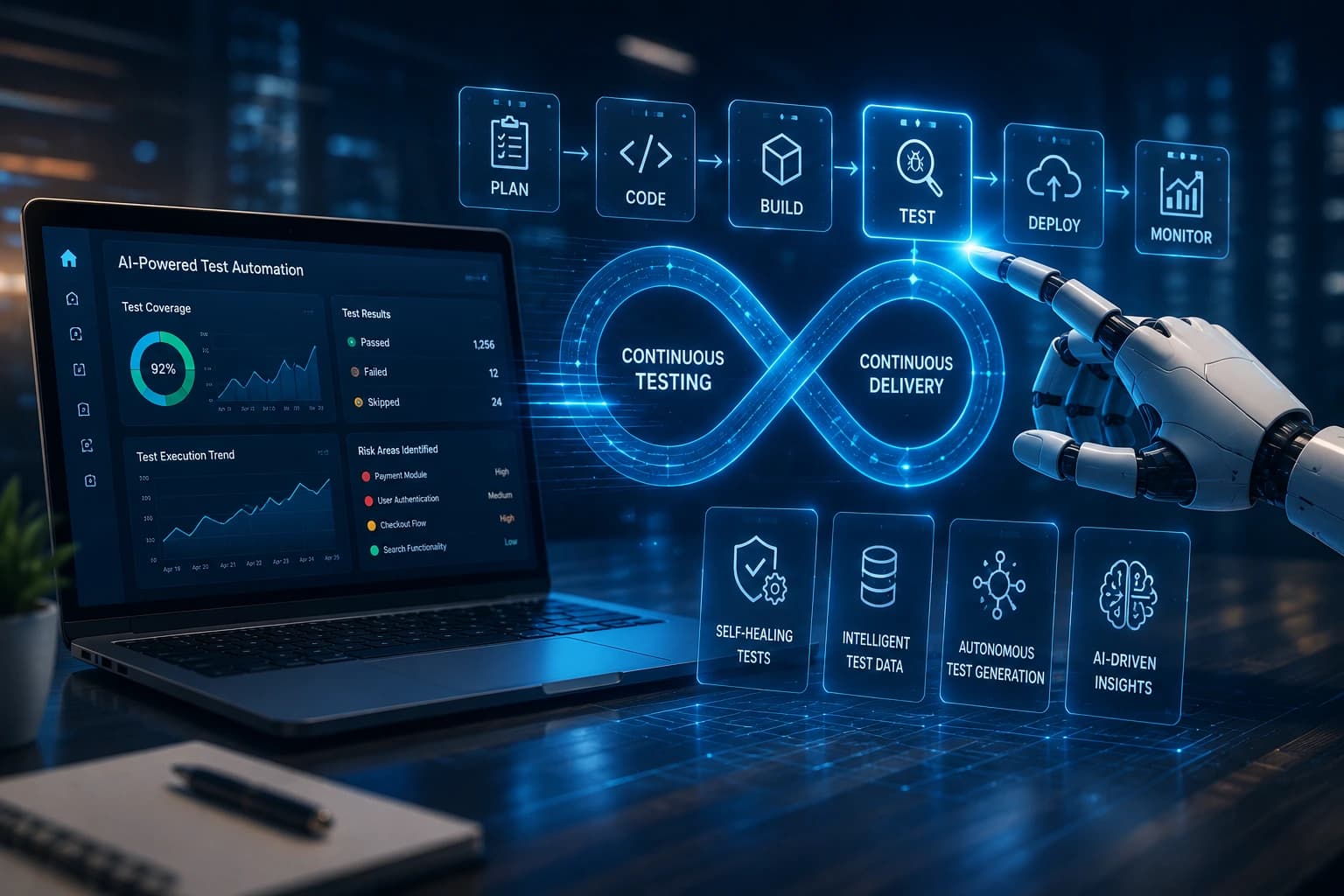
Enterprise engineering teams face a distinct operational imbalance. AI-powered code assistants have significantly increased developer productivity, allowing organizations to generate new software components at unprecedented speeds. Yet, the core release mechanism remains bound by legacy testing speeds.
When your development team accelerates code creation, but your validation infrastructure relies on linear, stage-gated processes; your enterprise software delivery pipeline faces a severe bottleneck. Code velocity becomes irrelevant when final production deployments are stalled by multi-day regression runs or endless script maintenance cycles.
To bridge this operational divide, organizations must shift from reactive testing models to systemic frameworks built around AI quality engineering.
Why Legacy Testing Automation Fails Under Continuous Delivery
Traditional test automation was built for a world where applications changed gradually. Scripts were designed to follow rigid, pre-defined execution paths. When an application changes continuously, this static model breaks down under the weight of three key operational pressures.
The Maintenance Trap
Brittle scripts represent a massive hidden cost in QA engineering. When developers modify a single DOM element, update an API payload structure, or change an object ID, standard automation tools throw immediate exception errors.
Engineering teams waste a significant amount of their operational hours refactoring old scripts just to keep their existing pipelines running. This constant maintenance cycle diverts senior QA engineers away from critical test design and exploratory validation.
Regression Bloat
As an enterprise platform expands, its corresponding test suite grows heavier. Monolithic regression suites often take several days to complete a full execution cycle. Since traditional frameworks lack the context to know which specific tests need to run for a given code change, they execute everything. This all-or-nothing approach completely derails efforts to achieve true continuous testing in CI/CD.
The Multiplier Cost of Late Defect Discovery
When validation acts as a separate downstream checkpoint at the end of a sprint or release cycle, bugs remain hidden in code branches for days or weeks.
Finding architectural flaws or integration breakages right before production creates intense release pressure. Industry data confirms that resolving defects late in the deployment cycle costs 10x to 30x more than addressing them during the initial design or code check-in phases.
Defining the Mechanics of AI-Driven Quality Engineering
To resolve these pipeline delays, organizations must recognize that checking software functionality at the end of a lifecycle is no longer sufficient. Modern quality frameworks must actively ensure system stability, observability, and traceability as the codebase grows.
This is the exact operational shift achieved through AI-driven quality engineering. Rather than executing static instructions, such frameworks use machine learning algorithms to continuously analyze behavioral data generated by your software ecosystem. It monitors:
Execution histories across diverse test runners
Log streams from distributed application servers
Live payload schemas passing through enterprise APIs
System performance metrics during heavy load cycles
The quality framework combines these data sources to provide a dynamic operational baseline for how your application operates. So, when a developer releases an update, the AI evaluates the changes in the environment. If a button's positioning or ID changes but its functionality remains same, the framework will automatically update its internal object map without crashing the build procedure.
Transforming the Software Delivery Pipeline with Intelligent Automation
Transitioning to an AI-driven quality engineering model replaces manual maintenance with automated, adaptive validation layers. This approach injects speed and accuracy directly into four critical areas of the delivery lifecycle.
Autonomous Scenario Generation
Traditional test creation requires manual translation of business requirements into functional scripts. Modern AI testing solutions read user stories, Jira specifications, and natural language documentation to automatically construct comprehensive test plans.
This eliminates human gaps in test coverage and ensures that newly introduced features are fully validated the moment they are merged.
Self-Healing Test Scripts
When a user interface undergoes structural modifications, intelligent test automation engines inspect the surrounding DOM tree to understand the functional purpose of the altered element.
If a locator fails, the AI identifies alternative attributes in real time, completes the validation run without stopping the pipeline, and updates the central repository. This step effectively cuts manual test maintenance down to near zero.
Data-Driven Prioritization
Running the entire regression suite for a minor, localized code change causes huge processing delays. The machine learning models scan the change logs and commit histories to build a map of exact code dependencies.
Then the system only executes those tests that are affected by that modification. This will reduce execution loops from hours to minutes, unleashing the real power of continuous testing in CI/CD.
Synthetic Test Data Synthesis
Without clean and realistic test data, enterprise validation often comes to a grinding halt, especially when facing difficult edge cases or compliance limits.
Leading software testing solutions provide AI-driven synthetic production of quality datasets on demand. This enables teams to securely validate difficult edge situations without disclosing sensitive client data or breaking privacy requirements.
Deep-Dive: Industry-Specific AI Quality Engineering Impact
The use of AI-driven quality engineering is contingent on the regulatory, architectural, and operational settings. The following evaluations address how individual enterprise sectors deal with their particular pipeline concerns.
Financial Services and Banking
Enterprise banking systems rely on tightly coupled architectures where legacy mainframes interface directly with microservice-driven mobile banking APIs. A single defect in an API schema can cause transactional integrity failures across global ledger systems.
The Operational Bottleneck: Regression testing in financial environments involves large volumes of database entries that require manual masking to comply with PCI DSS regulations.
The AI Quality Engineering Strategy: AI engines analyze past database mutations and live API traffic to synthesize compliant test datasets. These datasets preserve complex relational logic without exposing actual account holder documentation.
Pipeline Outcome: Automate data creation and run parallel API validation loops in CI/CD pipelines, enabling financial firms to run continuous testing and reduce patch release timelines from weeks to hours.
Healthcare Technology and Digital Health Platforms
Healthcare delivery pipelines must adhere to stringent regulatory guidelines, such as HIPAA and FDA software validation criteria. Modifying an EHR (Electronic Health Record) module necessitates significant validation to ensure that patient data is correct throughout all integration levels.
The Operational Bottleneck: Manual validation of third-party medical device integrations leads to delayed release dates due to the unpredictable nature of asynchronous telemetry data streams.
The AI Quality Engineering Strategy: AI testing solutions construct automated diagnostic models using historical event logs from HL7 and FHIR data streams. These models are utilized to mimic unusual device behavior and to test whether the system flags medical alarms accurately under strained settings.
Pipeline Outcome: Testing environments evolve from superficial visual checks to deeply semantic safety monitoring, reducing the probability of software regressions in actual clinical scenarios.
Retail, E-Commerce, and Supply Chain Management
Modern retail architectures rely on dynamic, multi-tenant cloud platforms that experience immense seasonal demand spikes. Minor user interface adjustments occur daily, while backend inventory databases sync across global distribution networks.
The Operational Bottleneck: Brittle automation scripts crash repeatedly during continuous deployment because UI elements adjust dynamically in response to inventory updates and marketing promotions.
The AI Quality Engineering Strategy: Integrating intelligent test automation allows the testing infrastructure to analyze the layout contextually. If an e-commerce checkout button changes its class or DOM selector, the AI recognizes its functional purpose and executes the test smoothly.
Pipeline Outcome: Eliminating false-positive test failures avoids unnecessary pipeline blockages, enabling e-commerce software systems to deploy functional updates directly to production during high-traffic events.
Overcoming Enterprise Implementation Roadblocks
Transitioning an enterprise infrastructure to an AI quality engineering framework introduces technical and organizational challenges. Engineering leaders must address these concerns systematically to achieve operational stability.
Mitigating AI Test Flakiness and Trust Deficits
A primary concern among engineering executives is the risk that AI-generated tests may introduce false negatives or mute real software bugs during a self-healing process. To maintain strict pipeline integrity, self-healing events must not occur in a black box.
Modern frameworks generate explicit execution logs for every automatic script correction. These logs outline the precise delta between the original DOM selector and the newly discovered object attribute. QA engineers review these mutations asynchronously, ensuring the self-healing engine acts as an administrative assistant rather than an unmonitored decision-maker.
Integrating with Legacy Test Architecture
Enterprises cannot afford to discard the substantial investments made in legacy Selenium, Appium, or Cypress frameworks. AI-powered software testing platforms should be deployed as intelligent analytical layers on top of existing frameworks.
The AI scans existing test execution logs, structures the historical failure data, and injects self-healing capabilities directly into your current runtime infrastructure via custom plug-ins. This approach provides immediate optimization without requiring a full code rewrite.
Seasia Infotech’s Engineering Approach
Transitioning to advanced AI software testing requires a pragmatic approach that protects active production environments. Seasia Infotech helps organizations systematically evolve from maintenance-heavy QA operations into automated, self-optimizing validation environments.
Rather than suggesting a disruptive rip-and-replace strategy, we build intelligent quality layers directly into your existing infrastructure. Our engineering frameworks sit cleanly on top of your existing testing tools, capturing execution data, analyzing system logs, and providing automated insights without disrupting your release cadences.
We focus our implementation workflows on four clear engineering pillars:
Pipeline Instrumentation: Seamlessly embedding machine learning layers into your active CI/CD configurations to automate execution analysis.
Contextual Self-Healing Integration: Deploying smart object recognizers that automatically intercept and resolve brittle UI locator failures mid-run.
Autonomous Lifecycle Governance: Moving quality checks upstream into early planning phases through automated, natural-language requirement parsing.
Advanced Analytics Infrastructure: Providing deep operational dashboards that track engineering velocity, technical debt accumulation, and code stability metrics.
Next-Gen Operational Quality Metrics
To accurately track performance in modern, automated environments, we help enterprise teams shift focus toward advanced quality metrics:
Engineering Metric | Technical Objective | Business Impact |
|---|---|---|
Code Churn Ratio | Tracks the stability and rewrite frequency of newly committed, AI-generated code blocks. | Flags structural code instability before it breaks down in downstream branches. |
Reuse Velocity | Measures how effectively engineering teams leverage existing components versus generating duplicate code. | Restricts technical debt and keeps software maintenance costs manageable. |
Time to Explain (TTE) | Evaluates how long it takes an engineer to interpret and diagnose automated code anomalies. | Streamlines troubleshooting and significantly reduces MTTR (Mean Time to Resolution). |
Self-Healing Success Rate | Monitors the percentage of locator and script exceptions resolved autonomously by AI layers. | Directly lowers the engineering hours lost to manual script updates. |
Building Self-Optimizing Delivery Pipelines
The fundamental promise of incorporating AI into software development is not just faster code generation; it is the predictable delivery of enterprise business value. If validation structures remain slow, fragile, and disconnected from development speeds, your speed gains are instantly consumed by downstream testing bottlenecks, manual rework, and release uncertainty.
By moving to an AI quality engineering model, organizations may build enterprise software delivery pipelines that never stop running and respond autonomously to change. Technology leaders infuse information, predictive analytics and automated governance into the core delivery loop to create a clear and persistent competitive advantage via code velocity.
Modernize Your Testing Infrastructure
Are brittle automation scripts and expanding regression loops slowing down your deployment pipeline? Contact our engineering team today to review your current delivery workflows and map out a practical transition to an intelligent, self-healing quality environment.