There was a time when AR and VR felt more like future-facing experiments than serious business tools. They looked impressive in demos, generated a lot of curiosity, and then often got pushed aside as “something to explore later.”
That is no longer the case.
Today, immersive technology is finding a much more practical role inside the enterprise. AR is helping frontline teams work with more accuracy. VR is improving training in ways traditional formats struggle to match. And now, Agentic AI is adding a new layer altogether that can interpret context, make decisions, and move workflows forward instead of simply waiting for instructions.
That shift matters.
Because when AR, VR, and Agentic AI come together, businesses are no longer just building immersive experiences. They are building systems that can train people better, support operations in real time, reduce friction on the ground, and make enterprise data more actionable in the moment it is needed.
This is where the real value lies. Not in using these technologies for novelty, but in using them to solve real operational problems.
The Opportunity Is Bigger Than It First Appears
What makes this space so important is not just the size of the market. It is the fact that the use cases are finally maturing.
Businesses have moved past the stage of asking whether immersive technologies are interesting. The more relevant question now is where they fit best, how they can be implemented sensibly, and what kind of business outcomes they can improve.
In many industries, the answer is already becoming clear.
$75B+ | 24.87% | $693B+ | 76% |
|---|---|---|---|
Global AR/VR Market Size | CAGR — Fastest Growing Tech Sector | Projected Market Size (10-Year Horizon) | Better Learning Outcomes with VR vs. Traditional |
What Enterprise AR/VR Development Really Means
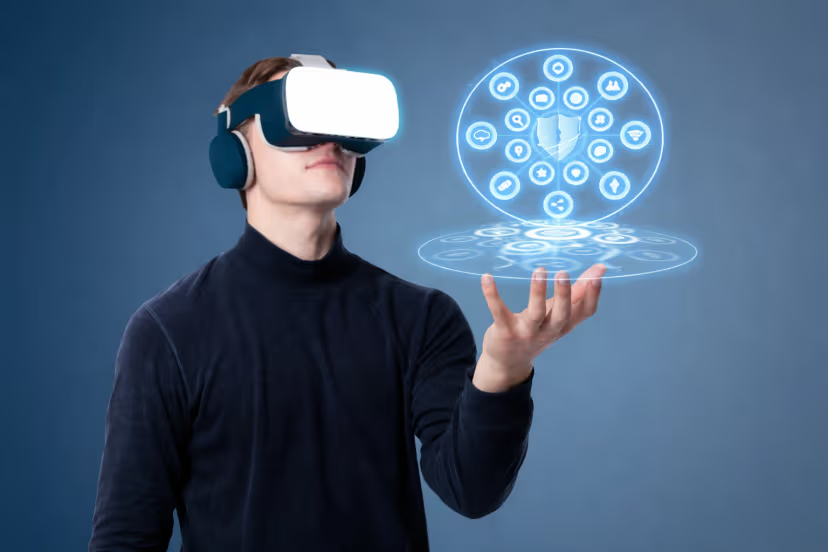
Enterprise AR/VR development is not about building flashy digital experiences for the sake of it. It is about creating immersive applications that solve specific business problems and work reliably in real environments.
That distinction matters.
Consumer AR and VR applications usually focus on entertainment, engagement, or brand interaction. Enterprise applications have a very different standard to meet. They need to function inside corporate systems, align with operational workflows, support multiple user environments, and hold up under real business pressure.
A serious enterprise AR/VR application should be able to do a few things well:
Work across the devices and environments it is meant for
Integrate with systems like ERP, CRM, LMS, IoT platforms, and analytics tools
Support measurable outcomes, whether that is better training, faster inspections, fewer operational errors, or stronger engagement
Meet enterprise expectations around security, compliance, and scalability
Evolve over time as business needs change
The technology stack behind this may include Unity, Unreal Engine, ARKit, ARCore, WebAR, spatial computing platforms, cloud infrastructure, and AI models. But the technology itself is only one part of the story. What really matters is whether the solution fits into the way the business actually operates.
Why Agentic AI Changes the Equation
AR and VR can make experiences immersive. Agentic AI makes them far more useful.
Traditional AI systems usually respond to a prompt, return an answer, or identify a pattern. Agentic AI goes further. It can reason across multiple steps, make decisions, take actions, and adapt based on what is happening around it.
Inside an immersive enterprise application, that opens up a very different level of capability.
Instead of simply showing a technician where a part is located, the system can help diagnose the issue, pull relevant records, suggest the next step, and trigger a maintenance workflow. Instead of offering every employee the same VR training module, it can adjust the difficulty level based on performance and give targeted feedback as the session progresses.
That is the real difference. The application stops being a passive interface and starts becoming an active participant in the workflow.
What Agentic AI Can Enable Inside AR/VR Applications
When used well, Agentic AI can make enterprise AR/VR applications far more practical and intelligent.
Capability | Enterprise Impact |
|---|---|
Autonomous Task Execution | AI agents complete multi-step workflows inside immersive environments, e.g., automatically flagging defects, updating records, and notifying supervisors during an AR inspection. |
Real-Time Contextual Guidance | Agents analyze the environment in real time and deliver step-by-step instructions without human intervention, ideal for field service, surgery simulation, and onboarding. |
Adaptive Learning Paths | In VR training, Agentic AI monitors learner performance and dynamically adjusts difficulty, scenarios, and coaching without a human instructor in the loop. |
Natural Language Interaction | Workers can speak to AI agents within AR headsets to query manuals, log issues, request support, or control machinery hands-free, in context. |
Predictive Decision Support | Agents surface predictive insights during operations, e.g., alerting a technician in AR that a component has a 73% failure probability before it shows visible symptoms. |
Cross-System Orchestration | Agentic AI connects AR/VR environments with CRM, ERP, IoT, and analytics platforms, acting as the intelligent layer that makes data actionable in the physical world. |
At Seasia, this is where our AI/ML and artificial intelligence consulting capabilities become especially relevant. We don’t see Agentic AI as an extra layer added at the end. We see it as something that should be built into the architecture from the start.
Where This Is Already Creating Value
The strongest proof point for AR, VR, and Agentic AI is that the use cases are no longer hypothetical. Businesses across industries are already using these technologies to address very real challenges.
Healthcare
Healthcare is one of the most compelling sectors for immersive technology, especially within modern healthcare technology solutions. VR is being used for surgical simulation, staff training, therapy support, and education. AR is supporting procedure guidance and remote collaboration. Add Agentic AI, and these environments can become more adaptive, more personalized, and more useful in high-stakes settings.
For example, simulation-based training can respond to a learner’s actions in real time rather than following a fixed script. Clinical support tools can surface contextual information during procedures instead of requiring practitioners to step outside the workflow.
This is one of the reasons healthcare organizations are showing increasing interest in immersive platforms that go beyond static learning experiences.
Retail and eCommerce
Retail has already seen strong early adoption of AR, especially in areas like virtual try-ons, furniture placement, and product visualization. But the next wave is more intelligent and more personalized.
When Agentic AI is layered into these experiences, businesses can recommend products in real time based on user behavior, guide shoppers through decisions more intelligently, and create commerce journeys that feel more consultative than transactional.
Seasia’s work in immersive commerce, including solutions like the Virtual Dressing Room App, reflects how these experiences can directly support conversion and customer engagement.
Manufacturing and industrial operations
This is one of the clearest enterprise use cases because the value is easier to measure. AR can support assembly guidance, maintenance workflows, remote expert assistance, and digital twin visualization. VR can improve safety training and simulate high-risk conditions before workers step onto the floor.
Agentic AI makes these systems even stronger by helping detect defects, trigger workflows, surface predictive alerts, and reduce the need for constant manual intervention.
Solutions like Seasia’s AI-InspectX show how computer vision, AI, and AR can work together to support more intelligent inspection processes in industrial environments.
EdTech and workforce learning
Immersive learning tends to perform especially well when the goal is practice, retention, and confidence-building. VR makes it possible to simulate real situations without real-world risk. AR can make learning more interactive and contextual. Agentic AI adds personalization.
That means training can become far more dynamic. Instead of putting every learner through the same experience, the system can coach differently depending on performance, identify skill gaps early, and adapt assessments accordingly.
For enterprises and education providers alike, that makes immersive learning far more compelling than one-size-fits-all digital training modules.
Fintech and BFSI
Financial services may not be the first sector people associate with AR/VR, but there are interesting use cases emerging in visualization, advisory experiences, training, and collaborative d