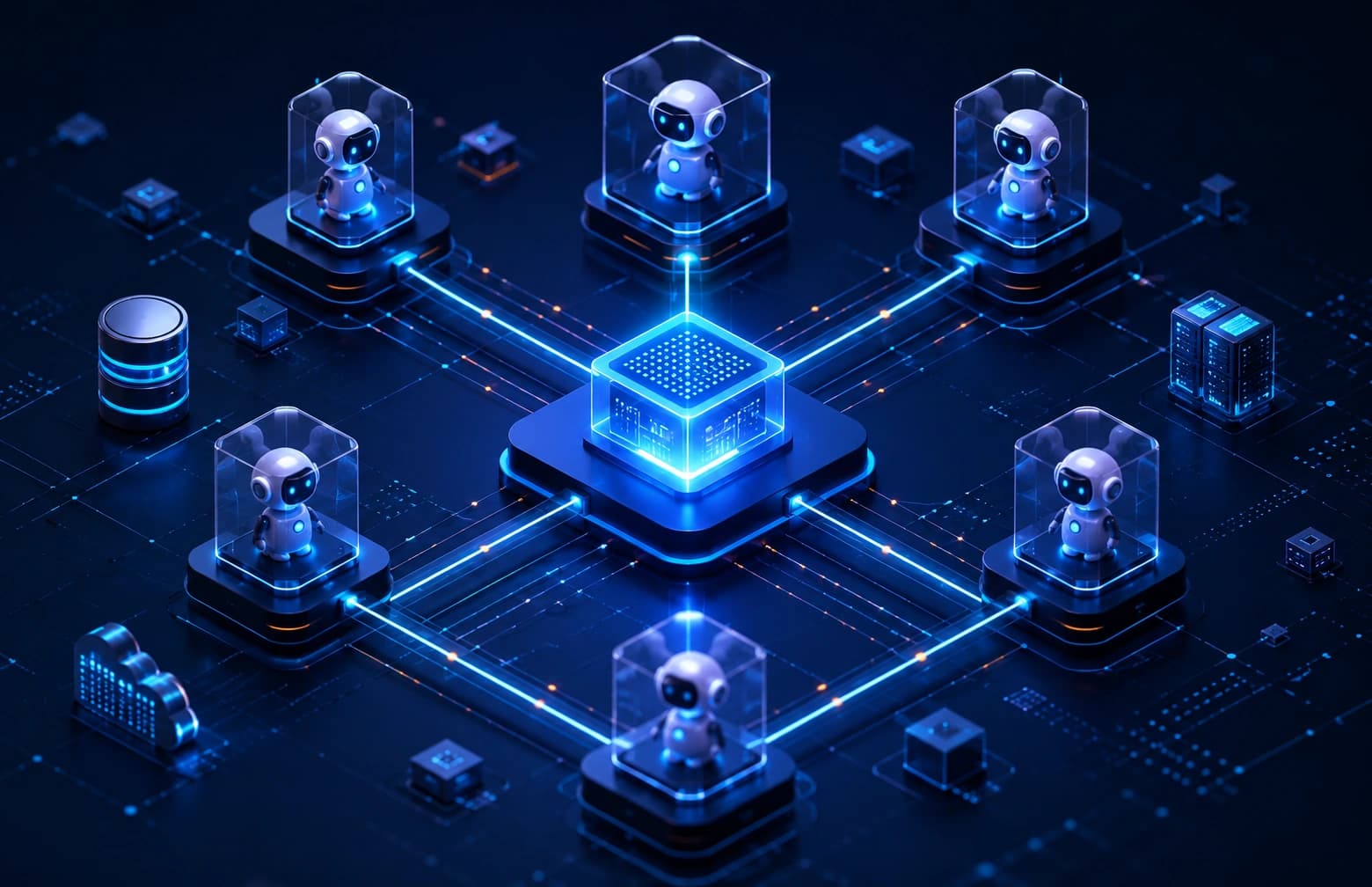
IT leaders are no longer debating whether AI agents work, that capability is well established. The central operational challenge now revolves around governance and coordination, and to figure how to orchestrate multiple autonomous agents from diverse vendors without conflicting decisions, duplicated efforts, or security breaches.
AI agent orchestration addresses this challenge and is reshaping enterprise architecture.
Scaling Autonomous Systems: From Single Agents to Multi-Agent Ecosystems
While single-purpose AI agents are straightforward to deploy, managing multi-agent workflows presents a significant architectural hurdle.
When distinct agents handle CRM data retrieval, draft generation, and compliance checks, operating them without a centralized control plane leads to redundant processing, race conditions, and inconsistent outputs. Consequently, internal enterprise AI consulting programs frequently stall - not from model underperformance, but from a lack of inter-agent coordination.
For instance, in a claims-processing environment involving separate agents for ingestion, policy checks, fraud detection, and communication, uncoordinated execution results in out-of-order operations and conflicting decisions. These operational breakdowns stem from flaws in workflow sequencing and accountability rather than model limitations.
Overcoming this bottleneck demands an AI agent orchestration platform to standardize handoffs, maintain shared context, and govern multi-agent ecosystems under a single operational objective.
Why Has Multi-Agent Orchestration Become a Boardroom Priority?
Financial allocations reflect strategic priorities, and current enterprise investment in autonomous systems is accelerating. Gartner projects that nearly 40% of enterprise applications will incorporate embedded, task-specific AI agents by the end of 2026, a stark increase from under 5% just two years prior. Scaling of this magnitude is driven not by market sentiment, but by measurable return on investment.
Beneath this growth, the strategic focus has fundamentally shifted. Where organizations previously concentrated on model selection, the primary imperative is now governance - establishing clear ownership, defining risk-mitigation protocols for incorrect outputs, and determining appropriate boundaries for human-in-the-loop oversight.
Highly regulated sectors, such as banking and insurance, lead this shift by extending their existing rules-based automation frameworks to autonomous agents.
Ultimately, the executive challenge is no longer technological feasibility, but governance at scale - maintaining oversight and accountability across interconnected agentic systems. Enterprise AI orchestration provides the governance structure required to resolve this challenge.
Key Market Dynamics Driving Multi-Agent Adoption
Three primary market shifts are currently defining enterprise AI deployment:
1. Protocol Standardization Over Custom Integration
Open protocols, such as the Model Context Protocol and emerging Agent-to-Agent communication standards, have matured rapidly from research concepts to production-grade infrastructure. By enabling cross-platform interoperability without custom connector code, these standards reduce vendor lock-in and form the foundation of scalable orchestration architectures.
2. Accelerating, Asymmetrical Enterprise Adoption
Production adoption remains bifurcated. Approximately 30% of enterprises have deployed at least one autonomous agent in production, with financial services and insurance approaching 50%. Conversely, highly regulated sectors like healthcare and the public domain lag behind due to stringent compliance requirements and immature governance frameworks. This adoption gap will dictate market positioning over the next two years.
3. Compressed Time-to-Value
Deployment payback windows have narrowed significantly. Recent industry benchmarks from BCG and Forrester indicate a median payback period of approximately five months for well-architected agent deployments.
This accelerated return on investment has prompted capital allocators to require comprehensive orchestration roadmaps prior to approving isolated pilots.
Maximizing these returns requires treating multi-agent AI systems coordination as a core architectural requirement from day one, rather than a remediation step after systems conflict.
Key Architectural Principles for Enterprise-Grade AI Deployment
Organizations that successfully deploy production-grade AI workflow orchestration adhere to a consistent operational framework. While straightforward, these principles are often bypassed during rapid prototyping:
Constrained Initial Scope
Implementation begins with a targeted workflow, a limited agent cluster, and a single measurable key performance indicator before attempting enterprise-wide expansion.
Centralized State Management
Systems are architected with unified contextual memory. Lacking shared visibility into prior agent actions, independent systems inevitably generate redundant operations or conflicting customer-facing outputs.
Risk-Proportional Autonomy
While full autonomy remains a popular narrative, resilient architectures employ human-in-the-loop oversight for high-stakes operational nodes, specifically financial transactions and regulatory compliance validations.
Defined Control Limits & Governance
Every autonomous agent operates under pre-established operational guardrails, accompanied by instant kill-switch controls to mitigate systemic risk immediately upon detecting anomalous behavior.
Strategic Infrastructure Partnerships
Rather than engineering underlying orchestration mechanisms internally, leading organizations leverage custom AI agent development expertise to accelerate deployment schedules and avoid established pitfall patterns.
The Engineering Gap in Cross-Platform Context
The complexity of multi-agent deployment is frequently underestimated. While deploying a basic conversational interface requires minimal overhead, constructing an enterprise orchestration layer capable of maintaining persistent state across disparate channels - such as WhatsApp, Slack, Microsoft Teams, and Outlook - presents a complex systems engineering challenge.
Collaborating with experienced enterprise AI development services ensures faster delivery of stable, compliant systems.
Real-World Execution - Lessons from Production
A case study involving Seasia Infotech and Orchestro AI illustrates this requirement. The objective was to replace fragmented communication workflows with an enterprise-grade, retrieval-augmented system capable of live API integration, persistent multi-session context retention, and multilingual support. The initiative demonstrated that operational success depends not on model capabilities, but on backend orchestration discipline. Specifically, the precise synchronization of session memory, retrieval accuracy, and fallback protocols.
A parallel dynamic exists within healthcare automation. In workflows such as prior authorizations and claims processing, the core complexity lies beyond document parsing. The challenge rests in coordinating discrete validation, compliance, and messaging agents into a unified pipeline that optimizes throughput without compromising decision accuracy. Applying structured orchestration principles allows healthcare operations to transition from reactive processing toward predictive, coordinated workflows.
The Cost of Inaction
Inaction carries a quantifiable cost. Competitors deploying coordinated agent networks compound their advantages in operational velocity and output consistency with every passing quarter. Gartner research indicates that a significant portion of agentic AI initiatives will be abandoned over the next two years. The root cause of these failures is consistent - fragmented ownership, lack of unified architecture, and isolated deployments designed without interoperability.
Organizations that recognize agent orchestration as foundational enterprise infrastructure rather than an ad-hoc technical experiment, will define the next generation of digital leadership. Conversely, those deferring structural coordination will remain trapped in an unproductive cycle of disconnected pilots.
The Bottom Line
Transitioning from isolated software tools to coordinated multi-agent ecosystems is no longer a future concept - it is a current operational imperative. Organizations that establish an enterprise AI orchestration framework build lasting agility, tighter cost control, and stronger corporate governance. Navigating this architecture requires proven execution and clear vision. Partnering with an experienced AI software development company like Seasia Infotech empowers leadership teams to build, deploy, and scale custom AI automation solutions that drive long-term commercial value.