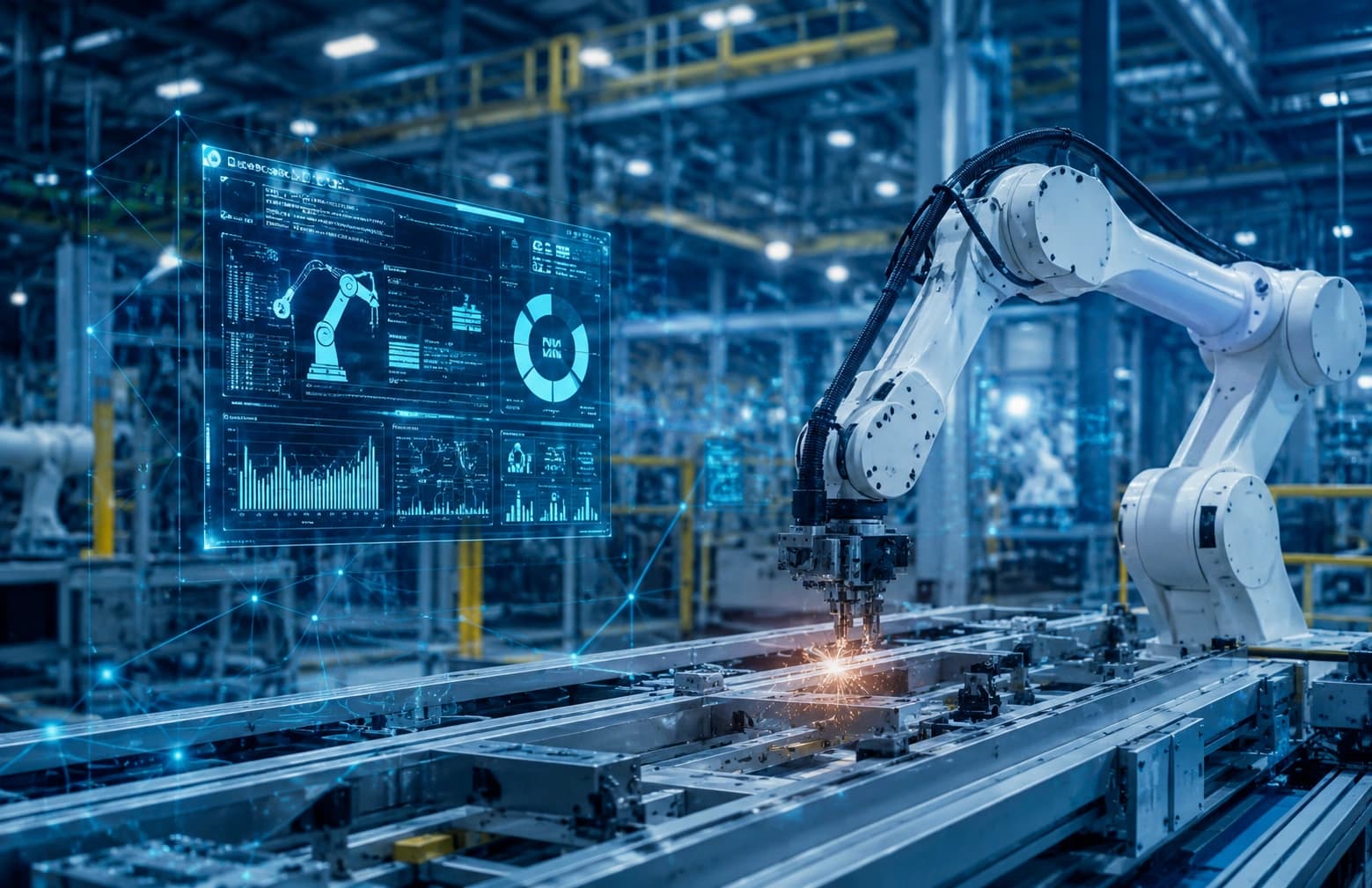
AI adoption in manufacturing is moving into a more practical phase.
The conversation is no longer centered on whether machine learning, computer vision, or generative AI can work in an industrial environment. Manufacturers are now evaluating where these technologies can produce measurable improvements in uptime, yield, throughput, quality, inventory performance, and operating cost.
That distinction matters.
Manufacturing environments are constrained by physical assets, process variability, safety requirements, legacy control systems, and production schedules. A model that performs well in a lab has little value if it cannot ingest reliable plant data, integrate with existing MES or SCADA environments, or produce an output that operators can act on.
The most useful applications of AI in manufacturing therefore tend to sit at the intersection of three things: a clearly defined operational problem, sufficient contextual data, and a workflow where better prediction or decision support can materially change the outcome.
For U.S. manufacturers balancing productivity targets, workforce constraints, supply-chain exposure, and modernization of aging infrastructure, the following ten use cases are among the most commercially relevant.
10 AI Use Cases Delivering Practical Value in Manufacturing
1. Predictive Maintenance and Asset Reliability
Predictive maintenance remains one of the clearest examples of AI creating value from existing operational data.
Condition-based monitoring systems already capture vibration, temperature, pressure, acoustic, electrical, and other machine signals. Machine learning extends this by detecting degradation patterns that may not be apparent through fixed thresholds alone.
The real opportunity is not simply predicting that a machine may fail. It is improving maintenance decision-making.
A mature implementation combines condition data with maintenance history, asset criticality, operating context, failure modes, and spare-parts availability. That allows maintenance teams to prioritize intervention based on business impact rather than alarms alone.
In practice, successful deployment often depends as much on integration with historians, CMMS platforms, SCADA, and edge systems as it does on model performance.
2. Computer Vision for Quality Inspection
Quality inspection is another area where AI manufacturing solutions are already moving beyond proof-of-concept deployments.
Traditional machine-vision systems remain highly effective where tolerances and defect definitions are deterministic. AI-based vision becomes more useful when defects are irregular, subtle, highly variable, or difficult to encode through fixed rules.
Typical applications include surface inspection, assembly verification, dimensional checks, packaging validation, weld inspection, and foreign-object detection.
The more advanced implementations go further than reject classification.
Inspection data can be correlated with tooling, machine settings, operator shifts, supplier batches, process conditions, or upstream equipment behavior. This turns computer vision into part of a broader quality-intelligence system rather than an isolated inspection station.
For manufacturers, that distinction is important because the greater value often lies in identifying why defects are occurring, not simply detecting them faster.
3. Process Optimization and Yield Improvement
Many manufacturing processes operate within a relatively narrow performance envelope.
Temperature, speed, pressure, feed rates, tooling condition, material characteristics, cycle time, and environmental conditions can all affect output quality and yield. In complex processes, the interaction between these variables is difficult to model through conventional rules alone.
Machine learning can identify relationships across historical process data and help determine which parameter combinations are associated with higher yield, lower scrap, or more stable production.
This is particularly relevant in continuous and high-volume manufacturing, where small improvements in process performance can have a disproportionate financial impact.
The practical challenge is ensuring that recommendations remain within validated engineering limits. AI should optimize within process constraints, not bypass them.
4. Production Scheduling and Capacity Optimization
Production scheduling becomes increasingly difficult as the number of constraints increases.
Real plants operate with changing demand, machine downtime, labor limitations, material availability, maintenance windows, setup times, and priority orders. Static planning logic can struggle when several of these conditions change simultaneously.
AI-supported scheduling systems can evaluate a larger number of variables and continuously rebalance production plans as conditions evolve.
This is where AI in the manufacturing industry can complement existing MES and advanced planning systems rather than replace them.
The highest-value use cases typically focus on reducing changeovers, improving machine utilization, protecting committed delivery dates, or minimizing idle capacity.
The objective is not necessarily a fully autonomous production schedule. For many manufacturers, a better outcome is a planning system that gives production managers stronger recommendations and exposes the operational consequences of different scheduling decisions.
5. Demand Forecasting and Inventory Planning
Demand forecasting becomes an AI problem when conventional statistical methods are no longer sufficient to capture the number of variables influencing demand.
Machine-learning models can incorporate order history, seasonality, customer behavior, market signals, lead times, product mix, promotional activity, and other relevant variables to improve forecast accuracy.
For manufacturers, however, forecast accuracy is only useful when it improves downstream decisions.
The operational value comes from translating better forecasts into material requirements, capacity planning, safety-stock levels, production sequencing, and procurement decisions.
For businesses managing expensive components or long supplier lead times, even relatively small improvements in planning accuracy can reduce working-capital pressure and inventory risk.
6. Supply Chain Risk Intelligence
Supply-chain optimization is often discussed in broad terms, but the more useful AI applications are usually very specific.
Manufacturers may use predictive models to identify supplier reliability issues, forecast component shortages, detect abnormal lead-time behavior, prioritize purchase orders, or estimate the downstream production impact of an incoming disruption.
AI can also support scenario analysis across multi-tier supply networks, particularly where the manufacturer has sufficient supplier and logistics data.
The requirement is becoming more relevant as U.S. manufacturers attempt to improve resilience without simply increasing buffer inventory.
A strong smart manufacturing architecture therefore needs visibility beyond the plant floor. Production intelligence and supply-chain intelligence increasingly need to operate against the same demand, inventory, and capacity assumptions.
7. AI-Enhanced Digital Twins
Digital twins are valuable when manufacturers need to understand the behavior of a physical asset or process without repeatedly experimenting on the real system.
AI expands that capability by bringing predictive analytics into the twin environment.
A digital twin can combine engineering models, sensor data, operating history, and machine-learning outputs to evaluate degradation, simulate production changes, compare operating scenarios, or estimate the impact of different process conditions.
The strongest applications are typically found where physical experimentation is expensive, slow, or disruptive.
This might include evaluating production-line changes, optimizing equipment operating windows, assessing asset performance, or predicting the effects of process modifications.
The technical challenge lies in model fidelity. A digital representation that is poorly synchronized with physical conditions will produce equally poor decisions, regardless of how sophisticated the AI layer appears.
8. Intelligent Robotics and Autonomous Operations
Industrial robotics is increasingly being augmented by AI rather than replaced by it.
Computer vision, sensor fusion, motion planning, and machine learning are allowing robotic systems to operate in environments with more variation than conventional pre-programmed automation could comfortably handle.
Applications include vision-guided picking, robotic inspection, flexible assembly, autonomous mobile robots, pallet movement, bin picking, and dynamic material handling.
The important architectural point is that intelligence and control should remain separate where required.
Safety-critical functions still depend on validated control systems, PLC logic, safety controllers, and deterministic behavior. AI may influence perception, optimization, or task selection, but it should operate within clearly defined control boundaries.
This separation becomes increasingly important as manufacturers adopt more autonomous workflows.
9. Energy and Utility Optimization
Energy optimization is becoming more sophisticated as manufacturers gain better visibility into consumption at machine, line, and facility level.
AI models can correlate energy usage with production schedules, machine loading, equipment condition, environmental systems, and utility demand.
That allows manufacturers to distinguish unavoidable process consumption from avoidable inefficiency.
Examples include compressed-air optimization, HVAC control, furnace performance, peak-load management, idle equipment detection, and production scheduling based on energy intensity.
The same analytical approach can be extended to water, raw materials, consumables, and other production resources.
For energy-intensive manufacturers, this is increasingly an operational optimization problem rather than a standalone sustainability initiative.
10. Generative AI and Agentic Workflows
Generative AI is beginning to find more credible applications in manufacturing as companies connect language models to internal technical knowledge and enterprise systems.
The immediate value is largely knowledge-oriented.
Engineering teams can search maintenance logs, SOPs, equipment manuals, quality records, troubleshooting documents, and historical work orders using natural-language interfaces. Models can summarize incidents, retrieve relevant procedures, or assist with root-cause investigation.
Agentic AI introduces a different level of functionality.
An AI agent can be given access to approved systems and allowed to execute a defined sequence of actions rather than simply return information.
A maintenance workflow, for example, could involve detecting an abnormal equipment condition, retrieving recent work history, checking parts availability, creating a draft work order, and routing it for approval.
The value is workflow compression. The risk is uncontrolled autonomy.
Manufacturing environments therefore require stricter agent design than conventional business applications. Permissioning, auditability, escalation logic, deterministic guardrails, human approval, and system isolation all become part of the solution architecture.
Where Manufacturing AI Projects Usually Fail
Most unsuccessful projects do not fail because the model is incapable. They fail because the surrounding environment was underestimated.
Manufacturing data is rarely clean, centralized, or uniformly structured. Equipment may come from multiple generations and vendors. Communication protocols vary. Some assets expose rich telemetry, while others expose almost nothing.
There may also be substantial gaps between IT and OT environments.
An AI system designed around cloud-native APIs may need to operate alongside PLCs, historians, OPC UA interfaces, proprietary controllers, edge gateways, SCADA applications, MES platforms, and ERP systems.
That changes the nature of manufacturing software development.
The project is no longer simply an ML implementation. It becomes a systems-engineering problem involving data acquisition, normalization, integration, model deployment, observability, cybersecurity, and operational change management.
Data Context Matters More Than Data Volume
Manufacturers often assume they need enormous amounts of data before an AI project can begin.
What they usually need first is useful data.
Sensor readings without machine state, operating mode, batch information, maintenance history, or process context may have limited value. A relatively small amount of well-labeled and operationally meaningful data can sometimes be more useful than years of unstructured telemetry.
Integration Must Be Designed Early
AI should not be treated as a separate layer that is integrated after the model has been built.
The source systems, latency requirements, deployment environment, user workflow, and downstream action should influence the architecture from the beginning.
A predictive model that generates a probability score every five minutes may be technically successful, but if that score does not reach the maintenance team through a system they actually use, the project has failed operationally.
OT Cybersecurity Cannot Be an Afterthought
Introducing new connectivity into production environments expands the attack surface.
Identity, network segmentation, device trust, data movement, remote access, API security, and auditability need to be considered at architecture level, particularly when AI applications interact with operational systems.
The objective should be increased intelligence without introducing unnecessary operational exposure.
How Manufacturers Should Approach AI Implementation
The strongest AI programs tend to start narrow.
Manufacturers should identify a process where the current problem is measurable and where improved prediction, detection, or decision-making would produce a meaningful business result.
That could be:
reducing downtime on a critical asset class,
improving first-pass yield,
detecting a specific defect earlier,
reducing schedule disruption,
improving forecast accuracy,
or lowering material waste on a high-cost process.
The existing baseline should then be quantified before any model is developed.
From there, the focus shifts to data readiness, system architecture, pilot scope, validation criteria, operational integration, and ROI.
A pilot should prove more than model accuracy. It should demonstrate that the output is reliable under actual production conditions and that plant teams can use it without disrupting established operations.
Only then does scaling make sense.
Building AI Around the Manufacturing Environment
There is no universal AI architecture for manufacturing.
A brownfield plant with legacy equipment has different requirements from a new highly connected facility. A computer-vision inspection system has different latency and edge-compute requirements from a demand-forecasting platform. An agentic maintenance workflow has different governance requirements from a predictive model.
The technology needs to follow the operating environment.
Seasia Infotech works with manufacturers and industrial enterprises across AI, computer vision, IoT, data engineering, cloud, enterprise software, and system integration to build solutions around those operational realities.
Rather than treating AI as a standalone capability, the focus is on connecting it with the systems, data, and workflows already running the business.
For manufacturers evaluating AI manufacturing solutions, that is ultimately the more useful question to ask: not where AI can be introduced, but where it can improve a measurable production outcome without creating unnecessary complexity.
Looking to evaluate a manufacturing AI use case or modernize the software around your production environment? Talk to Seasia Infotech’s manufacturing technology team.