In 2026, creating a healthcare app involves striking the right balance between compliance and advanced technology. The cost of healthcare app development can vary from $40,000 to $500,000+. This fee is based on the extent of the project.
This guide breaks down the cost to build a healthcare app by looking at different types, features, and legal requirements. By the end, you will have a clear idea of the budget needed for your software.
Why Healthcare Apps Cost More Than Regular Apps
Medical software costs more to invest in than normal consumer products. This is mostly owing to rigorous security rules for patient data. A social media app may be all about engagement numbers, but a health app is all about data integrity and regulatory compliance.
Compliance with HIPAA increases the original cost by 20-40%. The government has been more restrictive since 2024. All data should be encrypted with Protected Health Information (PHI) by the developers. This needs careful preparation to prevent unwanted access. Every data point, whether it’s a heart rate readout or a patient’s identity, has to be protected.
Business Associate Agreements (BAA) are another aspect that adds to the healthcare app development cost. Each vendor (cloud provider, etc.) needs to sign one. Penetration testing has to be done. Security experts use simulated assaults to try to uncover problems before the app goes live. Audits and threat monitoring nevertheless remain costly post-launch. This defense keeps the program safe from online threats.
The cost of a data leak is the highest it has ever been in 2026. The cost of legal expenses and the loss of confidence is much more than the cost of investing in security at the front. That is why experienced developers spend a large percentage of the cash on the backend infrastructure. It’s not only about making the software operate, but it’s about making it unhackable.
Healthcare App Cost by Type
The medical app development cost changes based on what the app does and the data it handles. Different niches have different standards for interoperability and user experience.
Telemedicine App
An MVP for a telemedicine app development costs roughly $70,000 to $120,000. It has secure video, scheduling, and computerized prescriptions. The major technological requirements are high-speed video and end-to-end encryption. In 2026, users want minimal latency, HD clarity, and that means premium streaming APIs.
Remote Patient Monitoring (RPM)
RPM solutions range from $80,000 to $150,000. These must sync with wearables or medical hardware. The software processes live data like heart rate and sends alerts if the numbers look unsafe. The challenge here is data synchronization. Ensuring that a blood pressure cuff talks to the app without errors takes specialized engineering work.
Mental Health App
Costs for these platforms sit between $60,000 and $130,000. Many now include AI mood tracking. The price goes up with personalized therapy modules and self-help tools. Privacy is exceptionally sensitive in a mental health app. Features like "panic buttons" or instant chat with a therapist add to the development hours.
AI-Powered Healthcare App
The healthcare app development cost 2026 for AI tools is $150,000 to $300,000+. Using large models for clinical decisions requires expert data scientists. These tools must be checked for bias and privacy. AI can help with diagnosis or suggest treatment plans, but the logic must be flawless to pass regulatory checks.
EHR / Clinical Management
Electronic Health Record (EHR) systems cost around $150,000 and $500,000 and above. They collaborate with hospital systems and vast databases for physicians and personnel. These are business tools. They should have a thorough grasp of clinical workflows and be capable of handling thousands of concurrent users without performance degradation.
Health Benefits Management
Building an insurance platform costs $100,000 to $200,000. This involves connecting to insurance databases and secure payment tools. Security for financial data is a top priority. These apps often serve as a bridge between the employer, the employee, and the insurance carrier in health benefits management.
Cost Breakdown by Development Phase
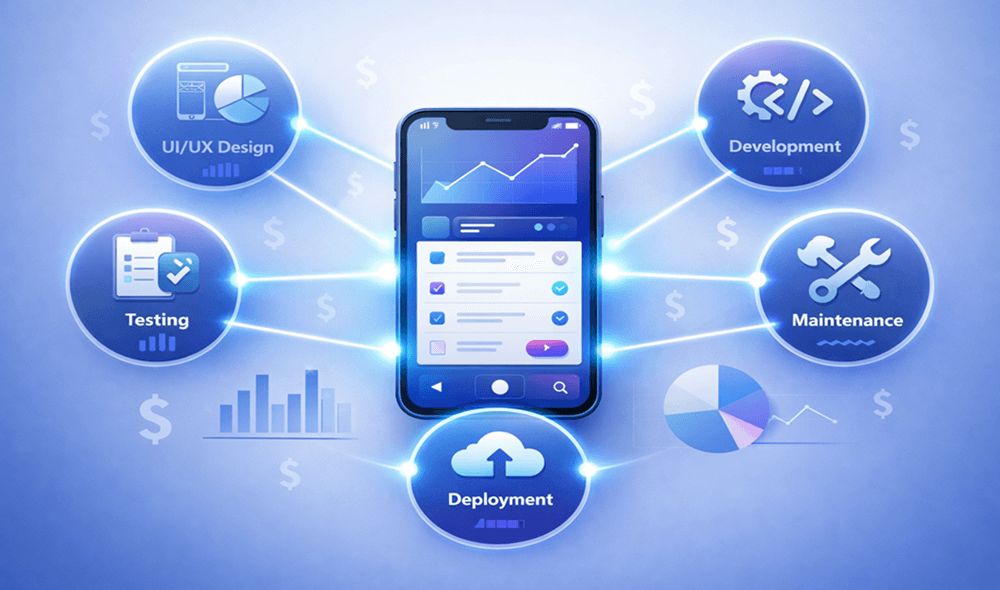
The healthcare app development cost breakdown covers every part of the creation process. Each phase has its own set of deliverables and risks.
Phase | What's Included | Cost Range |
|---|---|---|
Discovery & Compliance | PHI mapping, risk planning, market research | $8,000 – $20,000 |
UI/UX Design | Wireframes, accessibility (WCAG 2.2) | $10,000 – $40,000 |
Frontend Development | iOS, Android, or Flutter/React Native | $20,000 – $80,000 |
Backend Development | APIs, database, secure server logic | $30,000 – $120,000 |
Third-party Integrations | EHR (Epic/Cerner), payments, wearables | $15,000 – $60,000 |
Security & Compliance | AES-256 encryption, audit logs, MFA | $15,000 – $40,000 |
QA & Pen Testing | Bug checks, load testing, security audits | $10,000 – $30,000 |
Launch & Deployment | Cloud setup, app store approval, CI/CD | $5,000 – $15,000 |
Ongoing Costs After Launch
Budgeting for healthcare app development services continues after the app is live. A static app is a vulnerable app.
Annual HIPAA Risk Assessment
Regular audits to stay legal. Laws change, and your app must adapt.
Cloud Infrastructure
Monthly fees for secure servers. In 2026, specialized healthcare clouds provide the best security but come at a premium.
Security Monitoring
Constant checks for hacking attempts. Automated systems track login patterns and flag unusual behavior.
App Maintenance
Budget 15-20% of the build cost every year. This covers OS updates (like new iOS versions) and general bug fixes.
Staff Training
Empowering staff to securely work with data. The greatest hazard to data security comes from human mistakes.
Data Backups
Secure, redundant backups ensure that if a server fails, patient records are not lost. This is a non-negotiable part of the budget.
Factors That Affect Your Final Cost Most
When figuring out how much does a health app cost, look at these five areas:
Compliance: Standard HIPAA is one price, but adding international laws like GDPR (Europe) or PIPEDA (Canada) adds more. Each region has specific requirements for where data is stored.
Integrations: Connecting to systems like Epic or Cerner takes a lot of work. These systems use legacy code that often conflicts with modern app architecture.
Platform Choice: Native apps for both iOS and Android cost more than cross-platform code. However, native apps offer the best performance for complex medical imaging.
AI Features: Automated triaging or voice tools add many hours to the build. Training a model on medical data requires high-level expertise to ensure accuracy.
Partner Location: A healthcare app development company in North America costs more than one in Asia or Eastern Europe. While offshore can save money, you must ensure they understand US healthcare laws.
Real Cost Examples by App Type
This table shows hospital app development pricing and timelines for an MVP in 2026. These figures represent a professional, market-ready product, not a prototype.
App Type | MVP Cost | Timeline |
|---|---|---|
Telemedicine | $70,000 – $120,000 | 5–7 months |
Mental Health | $60,000 – $130,000 | 4–6 months |
Remote Patient Monitoring | $80,000 – $150,000 | 6–8 months |
Cardiology / Vitals | $75,000 – $140,000 | 5–7 months |
Health Benefits Platform | $100,000 – $200,000 | 7–10 months |
AI-Powered Clinical Tool | $150,000 – $300,000 | 8–12 months |
Technical Details for Custom Healthcare Software Cost
The custom healthcare software cost is related to app development for growth. Many teams are using microservices in 2026. This allows sections of the program, like login and data, to function independently. If the video component crashes, the rest of the app stays up. This is more expensive to implement, but lowers the expenses for adding additional users later on.
Interoperability is a legal need. Laws like the 21st Century Cures Act force applications to exchange data quickly. Getting these data pathways right adds something like 15% to the backend labor. Data security in the medical cloud also costs more than traditional hosting. There are built-in safety safeguards in these situations.
Data standards such as FHIR (Fast Healthcare Interoperability Resources) will be the language of healthcare in 2026. By adopting these standards, your app will be able to connect with any hospital in the country. This eliminates the likelihood of “data silos” but demands engineers who understand the medical data standards.
Security Infrastructure Costs
Security is not a one-time setup. It is a layered defense. This significantly impacts the healthcare app development cost.
Identity Management: Multi-factor authentication (MFA) and biometric logins (FaceID/Fingerprint) are the norm.
Encryption: Data should be encrypted when it is resting on a server and when it is in transit over the internet.
Audit Logs: The app should keep a log of every time a record is viewed, including who saw it and when. This is a condition of audits.
Session Management: In a clinical environment, to avoid unauthorized access, Session Management Apps need to automatically log out users after a time of inactivity.
Each of these levels adds to the development time. But miss one, and you might face a compliance violation that could shut your firm down.
Ways to Manage Your Budget
With clever decisions, you can moderate the cost of the medical app development. You do not have to construct everything at the same time.
Develop the MVP: Before adding any other features, add only the most necessary ones first. When developing a telemedicine app, you need to pay attention to the video and the prescriptions. Get the AI-based symptom checker to version 2.0.
Use Middleware: A better way to do this than to create custom links to all hospital systems is to use tools that provide a single connection point. This will save weeks of the development time.
Cross-Platform Tools: Frameworks, such as Flutter, can reduce the frontend by 30% by using the same codebase across all phones. It is an excellent means of reaching both iPhone and Android users at a low cost.
Automation: Testing scripts found early save money later on manual tests. In 2026, AI-based testing technologies will be able to find flaws considerably faster than a human team.
Choosing a Development Partner
Finding the right healthcare app development company is a major step. A partner with medical experience knows how to manage PHI and audits. They should have in-depth knowledge of the regulatory framework in your target market.
Request examples of previous work and how they will keep the website secure. Starting with a discovery phase means your team won’t be blindsided by costs. They should be able to walk you through how they encrypt data and what their procedure is for signing BAAs with third-party providers.
The cheapest is not always the greatest in healthcare. A coding error might lead to a legal nightmare. Find a partner who cares more about security and quality than haste. Seasia has completed several healthcare initiatives focusing on safety. Our professionals understand the particular issues the medical industry faces.