
 AI Strategy
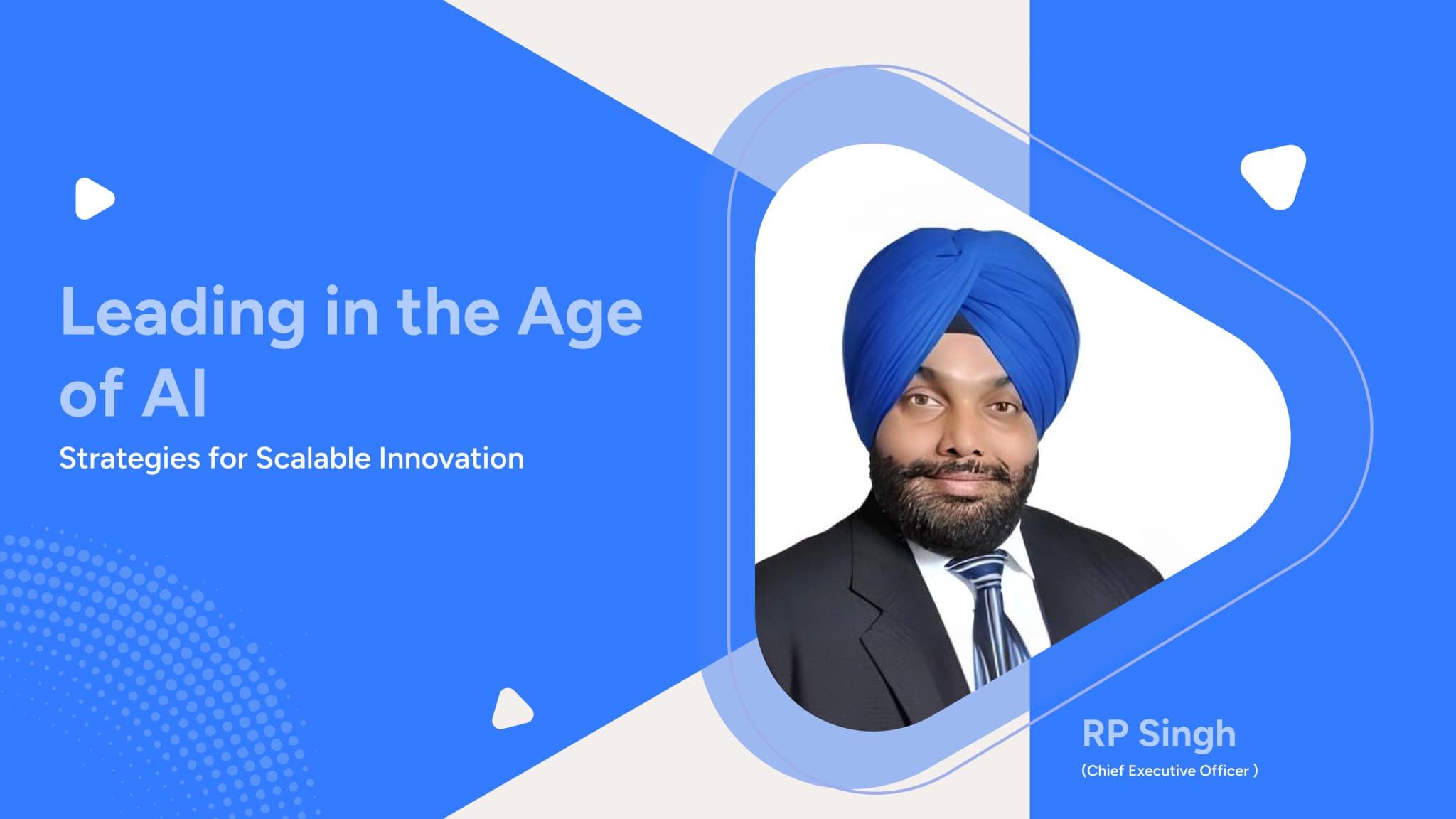
Leading in the Age of AI: Strategies for Scalable Innovation
A year ago, most enterprise AI conversations were still centered on pilots, copilots, and controlled experimentation. Today, the question has changed.
AI adoption is no longer the differentiator. Scalable impact is.
Nearly every serious enterprise is using AI somewhere, whether in software delivery, customer support, analytics, content operations, compliance, or internal productivity. But using AI and building an AI-ready organization are not the same thing. The real test is whether intelligence can be embedded into workflows, governed responsibly, measured against business outcomes, and scaled without creating operational chaos.
That is the leadership gap AI has exposed.
The companies that win in this cycle will not be the ones with the most impressive demos. They will be the ones that can turn AI into repeatable, secure, production-grade systems that improve how the business actually runs.
The Leadership Gap AI Has Exposed
Most organizations were not designed for this pace of change. They still operate with long approval cycles, fragmented data ownership, instinct-led decision-making, and technology functions that are treated more as cost centers than strategic engines.
AI challenges all of that.
When intelligent systems can summarize compliance reports, refactor code, predict demand, detect anomalies, and support customer interactions in near real time, leadership can no longer rely only on experience, hierarchy, or delayed reporting. The margin for “gut feel” is narrowing.
This does not mean leaders need to become machine learning engineers. But they do need algorithmic literacy.
They need to understand how AI decisions are made, where the risks sit, how model outputs affect customer experience, how automation changes roles, and how data quality directly impacts business judgement. They also need to know when not to use AI, which is often just as important.
Leadership in the AI era is not about chasing every new tool. It is about knowing which parts of the business need intelligence, which parts need automation, and which parts still need human judgement at the center.
Redefining Scalable Innovation
A proof of concept that impresses a boardroom is not innovation. A model that works inside live operations, adapts to changing data, integrates with existing systems, and serves real users reliably is.
That is where many enterprises are now getting stuck. They have pilots. They have use cases. They have teams experimenting with copilots and agents. What they often lack is the architecture, governance, security, and operating discipline required to scale those experiments into measurable business value.
At Seasia, we define scalable innovation through three principles.
First, personalization at population scale. AI should help enterprises serve customers, employees, and partners with greater relevance, but without crossing the line into intrusion. Trust has to be built into the experience, not added as a disclaimer later.
Second, speed as default. The businesses that adapt fastest will have an advantage, but speed cannot come at the cost of reliability. The goal is not reckless acceleration. The goal is shorter feedback loops, faster decisions, and cleaner execution.
Third, adaptability by design. AI systems cannot be static. They must be built to learn, unlearn, and relearn as markets, regulations, user behavior, and business priorities change.
The real opportunity is not to deskill people. It is to move people toward higher-order problem-solving, better decision-making, and more meaningful work.
From AI Tools to AI Operating Models
One of the biggest shifts now underway is the move from isolated AI tools to AI-enabled operating models.
In the first wave, enterprises asked, “Which AI tool should we use?”
Now, the better question is, “Which workflow should we redesign?”
That is where agentic AI becomes important. Agents are not just another interface. Used well, they can coordinate tasks across systems, trigger actions, analyze context, and support multi-step business processes. But they also increase the need for guardrails, auditability, and clear accountability.
A poorly governed agent can create more risk than value. A well-designed one can remove friction from complex enterprise workflows.
This is why AI leadership can no longer sit only inside innovation teams. It needs alignment across engineering, security, finance, operations, HR, and business leadership. AI strategy is now operating strategy.
How Seasia Leads with Purpose and Precision
At Seasia, our focus has never been on chasing AI headlines. We are more interested in building systems that can survive real enterprise conditions: incomplete data, legacy platforms, compliance constraints, user variability, and changing business priorities.
Through MoogleLabs, our R&D arm, we continue to translate frontier AI research into practical accelerators for enterprise use cases. The goal is not experimentation for its own sake. The goal is to help clients move faster from concept to production with reusable frameworks, stronger architectures, and clearer governance.
Inside our delivery teams, AI is now part of the engineering rhythm. Developers, QA specialists, architects, and project teams use AI-assisted workflows to improve velocity, increase test coverage, strengthen documentation, and reduce repetitive effort. But the human layer remains central. AI can assist execution, but accountability still belongs to people.
We also prioritize architecture over artifacts. A flashy prototype may create excitement for a week, but a scalable reference architecture creates long-term enterprise value. That means systems that can auto-scale, self-monitor, integrate securely, and evolve with the business.
Our applied AI work spans industry-specific problems, from diagnostic support in healthcare to predictive maintenance in EV ecosystems and fraud analytics in BFSI. These are not abstract use cases. They are business-critical problems where speed, accuracy, trust, and governance all matter at the same time.
The Mindset of an AI-Ready Leader
The AI-ready leader is not the loudest advocate of AI in the room. It is the leader who can connect AI decisions to business consequences.
That requires strategic clarity. Leaders must be able to explain why AI is being used before deciding what model or platform to deploy.
It requires digital intuition. Reading latency charts, model behavior, adoption patterns, and automation risks should become as natural as reading revenue reports.
It requires ethical accountability. Bias, transparency, data privacy, and security cannot be delegated entirely to technical teams. They are board-level responsibilities.
It also requires comfort with speed. AI does not reward organizations that wait endlessly for perfect certainty. The better model is to ship carefully, learn quickly, govern continuously, and improve with discipline.
Inside Seasia, we are building this mindset deliberately. Our managers are trained to understand AI not only as a technology trend, but as an operating capability. We pair data specialists with domain experts so that AI solutions are not built in isolation from the business problems they are meant to solve.
Scale Is No Longer Optional
The next phase of AI will not be defined by who experiments first. It will be defined by who scales responsibly.
The enterprises that matter over the next decade will be the ones that can combine intelligence with trust, automation with accountability, and speed with discipline. They will not treat AI as a side project. They will build it into how decisions are made, how software is delivered, how customers are served, and how teams operate.
At Seasia, we see AI not as a disruption to survive, but as a design space to build within.
The inflection point is already here. The question is no longer whether enterprises will use AI. The question is whether they will lead with enough clarity, courage, and discipline to make it count.
Related Articles

The Hidden Environmental Cost of Artificial Intelligence
AI may feel effortless to users, but every query depends on energy, cooling and infrastructure. This article explores why the AI industry must make sustainability part of innovation.
The Rise of Autonomous SDLC: How AI Agents Are Redefining Software Delivery
Discover how Autonomous SDLC is reshaping software engineering with AI agents that automate development, testing, deployment, and governance while empowering teams to build better software faster.
_(1).webp&w=828&q=75)
Why EdTech’s Next Decade Will Be Built on AI, Blockchain, and Micro-Credentials
EdTech is shifting from simple content delivery to intelligent learning ecosystems. Explore how AI-powered personalization, blockchain-verified credentials, and micro-credentials are defining the next decade of education technology.