
 AI Strategy
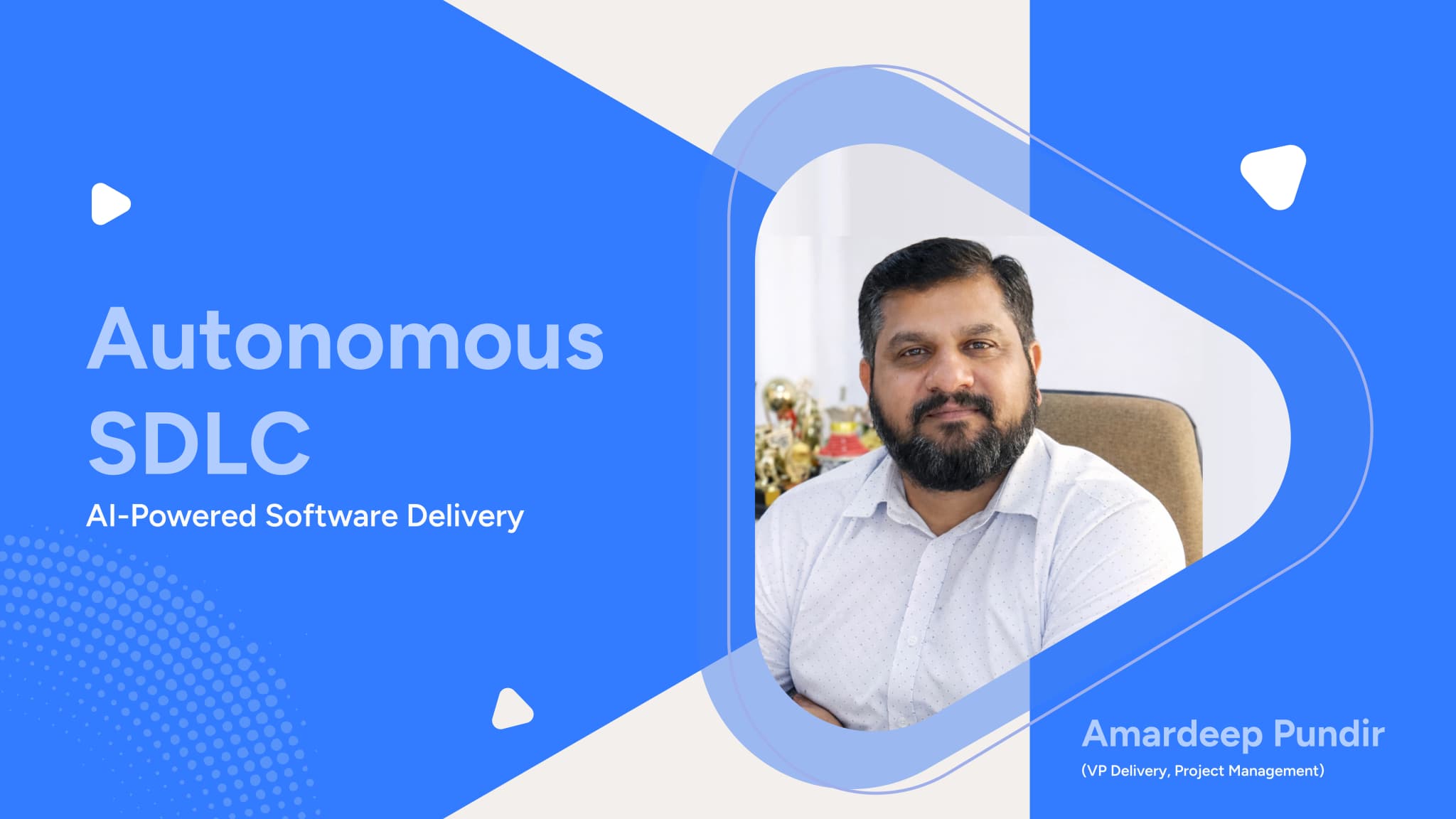
The Rise of Autonomous SDLC: How AI Agents Are Redefining Software Delivery
For decades, the SDLC has been driven by structured processes, skilled engineering teams, and collaborative project management. While Agile, DevOps, and cloud-native technologies significantly improved the speed and quality of software delivery, they still relied heavily on manual coordination, repetitive tasks, and human intervention.
Today, we stand at the beginning of a new transformation.
From assisting developers by generating code or answering technical questions, artificial intelligence has now evolved into an intelligent collaborator capable of participating across the entire software delivery lifecycle. We are moving beyond AI-assisted development into what I believe is the next major evolution of software engineering: the Autonomous Software Development Life Cycle (Autonomous SDLC).
This is not about replacing software engineers. It is about augmenting every phase of software delivery with AI agents that can analyze, reason, recommend, automate, and continuously improve delivery outcomes.
Organizations that embrace this transformation early will deliver software faster, improve quality, reduce operational costs, and unlock entirely new levels of engineering productivity.
What Is Autonomous SDLC?
Autonomous SDLC is an AI-driven approach where specialized AI agents work alongside software teams throughout the software development lifecycle.
Instead of using AI only for code generation, organizations deploy multiple AI agents, each responsible for a specific engineering function. These agents collaborate with developers, architects, testers, project managers, and business stakeholders to automate routine work while enabling humans to focus on innovation and strategic decision-making.
The objective is not fully autonomous software development, it is intelligently orchestrated software delivery.
From Traditional SDLC to Autonomous SDLC
Traditional software delivery often follows this sequence:
Business Requirement Gathering
Solution Design
Development
Testing
Deployment
Maintenance
Each stage involves numerous manual activities, including requirement analysis, documentation, estimation, code reviews, test planning, reporting, risk identification, and release coordination.
In an Autonomous SDLC, AI agents actively support each stage. Rather than waiting for issues to be identified manually, AI continuously analyzes project data, predicts risks, generates recommendations, and assists teams in making informed decisions.
This transforms SDLC from a reactive process into a proactive and intelligent delivery ecosystem.
AI Agents Across the Software Development Lifecycle
One of the most exciting aspects of Autonomous SDLC is the emergence of specialized AI agents designed for different delivery functions.
Requirement Intelligence Agent
The journey begins with business requirements.
An AI-powered Requirement Intelligence Agent can:
Analyze requirement documents
Identify missing or conflicting requirements
Detect ambiguities
Recommend functional improvements
Generate user stories
Suggest acceptance criteria
Build requirement traceability
This significantly reduces misunderstandings during project execution.
Solution Architecture Agent
Once requirements are finalized, AI can assist solution architects by:
Recommending architectural patterns
Evaluating scalability
Suggesting cloud services
Identifying security concerns
Performing technology comparisons
Producing initial architecture documentation
Architects remain responsible for final decisions, but AI dramatically accelerates the design process.
Development Agent
Development agents extend far beyond code completion.
Modern AI systems can:
Generate production-ready code
Explain existing codebases
Recommend design patterns
Identify performance bottlenecks
Generate API documentation
Refactor legacy code
Detect security vulnerabilities
Developers become reviewers, problem-solvers, and innovation leaders rather than spending time writing repetitive boilerplate code.
Quality Assurance Agent
Software quality is another area undergoing rapid transformation.
AI-powered QA agents can:
Generate comprehensive test cases
Create automated UI tests
Produce API testing scripts
Perform regression analysis
Predict defect-prone modules
Recommend additional test coverage
Instead of testing becoming a bottleneck, quality becomes a continuous and intelligent process.
DevOps and Release Agent
Deployment is no longer simply pushing code to production.
AI agents can now:
Validate deployment readiness
Monitor CI/CD pipelines
Detect configuration issues
Predict deployment risks
Recommend rollback strategies
Analyze production incidents
Generate deployment summaries
This significantly improves release confidence while reducing operational risks.
Delivery Governance Agent
Perhaps the greatest opportunity lies in delivery management.
A Delivery Governance Agent can continuously monitor:
Sprint progress
Team velocity
Project health
Resource utilization
Budget consumption
Risk indicators
Client commitments
Delivery KPIs
Rather than waiting for weekly status meetings, leadership receives real-time insights into project health, enabling proactive interventions before issues escalate.
Why Autonomous SDLC Matters
Organizations adopting Autonomous SDLC are beginning to realize benefits far beyond increased developer productivity.
Some of the most significant advantages include:
Faster Time-to-Market
AI reduces time spent on repetitive engineering activities, allowing teams to accelerate delivery without compromising quality.
Better Software Quality
Continuous AI-assisted validation improves code quality, testing effectiveness, and architectural consistency.
Improved Predictability
AI-driven project analytics provide early visibility into delivery risks, helping teams make timely corrective decisions.
Lower Delivery Costs
Automation reduces manual effort across documentation, testing, reporting, and project coordination.
Enhanced Customer Experience
Clients benefit from faster releases, greater transparency, higher quality, and more predictable outcomes.
Human Expertise Remains Essential
One common misconception is that Autonomous SDLC eliminates the need for software professionals. The reality is quite the opposite.
AI excels at automation, pattern recognition, and processing vast amounts of information.
Humans excel at:
Business understanding
Creativity
Innovation
Strategic thinking
Customer relationships
Ethical judgment
Complex decision-making
The future belongs to organizations where AI and human expertise complement each other.
Developers evolve into solution engineers. Testers become quality strategists. Project managers become AI-enabled delivery leaders. Architects focus on innovation rather than documentation. This evolution enhances (not diminishes) the value of skilled professionals.
Challenges Organizations Must Address
While the opportunities are significant, successful adoption requires careful planning.
Technology leaders should focus on:
Establishing AI governance frameworks
Protecting intellectual property
Ensuring data privacy and regulatory compliance
Validating AI-generated outputs through human review
Upskilling engineering teams in AI literacy
Measuring productivity using meaningful business outcomes rather than only coding metrics
Autonomous SDLC should be introduced as a strategic transformation initiative, not simply as another technology deployment.
The Road Ahead
The software industry has experienced several transformative shifts, from Waterfall to Agile, from Agile to DevOps, and from DevOps to cloud-native engineering.
Autonomous SDLC represents the next chapter in that evolution.
Over the next five years, AI agents will become embedded across every phase of software delivery. Organizations that successfully integrate these capabilities will build software more efficiently, innovate faster, and respond more effectively to changing business needs.
However, technology alone is not enough. Success will depend on combining intelligent automation with disciplined engineering, strong governance, and continuous learning.
Final Thoughts
The future of software delivery is not about replacing engineers with machines. It is about empowering engineering teams with intelligent AI agents that eliminate repetitive work, improve decision-making, and elevate the quality of every stage of the Software Development Life Cycle.
Autonomous SDLC is more than a technological advancement, it is a fundamental shift in how software is conceived, built, tested, and delivered. Organizations that embrace this evolution today will define the standards of software engineering tomorrow.
Related Articles

The Hidden Environmental Cost of Artificial Intelligence
AI may feel effortless to users, but every query depends on energy, cooling and infrastructure. This article explores why the AI industry must make sustainability part of innovation.
Leading in the Age of AI: Strategies for Scalable Innovation
Learn how enterprise leaders can scale AI responsibly, transform operating models, and turn intelligent automation into measurable business value.

The Future of Retail: How NCLC Is Becoming the Backbone of Digital Transformation
Explore how NCLC helps retail and wholesale businesses simplify operations, automate loyalty programs, and empower teams to deliver better customer experiences and adapt faster to changing demands.