Modern businesses need real-time visibility into what is happening across their facilities, assets, and field operations. Within active industrial settings, logistics hubs, and physical facilities, thousands of edge nodes capture operational signals every second. Yet, the real strategic challenge is not merely collecting these signals. The true bottleneck lies in moving this data directly into core databases, resource planning platforms, and asset tracking systems without human delay.
Bridging this gap requires structured Bluetooth Low Energy (BLE) system integration, an approach that transforms scattered physical hardware into a coordinated, intelligent extension of corporate infrastructure.
What is BLE?
Bluetooth Low Energy is a wireless communication protocol designed for short-range data transmission with minimal power consumption. Unlike traditional Bluetooth, which keeps a constant connection active for heavy data like continuous audio, BLE remains in a sleep state until a data transfer is triggered. This approach allows compact, battery-powered hardware to run for months or even years without replacement.
Market Evolution and Technical Upgrades
The technology has shifted from basic device pairing to advanced spatial intelligence. Modern infrastructure leverages high data throughput options and complex networking layers to build large-scale, automated device ecosystems.
High-Precision Location Tracking
A major addition to the wireless environment is Bluetooth Channel Sounding. Historically, location tracking depended on signal strength indicators, which are easily disrupted by walls, furniture, or human bodies. The latest standard introduces phase-based ranging, allowing infrastructure to determine the exact distance between nodes with centimeter-level accuracy.
Commercial Audio Networks
The rollout of low-power broadcast audio features enables a single source to stream synchronized, high-quality audio to an unlimited number of nearby receivers. This capability is transforming assistive listening systems and shared public spaces.
Scaled Connectivity and Enterprise Demands
The rapid expansion of the internet of things (IoT) is fundamentally reshaping industrial environments. Crucially, Bluetooth technology serves as a primary pillar of this ecosystem, accounting for 24% of all global IoT connections.
This massive influx of active devices creates an urgent operational requirement - the need for seamless, low-latency device-to-application connectivity. It is no longer practical to manage separate silos for physical operations and digital management.
Enterprise operations need a direct line of sight from physical events to backend software. If a temperature-sensitive pharmaceutical shipment fluctuates on a warehouse floor, or an industrial component experiences micro-vibrations, the enterprise application layer must capture that reality instantly.
Structural Clarity: BLE vs. Traditional Bluetooth
To understand why enterprises favor Bluetooth Low Energy integration, it is helpful to look at how it differs structurally from Classic Bluetooth. While both operate on the 2.4 GHz spectrum, they are engineered for entirely different workloads.
When evaluating wireless connectivity options, a common point of confusion is how Bluetooth Low Energy differs from traditional Bluetooth. The choice between these protocols directly impacts both application architecture and overall operational costs. Traditional Bluetooth requires continuous, power-intensive connections to maintain high-throughput streaming. This makes it ideal for consumer audio but completely impractical for a fleet of thousands of automated industrial sensors.
Conversely, BLE is designed for intermittent transmissions of small data packets. A BLE device remains in a low-power "deep sleep" state, waking up for only a few milliseconds to advertise or transmit data before immediately returning to sleep.
This structural efficiency is what enables modern BLE system integration services to build highly scalable, low-maintenance IoT networks.
Connectivity Metric | Traditional Bluetooth | Bluetooth Low Energy (BLE) | Impact on Enterprise Application |
|---|---|---|---|
Power Usage | High (measured in hours or days) | Ultra-low (measured in years on a coin cell) | Dramatically reduces manual maintenance and field replacements. |
Data Throughput | Up to 3.0 Mbps | 1.0 to 2.0 Mbps | Ideal for lightweight telemetry, sensor packets, and positioning. |
Network Topology | Point-to-point (one-to-one) | Star (one-to-many) and Mesh (many-to-many) | Allows a single gateway or app to coordinate thousands of nodes. |
Range Profile | Short range (typically 10-100 meters) | Long range (up to 1.5 km with Coded PHY) | Enables industrial-scale monitoring across entire facilities. |
Connection Overhead | Constant, persistent pairing | Fast, connectionless advertising or scheduled events | Lowers network latency and ensures instant device data reporting. |
For commercial operations managing thousands of mobile assets or environmental sensors across vast locations, this power profile makes all the difference. Relying on specialized custom BLE solutions allows organizations to avoid the high infrastructure cost and constant maintenance demands that traditional wireless frameworks require.
Why are Enterprises Investing in BLE Integration Solutions?
Organizations are deploying BLE integration solutions because they solve a core problem - traditional local networks are often too expensive, rigid, or complex to scale effectively across massive environments.
1. Superior Energy Efficiency
Because BLE devices integration run on minimal power, teams can deploy sensors in hard-to-reach industrial areas without worrying about power lines or frequent battery replacements. This dramatically lowers the ongoing total cost of ownership (TCO) for large-scale physical networks.
2. High Cost-Effectiveness
Compared to deploying cellular IoT or widespread Wi-Fi infrastructure, BLE hardware is remarkably affordable. Beacons, tags, and proximity sensors can be manufactured and deployed at scale for a fraction of the cost of alternative networking hardware.
3. Rapid Scalability and Flexibility
BLE system integration doesn't require intrusive building alterations or intensive wiring overhauls. They can be added, rearranged, or updated dynamically as operational layouts evolve, offering unmatched agility for fast-growing businesses.
Behind the Scenes: How BLE System Integration Works
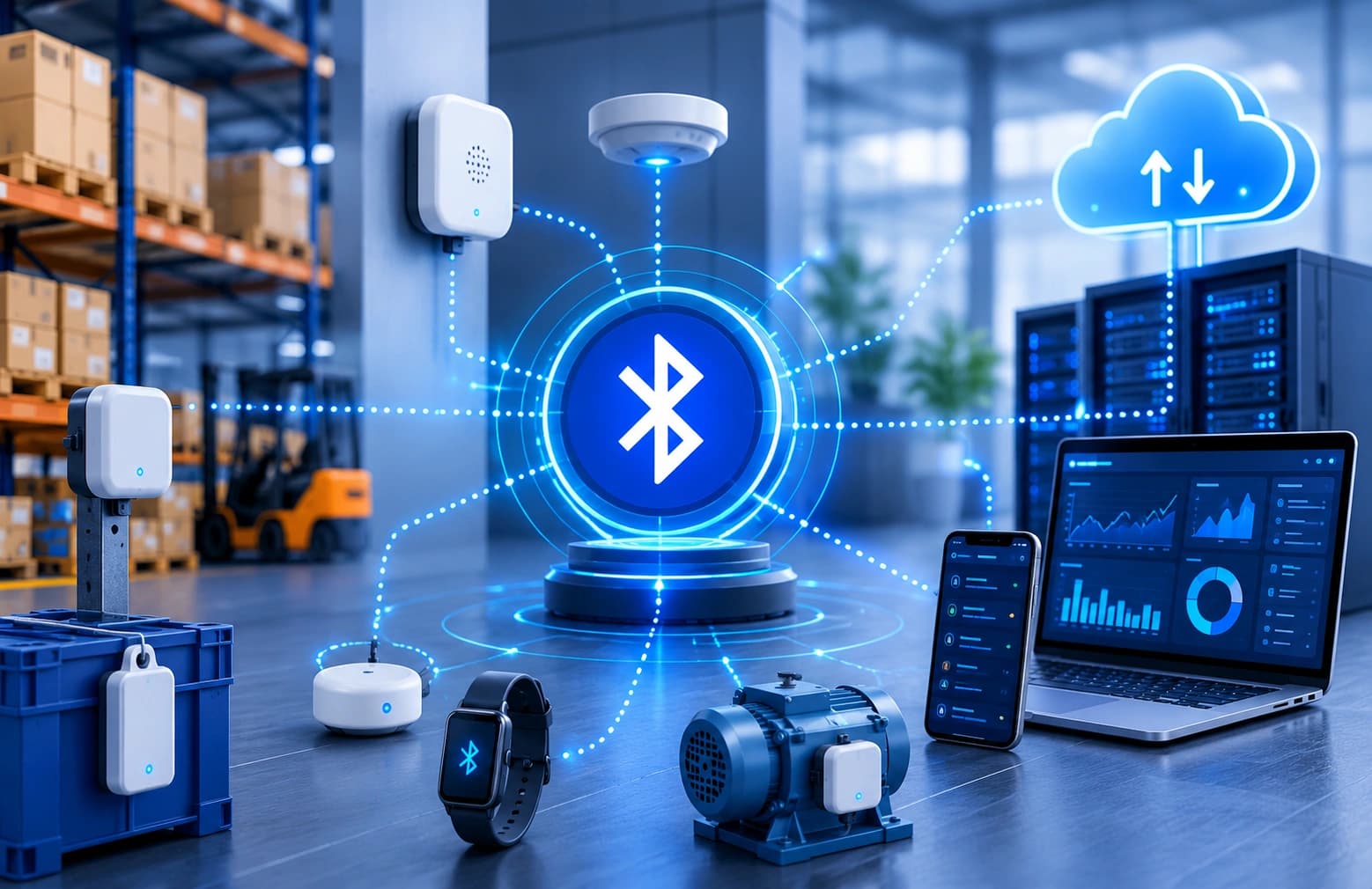
Connecting a physical asset to an enterprise resource planning (ERP) system or warehouse management system (WMS) requires a multi-tiered architecture that handles everything from localized radio signals to secure cloud protocols. A professional BLE IoT development company sets up this architectural pipeline through four primary steps:
1. Data Capture at the Edge
The process begins with physical BLE nodes such as temperature sensors, location tags, or equipment monitor, which continuously broadcast data payloads using short-range radio frequencies.
2. Protocol Translation via Smart Gateways
Because enterprise databases cannot read raw Bluetooth signals directly, smart BLE gateways act as the intermediary. These gateways listen for local broadcasts, aggregate the incoming packets, and translate the data into web-friendly communication protocols like MQTT or HTTPS.
3. Secure Transport Layer
The translated data is securely transmitted over the corporate intranet or cloud networks, protected by encryption frameworks to ensure data integrity during transit.
4. Integration with the Enterprise Application Layer
Finally, modern application programming interfaces (APIs) route the clean data directly into central business tools. This allows the system to update dashboards, trigger automated stock reorders, or log environmental compliance metrics automatically.
Enterprise Architectural Components
Building a resilient infrastructure requires harmonizing several hardware and software layers. Experienced technology partners, like Seasia, design these systems around three core architectural building blocks:
The Hardware Layer
This includes the physical BLE tags attached to inventory, wearable safety monitors worn by personnel, and smart gateways positioned strategically throughout a facility to maintain full signal coverage.
The Middleware Layer
This software layer acts as the system's brain, handling crucial tasks like filtering out redundant signals, managing device identification numbers, and formatting data packets for processing.
The Software and API Layer
The final bridge that links the middleware directly to core business software, ensuring a smooth, uninterrupted connection with platforms like SAP, Salesforce, or proprietary internal databases.
Cross-Industry Enterprise Use Cases
The versatility of BLE application development allows companies to drive operational improvements across a wide variety of commercial sectors. Businesses leverage Bluetooth low energy solutions to solve complex operational challenges across key business functions:
Intelligent Asset Management
In large-scale logistics and warehousing, BLE integration services enable micro-location tracking. Instead of manually scanning barcodes, systems automatically log inventory as it moves through dock doors, eliminating human error.
Predictive Operations & Smart Infrastructure
By integrating BLE sensors with central databases, facilities can monitor machinery's health and environmental changes instantly, triggering automated maintenance tickets before a breakdown occurs.
Automated Workflow Synchronization
Field service and shipping workflows sync automatically when assets or personnel enter specific zones, removing administrative delays and speeding up billing cycles.
By partnering with an experienced BLE integration company like Seasia, organizations can securely scale these systems, transforming raw edge data into sustainable business growth.
Smart Retail and Customer Operations
Retail environments use BLE proximity networks to improve indoor inventory management and create interactive customer journeys.
When paired with BLE mobile app integration, stores can automatically detect foot traffic patterns, optimize product displays, and send highly relevant offers to shoppers based on the exact aisle they are browsing.
Technical Synergy: BLE, Mobile Apps, and Next-Gen IoT
Mobile devices play a critical role in the broader enterprise IoT ecosystem. Smartphones and tablets function as highly capable, portable BLE gateways. Field technicians, delivery drivers, and floor supervisors don't need to stand near a fixed hardware station - they can interact with nearby industrial machinery, inspect cargo status, or download diagnostic logs directly through a secure mobile application.
When organizations combine custom BLE software development services with their broader IoT initiatives, they create powerful, self-sustaining operations loops. Edge device data feeds into central analytical engines, which then pass refined operational intelligence directly to teams on the ground via mobile apps. This integrated loop drastically cuts down manual verification steps and minimizes human error.
Enterprise Challenges: Security and the Evolution of Modern Architecture
Enterprise Security Checklist
AES-128 Encryption for all data payloads
Secure Bootstrapping for new devices
Dynamic Key Exchange Mechanisms
Firmware Over-the-Air (FOTA) updates enabled
Deploying thousand-node systems across an enterprise requires strict attention to cybersecurity. Protecting data at the edge demands advanced encryption standards, such as AES-128, along with secure device onboarding practices to prevent rogue endpoints from compromising the company network.
Because managing these security dynamics is highly complex, the ownership of these projects is shifting. IoT deployments are moving away from isolated, experimental tech teams and into the hands of core enterprise architecture teams.
Modern executives realize that edge data can no longer live in a separate lab - it must be treated as secure, core operational intelligence that integrates directly with the company's broader digital defense strategy.
Advancements: Bluetooth PAwR and the Shift in ROI
The arrival of Bluetooth PAwR (Periodic Advertising with Responses) has completely changed what is possible in large-scale deployments. Historically, BLE excelled at simple, one-way data broadcasts.
With PAwR, networks can handle large-scale, two-way communication between a central controller and thousands of connected devices simultaneously.
This technological leap allows management teams to send commands back to the edge nodes, such as updating thousands of electronic shelf labels instantly or adjusting industrial sensor behaviors on the fly.
Consequently, the return on investment (ROI) for these projects has shifted completely. Companies are no longer looking just for hardware savings - they are focused on driving sweeping operational automation.
BLE data has grown into enterprise-grade operational intelligence, enabling autonomous workflows that directly boost bottom-line business growth.
Conclusion
Building a fully integrated BLE ecosystem requires deep technical expertise, from handling hardware constraints at the edge to managing complex cloud integration protocols. Partnering with an established BLE IoT development company like Seasia ensures that your systems are engineered for long-term scalability, strict data security, and seamless alignment with your core business applications.
By turning isolated edge metrics into highly accurate, real-time data pipelines, modern enterprises can eliminate manual blind spots, streamline operational workflows, and position themselves to lead in a highly competitive, data-driven market.