Boardroom pressure to deploy autonomous workflows and agentic systems has reached an all-time high. Technical leaders face the daily challenge of balancing these aggressive timelines against the structural limitations of legacy infrastructure. The market reality is unyielding: data from the RAND Corporation and MIT Project NANDA reveal that more than 80% of enterprise artificial intelligence initiatives fail to deliver intended business value, and 95% of generative pilots show zero measurable impact on the profit-and-loss statement.
According to a Gartner study, 60% of AI projects that don't have data foundations for these technologies would be completely abandoned by 2026. The design collapses under the pressure of live production when a company hurries to implement complex models without inspecting system telemetry, data streaming delays, and pipeline contracts.
Rather than a model-selection issue, developing production-grade software in this area is primarily an infrastructure and data-engineering challenge. Moving past the initial proof-of-concept phase requires a repeatable, diagnostic blueprint: a formalized enterprise AI readiness assessment framework.
Deconstructing Staging Failures: Why Pilots Collapse under Real Loads
The primary barrier to production deployment is what engineering teams refer to as the sandbox illusion. A prototype or a retrieval-augmented generation (RAG) loop performs perfectly when tested with clean, static, and curated vector datasets in an isolated staging environment. The model accurately answers queries, matches user intent, and creates impressive internal presentations.
The system's stability changes when the same application runs in live production environments. Real-world enterprise operations involve thousands of concurrent user requests, unformatted documents, shifting databases, and complex edge cases. Without a structured validation method, an unoptimized application suffers from significant performance degradation.
The practical consequences of premature deployment include massive, unexpected cloud compute costs from unmanaged token usage, broken data parsing, latency spikes that ruin the user experience, and model hallucinations caused by missing context. Engineering leaders cannot rely on optimistic assumptions. System builders require an objective enterprise AI readiness assessment framework to run detailed validation audits before allocating engineering resources or purchasing software licenses.
The Enterprise Infrastructure Audit: Four Critical Layers
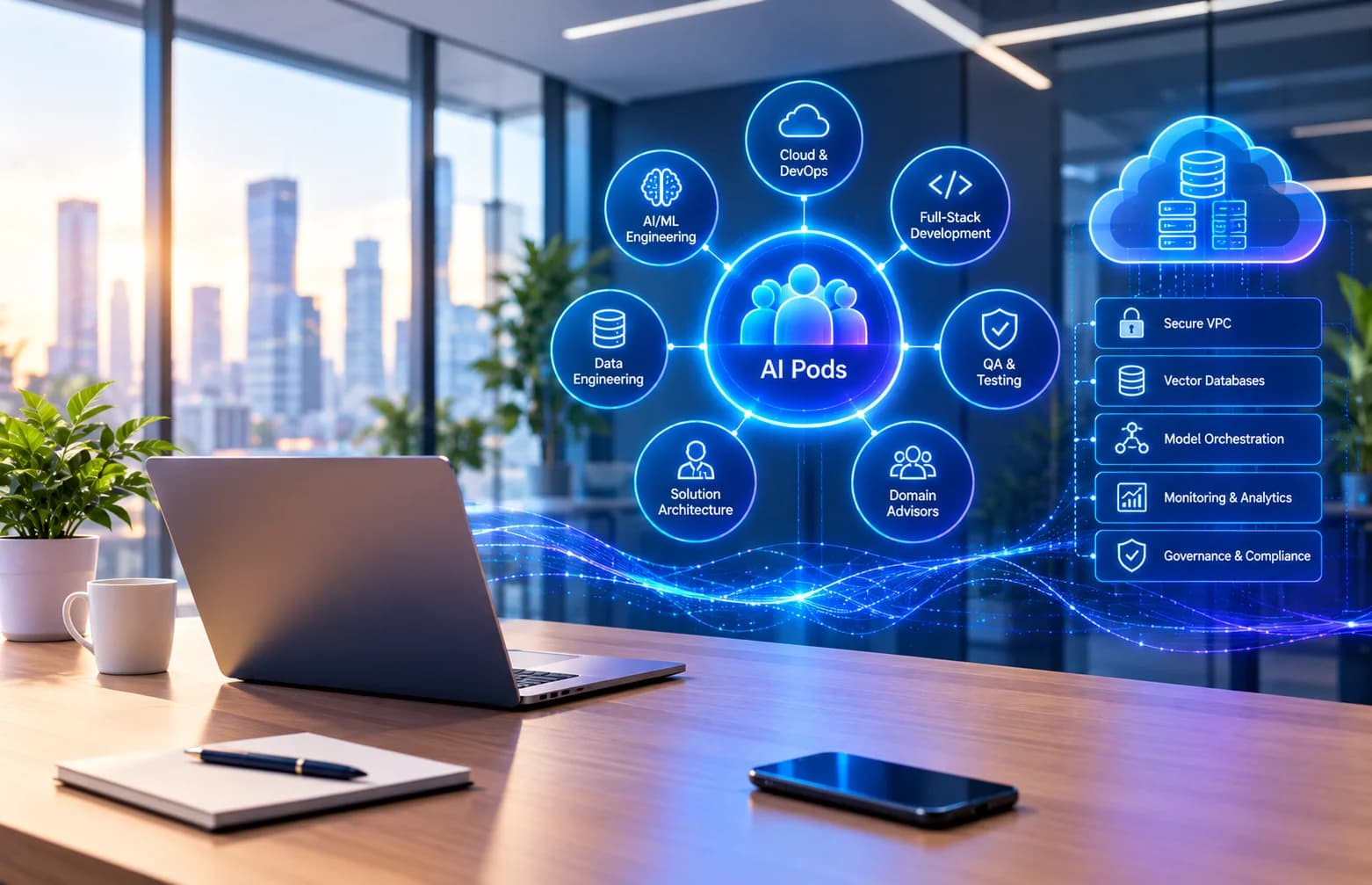
To transform a fragile prototype into a reliable, enterprise-grade system, an engineering organization must systematically audit four structural layers. Utilizing specialized AI readiness assessment services helps uncover the hidden infrastructure gaps that threaten software stability.
Layer A: The Production-Grade Data Engine
Traditional data management infrastructure works well for retrospective business intelligence dashboards or quarterly reporting cycles where minor anomalies are handled manually. Autonomous agents and language models do not tolerate these inconsistencies. An active data engine needs to support four distinct technical operational standards:
Enforcing Data Contracts: Engineering teams must implement strict, programmatic validation checkpoints at the ingestion boundary. If an upstream database changes its column schema or delivers a null value in a critical field, the data contract gate must automatically block that record, log an incident, and protect downstream vector pipelines from corruption.
Eliminating Storage Inconsistencies: Duplicate customer records or conflicting system entries confuse model logic. If a single entity has multiple addresses across separate internal databases, an automated system cannot determine the ground truth, resulting in faulty context injections.
Tackling Pipeline Latency: Models require near real-time operational context. Relying on legacy nightly batch transfers means system context remains stale for hours. Teams must evaluate a shift toward continuous-processing architectures, leveraging Change Data Capture (CDC) or event-driven message streaming to keep operational stores up to date.
The Universal Semantic Layer: Moving away from isolated database queries requires building a centralized semantic layer. This tier acts as a single source of truth, standardizing definitions, business metrics, and relations so models query information with accurate contextual grounding.
Organizations that achieve measurable returns often secure assistance from an experienced AI consulting company to overhaul these internal pipelines before writing application code.
Layer B: Retrieval Performance & Vector Architecture
As enterprise record counts scale into millions of items, retrieval mechanics determine system stability and cost profiles. A complete evaluation requires deep analysis of vector database choices and indexing configurations:
Evaluating Vector Storage: Software architects must evaluate clear engineering trade-offs when selecting indexing tools. For organizations with existing relational database footprints, deploying extensions such as pgvector on top of standard PostgreSQL instances minimizes infrastructure complexity.
Chunking Strategy Optimization: Standard fixed-size text splitting often truncates paragraphs mid-sentence, destroying semantic meaning. Engineering audits must verify that chunking strategies align with document layouts, using semantic or structural boundaries to keep context clean.
Embedding Model Alignment: Upgrading or changing an underlying embedding model requires a full re-indexing of historical data. Infrastructure reviews must account for the computational overhead of generating new embeddings across legacy enterprise repositories.
Layer C: MLOps/LLMOps Sandbox Setup
Moving software into production requires strict separation of operational environments. A mature deployment framework depends on automated development lifecycles:
Environment Isolation: Engineering groups must maintain completely independent testing, staging, and production sandboxes. Prototypes, validation experiments, and prompt optimization tasks should never execute on the same compute resources or access the same databases used by live customer applications.
Telemetry and Pipeline Tracking: Operational workflows require continuous tracking. System builders must standardize centralized model logs, infrastructure version history, and execution latency tracing across the entire toolchain.
Model Routing and FinOps: Sending every simple enterprise query to a premium frontier model causes a runaway total cost of ownership (TCO). A production-ready architecture uses specialized routing layers to direct routine validation steps to smaller open-source models while reserving complex processing tasks for larger models.
Layer D: System Observability & Compliance Controls
Enterprise operations require objective monitoring and clear accountability. Engineering leaders should avoid relying on subjective feedback and instead implement automated, continuous validation protocols:
Real-Time Performance Tracking: Organizations must establish automated monitoring alerts to identify input abnormalities, unexpected token spikes, and gradual model drift before these anomalies affect end users.
Auditing Routes: System configurations must log structural inputs, exact prompt context injections, model settings, and final outputs. This data retention provides clear verification records for regulatory compliance and debugging needs.
Human-in-the-Loop Triggers: High-risk automated decisions require explicit human oversight checkpoints. The system architecture should isolate anomalous outputs and route them to human specialists for manual review before triggering downstream application actions.
Implementing these structural layers requires specialized expertise. Engaging with professional enterprise AI consulting firms ensures that your monitoring, compliance, and infrastructure lines match modern software standards.
Technical Data Validation Rubric
Before allocating project budgets, infrastructure architects can utilize this verification matrix to score system assets and identify foundational engineering dependencies:
Engineering Parameter | Target Metric / Threshold | Practical Verification Method |
|---|---|---|
Schema Integrity | Zero unmapped schema variations across data sources. | Run automated contract validations at the ingestion layer. |
Pipeline Latency | Data synchronization delay under 1,000 milliseconds. | Measure message queues and end-to-end processing times. |
Retrieval Accuracy | Minimum 95% precision on test ground-truth sets. | Perform automated checks on embeddings against baseline evaluation datasets. |
System Availability | 99.9% API response success rate under target volume. | Execute automated stress testing to simulate peak concurrent production loads. |
An organization can use this scoring rubric within their broader evaluation strategy. If an internal audit scores below target metrics across two or more categories, the leadership team must pause application development and address the underlying data engine bottlenecks.
Reality Check: An Iterative Implementation Path
A common error among enterprise organizations is attempting a massive, multi-department technology transformation all at once. Corporate procurement processes, security clearances, compliance evaluations, and database lockouts often stall broad, horizontal initiatives.
Practical execution relies on a focused, iterative path. Enterprise leaders frequently partner with specialized AI implementation services providers to isolate specific target areas, resolve core structural gaps, and establish a repeatable deployment pipeline using a phased approach:
Phase 1: Pipeline Bottleneck Auditing
Identify a single, high-value operations workflow with well-defined parameters—such as parsing incoming supply chain invoices or automating routine internal technical support tickets. Map every data dependency, identify legacy database limitations, document access privileges, and clear security requirements within this restricted scope.
Phase 2: Contract Enforcement & Staging Setup
Build out the necessary data pipelines exclusively for the selected use case. Establish programmatic validation gates, configure the universal semantic layer for the target domain, select appropriate vector databases, and test integration points inside a secure staging sandbox.
Phase 3: Contained Live Deployment
Use the newly streamlined pipeline to route a small percentage of real operating traffic. Track data intake delay, evaluate cloud compute costs, keep an eye on performance indicators, and instantly validate model outputs. Engineering teams can increase the infrastructure footprint to accommodate larger business projects if the design demonstrates reliability under actual loads.
Before investing in larger, platform-wide projects, an organization may use this iterative approach to verify its internal preparedness, resolve crucial engineering obstacles on a smaller scale, and ensure predictable deployment outcomes.
Technical Architecture and Long-Term Strategy
Regular strategic planning is necessary to build a production system that is scalable. Unmanageable technological debt and fragile integrations result from relying on an ad hoc selection of heterogeneous APIs. Comprehensive engineering execution and professional guidance must be carefully combined for long-term operational success.
It is easier to align your technological decisions with long-term company ambitions when you work with a reputable source of AI strategy consultancy for businesses. This alignment demonstrates that investments in MLOps infrastructure, data categorization, and vector storage offer a reusable basis for future automation requirements across various business units.
Additionally, companies may go from brittle, independent scripts to organized, enterprise-grade application blocks by utilizing integrated AI transformation services. Data governance, compliance validation, and infrastructure optimization are certain to become routine elements of the development lifecycle thanks to our programmatic methodology.
Concluding Thoughts
Organizations that go beyond basic software wrappers and concentrate on engineering execution will have sustained competitive value. True technical readiness must be developed methodically through infrastructure discipline, stringent data contract enforcement, and ongoing performance telemetry; it cannot be bought out of the box.
Before investing in additional model licenses, engineering teams must evaluate their systems against a rigorous enterprise AI readiness assessment framework. Build automatic contract gates, find integration weaknesses, isolate your primary data streams, and stabilize a single production process. With this engineering focus, technological investments become dependable, production-grade corporate assets rather than experimental cost centers.
Optimize Your Production Infrastructure
Is your data architecture ready to support autonomous processes with high production volumes? To arrange a structured examination, contact Seasia Infotech's technical team now. To assist you in resolving pipeline bottlenecks and seamlessly transitioning your software from staging sandboxes into real, dependable production deployment, our experts offer thorough enterprise AI consulting and focused infrastructure assessments.