Third-party logistics has always involved coordination. What has changed is the volume of coordination required.
A single 3PL may now be managing orders from multiple commerce platforms, inventory across warehouses, different carrier networks, client-specific SLAs, returns, proof-of-delivery documents, billing rules, and real-time customer updates. When these processes rely heavily on spreadsheets, emails, manual data entry, and people moving information between systems, growth inevitably creates more administrative work.
That is the problem 3PL automation software is increasingly being built to solve.
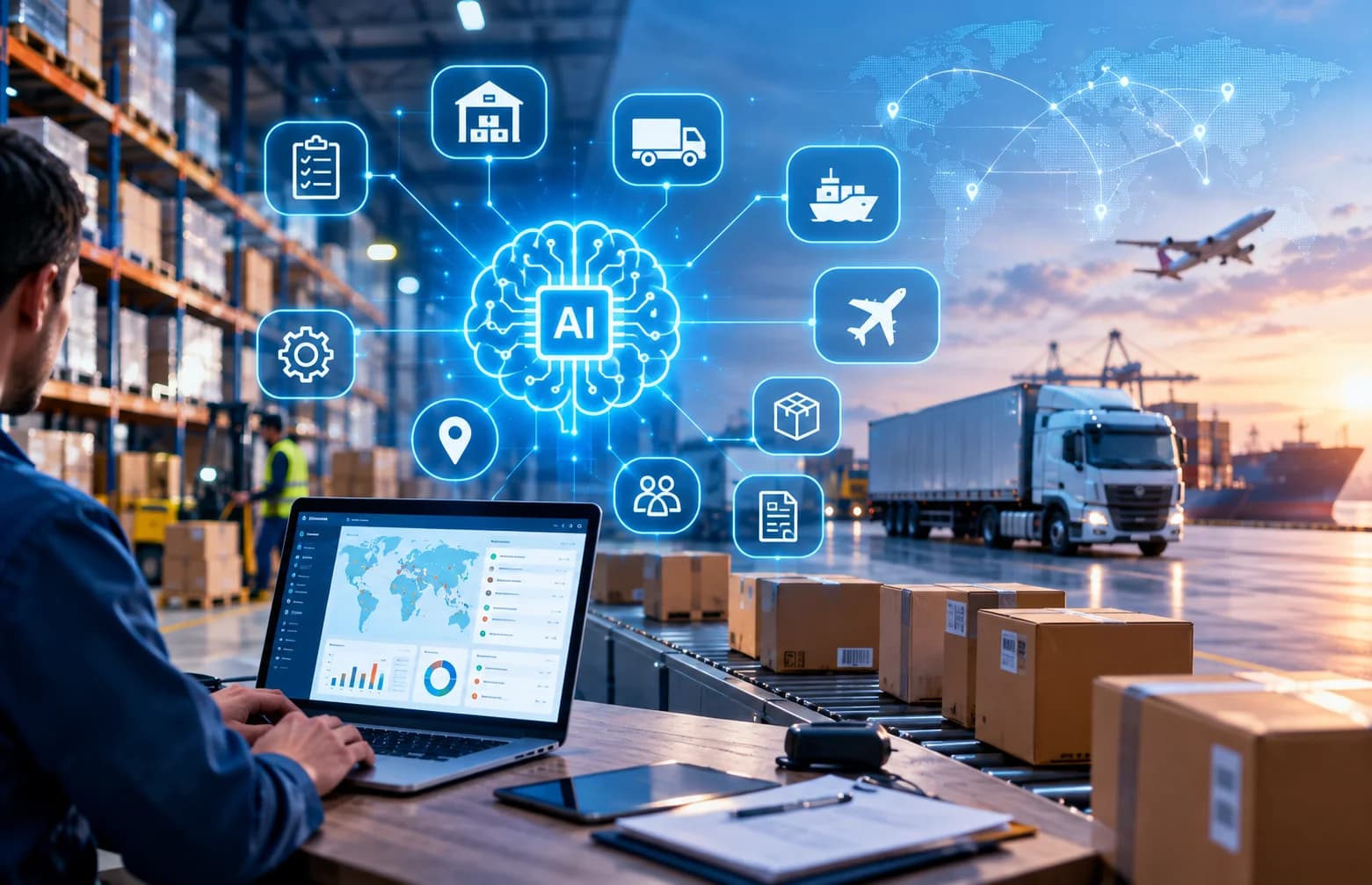
In 2026, automation is moving beyond predefined workflows. AI can now identify exceptions, interpret documents, predict delays, recommend actions, and automate parts of operational decision-making. For 3PL providers, this represents a shift from simply digitizing logistics processes to reducing the number of manual touches required to execute them.
Why Manual Operations Become a Problem as 3PLs Scale
Manual logistics processes rarely fail all at once. They become inefficient gradually.
An employee copies an order from an email into the 3PL software. Someone else confirms inventory availability. A dispatcher checks carrier capacity. Another team sends the customer a status update. The delivered shipment later has to be matched with its proof of delivery before finance can generate an invoice.
None of these actions appears particularly inefficient in isolation.
Multiply them across thousands of shipments, dozens of customers, multiple warehouses, and different billing agreements, however, and the operational burden becomes significant.
Common symptoms include:
repeated order and shipment data entry
delayed inventory updates
manual carrier and dispatch coordination
staff repeatedly checking shipment status
slow exception identification
manual POD and document processing
delayed customer notifications
missed or late billing events
Traditional logistics automation software handles some of these problems through predefined rules. AI adds another layer: the ability to analyze operational context and determine what requires action.
Where AI Is Changing 3PL Automation
The important development in 2026 is not simply that 3PL systems contain AI features. It is that AI is beginning to sit within operational workflows.
Gartner identifies both agentic AI and physical AI among its leading supply chain technology trends for 2026, describing a broader movement toward more autonomous and adaptive supply chain systems.
Here is where that transition is becoming practical.
1. Automated Order Intake and Validation
Orders rarely arrive in one standardized format.
A 3PL may receive transactions through ecommerce APIs, EDI, customer portals, CSV files, PDFs, emails, or ERP integrations.
Modern 3PL automation software can consolidate these inputs and validate information before the order enters fulfillment. AI can go further by extracting information from unstructured documents, identifying missing fields, recognizing unusual orders, and routing exceptions for review.
Instead of having operations teams manually verify every transaction, employees intervene primarily when the system detects something abnormal.
That is a more valuable form of automation than simply entering data faster.
2. Smarter Inventory and Warehouse Operations
Warehouse automation traditionally focused on barcode scanning, conveyors, pick-to-light systems, robotics, and automated storage.
Software intelligence is now becoming equally important.
AI-powered 3PL software can use inventory history, order velocity, SKU movement, space utilization, and incoming demand to support:
inventory allocation
replenishment planning
warehouse slotting
pick-path optimization
cycle-count prioritization
inventory anomaly detection
AI can also identify discrepancies between expected and actual inventory behavior before they become larger fulfillment problems.
DHL's Logistics Trend Radar highlights advanced analytics and computer vision among the AI technologies expected to have significant implications for logistics operations.
3. Predictive Exception Management
One of the most useful applications of AI for 3PL is determining which shipments need human attention.
Traditional systems tell teams that a shipment is late.
In logistics software development, AI logistics software can potentially identify that it is likely to become late based on carrier performance, route conditions, warehouse congestion, historical transit patterns, available capacity, and current operational events.
The software can then flag the shipment, suggest an alternative, or trigger a predefined escalation workflow.
That changes exception management from reactive monitoring to proactive intervention.
For operations teams handling thousands of shipments, this matters. Employees no longer have to continuously check everything. They can concentrate on the smaller percentage of orders where intervention creates value.
4. Dispatch and Transportation Automation
Dispatch remains one of the most coordination-intensive areas of logistics.
Teams need to consider shipment priority, vehicle capacity, delivery windows, carrier rates, driver availability, traffic conditions, and customer commitments.
AI-powered logistics automation can evaluate these variables simultaneously and support decisions such as:
carrier selection
load consolidation
shipment prioritization
route optimization
dynamic rescheduling
ETA prediction
AI does not necessarily need complete operational autonomy to deliver value. Even systems that provide ranked recommendations can substantially reduce the amount of manual analysis expected from dispatch teams.
5. Document Processing Without the Manual Paper Chase
Logistics produces a remarkable amount of documentation: bills of lading, delivery receipts, manifests, customs paperwork, invoices, carrier documents, contracts, and proof of delivery.
Processing these documents manually creates two problems.
First, it consumes administrative time. Second, information contained inside documents often becomes available to operational systems too late.
Document AI can extract relevant information, classify documents, validate fields against shipment records, identify discrepancies, and attach records automatically.
For example, an uploaded POD could be matched against the correct shipment and used to trigger downstream processes such as customer notification or invoice generation.
This is where logistics process automation creates value across departments rather than only inside the warehouse.
6. Automated Billing and Revenue Capture
Billing is often overlooked when companies discuss 3PL automation.
Yet third-party logistics billing can be unusually complex. A client may be charged according to pallet storage, cubic volume, pick activity, packaging, handling, transportation, detention, special services, or a negotiated combination of these factors.
If operational events and billing systems are disconnected, staff must reconstruct those charges manually.
Custom 3PL software can connect billable events directly with contract rules.
A receiving scan can create an inbound handling charge. Storage calculations can be generated from inventory records. A completed shipment can trigger transportation and fulfillment charges. Accessorial activities can be recorded at the point of execution.
The objective is not simply faster invoicing. It is ensuring that services performed actually become services billed.
7. Customer Service Without Constant Status Requests
A significant amount of 3PL customer service is not really customer service. It is information retrieval.
“Has the shipment left?”
“What inventory do we have?”
“When will this order arrive?”
“Can you send the POD?”
Integrated 3PL logistics software can make much of that information available automatically through customer portals, APIs, notifications, or AI-assisted interfaces.
AI can also interpret natural-language queries, summarize shipment histories, generate operational updates, and route genuine exceptions to human support teams.
Instead of customer service personnel spending their day finding information, they can focus on resolving the situations where customers actually need help.
Good 3PL Automation Starts With Integration, Not AI
There is an important limitation to all of this.
AI cannot compensate for fragmented logistics architecture.
An intelligent routing model has limited value if carrier information is outdated. Predictive inventory analysis is unreliable if warehouse movements are not recorded consistently. Automated billing cannot work properly if operational activities are disconnected from the billing engine.
Effective 3PL software development therefore starts with the underlying digital architecture.
The platform may need to integrate WMS, TMS, ERP, ecommerce systems, carrier APIs, payment systems, accounting tools, IoT devices, telematics platforms, customer portals, and data warehouses.
APIs and event-driven architecture can then allow changes in one part of the logistics network to trigger actions elsewhere.
AI becomes valuable after the system has reliable operational data to work with.
When Custom 3PL Automation Software Makes More Sense
Off-the-shelf platforms work well when the operation closely matches the workflows for which the product was designed.
The equation changes when a 3PL has highly specific client rules, billing models, warehouse processes, carrier integrations, reporting requirements, or legacy systems.
That is where custom 3PL software becomes relevant.
A targeted 3PL automation software development initiative can automate the workflows creating the most operational friction without requiring the business to redesign every process around a generic product.
The development approach should usually start with workflow mapping:
Operational process → manual touchpoints → integration gaps → automation opportunity → AI opportunity → measurable KPI.
Not every manual process requires AI. A rules engine may be perfectly adequate for predictable tasks. AI should be introduced where variability, prediction, unstructured data, or contextual decision-making makes conventional automation insufficient.
The Goal Is Not a Fully Autonomous 3PL
There is a tendency to frame AI automation as the removal of people from logistics.
That misses the point.
The practical objective is to remove unnecessary human involvement from predictable work while making human involvement more valuable where judgment is genuinely required.
The 2026 MHI Annual Industry Report reflects how quickly that transition is progressing: 53% of surveyed organizations reported AI already in use, while robotics and automation also continued to expand across supply chain operations.
The 3PL operations likely to benefit most are therefore not necessarily those trying to automate everything. They are the ones identifying exactly where people are functioning as the integration layer between systems, and redesigning those workflows.
Building AI-Powered Logistics Solutions with Seasia Infotech
Building effective 3PL technology solutions requires more than adding an AI model to an existing logistics application.
It requires understanding how orders, inventory, warehouses, transportation, customer communication, documents, billing, and external systems interact throughout the shipment lifecycle.
At Seasia Infotech, we help logistics businesses design and develop scalable digital platforms that combine workflow automation, system integrations, real-time data, analytics, and AI capabilities. From modernizing existing platforms to building custom 3PL automation software, the focus remains on solving measurable operational problems rather than introducing technology for its own sake.
As logistics networks become increasingly connected and intelligent, that distinction will matter.
The competitive advantage will not come from simply having AI.
It will come from knowing exactly where AI should be allowed to act!