Most enterprise learning platforms treat workforce education like static document archival. An employee signs in, clicks through a twenty-minute video recording, selects answers across five multiple-choice questions, and registers a database flag to verify administrative compliance.
Completion numbers stay low, technical skills degrade within quarters, and corporate balance sheets absorb heavy recurring subscription bills for portals that staff actively dread using. Legacy course registries were designed to protect administrators from audit penalties, not to help teams master difficult work.
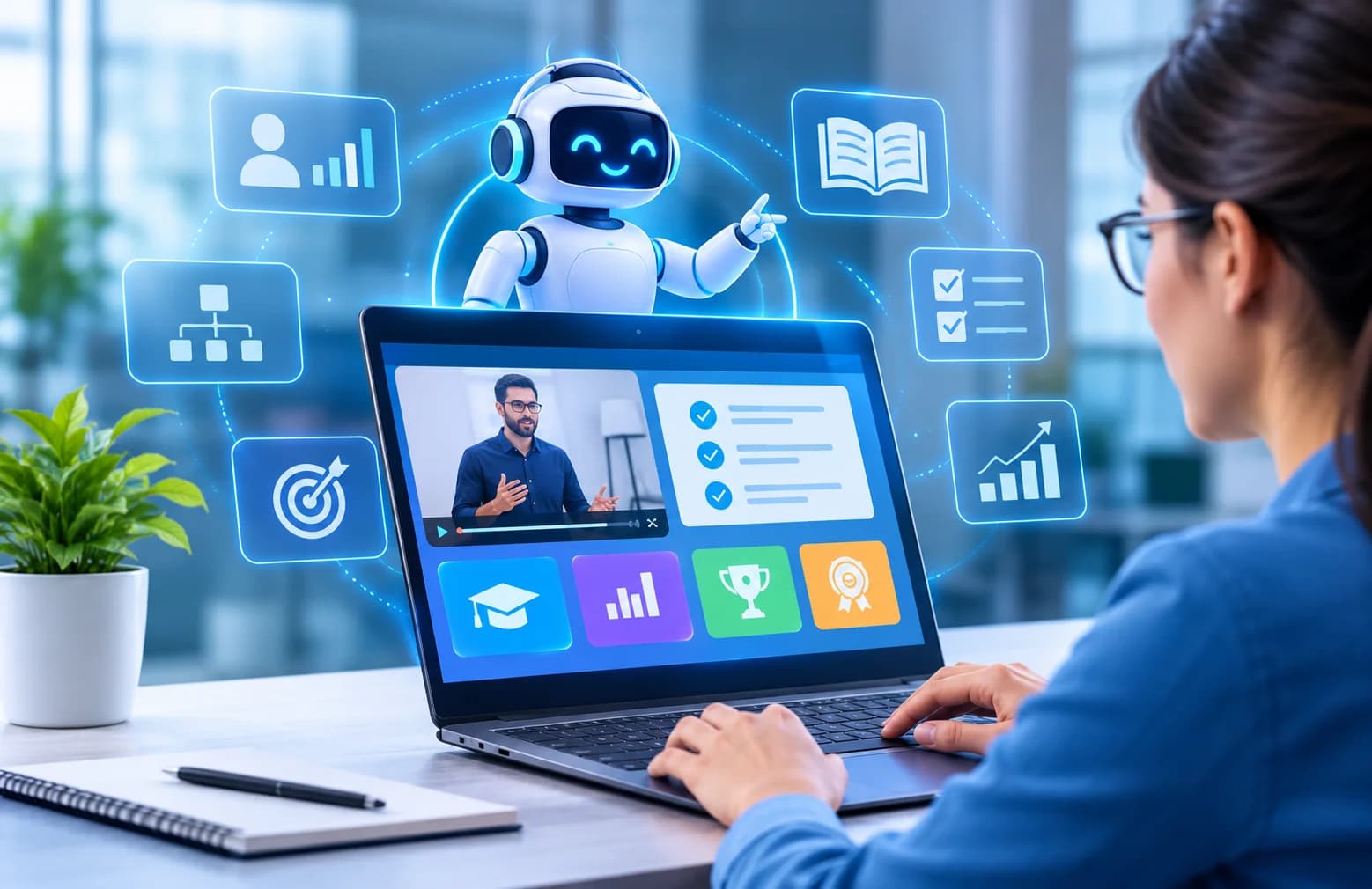
Modern operating environments require an AI-powered learning management system that shifts away from pre-rendered video modules toward real-time cognitive interaction.
The Monolithic LMS Deficit: Why "Click-to-Finish" Architecture Broke
Linear course sequencing is the fundamental flaw of legacy digital instruction. Systems force each learner down the same path: Course, Module, Lesson, Quiz. This setup assumes every engineer or ops person comes from the same background, learns concepts at the same speed, and trips over the same ideas. This rigid design creates considerable operational drag when an organization attempts to implement technical upskilling across thousands of employees:
Detecting Cognitive Friction: The platform looks for behavioral signals like video replays, pauses in interactive exercises, or prompt revisions to pinpoint difficult topics before students fail exams.
Knowledge Decay Prediction: Unsupervised learning algorithms can detect early signs of employee struggle weeks ahead of performance reviews, giving managers and trainers a heads-up to intervene.
Targeted Review Modules: If the platform detects a gap in understanding, it automatically offers a targeted review exercise or an interactive diagram to clarify the concept before the student moves on to more advanced work.
Fixing these problems requires dedicated EdTech software development that treats skills as flexible knowledge webs rather than static document folders. But with the right intelligent learning management system, training portals can become active operational partners instead of merely static course libraries. It analyses user queries, adjusts the pace of instruction, and ensures learning stays in line with daily production goals.
The Cognitive Anatomy of an AI-Native Learning Platform
Modern learning architectures run on coordinated machine learning services working directly alongside application logic, avoiding reliance on basic third-party text completions.
Dynamic Knowledge Graphs and Semantic Traversal
Replace rigid course directories with directed acyclic graphs and semantic vector embeddings. Within this framework, proficiencies and capabilities function as connected points across an operational skill graph. As a user completes exercises and answers technical questions, the software continuously updates their capability profile.
When a systems engineer shows competence in basic server orchestration, the platform updates linked skill nodes, skips entry-level virtualization material, and provides advanced container networking problems. This dynamic routing provides authentic AI-driven personalized learning, matching material to personal capabilities without forcing everyone through standard corporate paths.
Domain-Grounded AI Assistants
Standard conversational interfaces that query public language models can expose proprietary code and generate false claims. Dependable training environments run private Retrieval Augmented Generation pipelines wired directly to internal enterprise stores.
The software indexes engineering guidelines, standard operating procedures, architectural briefs, and internal courses into protected vector databases. When a worker asks a direct technical question, the system pulls source citations from private data repositories and delivers verifiable answers without referencing unvetted web pages.
Dynamic Scenario Generation
Fixed question pools encourage memorization and answer sharing between colleagues. Modern automated learning management software produces live, practical scenarios drawn directly from the active curriculum.
Instead of basic multiple-choice quizzes, the system designs live terminal troubleshooting sessions, customer negotiation chats, and specialized code audits. Learners resolve realistic business scenarios while automated evaluation models score their performance against standard operational metrics.
Enterprise Data Fabric: Moving from Static Logs to Predictive AI Learning Analytics
Early industry protocols like SCORM 1.2 record only shallow session details: Incomplete, Complete, Pass, or Fail. A modern AI learning management system replaces these shallow status flags with event-driven data streaming through the Experience API (xAPI) and Caliper Analytics, streaming interaction data directly into brokers like Apache Kafka.
Every user event generates valuable operational telemetry for AI learning analytics:
Detecting Cognitive Friction: Tracking behavioral signals such as video replays, pauses during interactive exercises, or prompt revisions helps the platform spot difficult topics long before exam failures happen.
Forecasting Knowledge Decay: Unsupervised learning algorithms identify early indicators of employee struggle weeks before scheduled evaluations, warning managers and trainers early enough to intervene.
Targeted Review Modules: When the platform spots a comprehension gap, it automatically delivers a focused review exercise or an interactive diagram to clarify the concept before the student tackles advanced work.
Architectural Evaluation: Commercial SaaS Limits vs. Custom LMS Development
Organizations modernizing their training systems face a clear strategic trade-off: pay for a multi-tenant commercial vendor or invest in custom LMS development. Off-the-shelf software promises quick setup, but expanding teams soon hit structural walls:
Architectural Dimension | Commercial Multi-Tenant SaaS | Custom-Engineered AI Platform |
|---|---|---|
Licensing Expenses | Compounding monthly per-seat fees that rise as headcount expands. | Stable cloud hosting expenses; zero per-seat licensing penalties as teams grow. |
Data Privacy & IP | Training records and private assets sit on shared, third-party infrastructure. | Deployed inside a dedicated virtual private cloud; complete ownership of model parameters. |
Integration Freedom | Restricted third-party connectors with hardcoded database schemas. | Native event connections into internal ERP systems, HR databases, CRMs, and IDEs. |
Model Specialization | Generic public AI endpoints; unable to train algorithms on private enterprise IP. | Custom retrieval pipelines and specialized models trained on company records. |
Business Logic | Fixed administrative rules; rigid multi-tenant setups and payout structures. | Tailored marketplace rules, automated revenue distribution, and custom payment routing. |
When high-volume corporate academies or education firms grow past tens of thousands of active users, commercial software constraints create operational bottlenecks.
During the development of the TeacherCool platform, packaged software options failed to handle multi-instructor revenue calculations, regional payment gateways, and high-concurrency video feeds simultaneously. Developing a custom foundation removed external middleware dependencies and gave the organization a proprietary software asset aligned directly with its commercial workflows.
Future Horizons: Multi-Agent Mentorship and Continuous Skill Graphs
Workforce instruction is moving beyond passive video players toward autonomous systems that assist workers throughout their daily careers.
An enterprise AI-powered learning management system will soon deploy coordinated multi-agent simulations. Instead of working through isolated lessons, an employee can practice complex client deals with simulated participants such as an automated buyer, an engineer pushing technical limits, and an evaluative coach assessing the interaction in the background.
Generative platforms will also assemble modular micro-lessons directly from daily workplace outputs, including merged pull requests, updated product documentation, and technical support tickets. Instead of waiting months for a curriculum update, training updates can publish the moment new software features launch.
Verifiable digital credentials will replace static paper certificates. As proven in Seasia's scalable AI learning management solution, tamper-proof skill registries validate hands-on abilities using real-world testing records, removing resume exaggeration entirely.
Engineering Your Scalable Learning Infrastructure with Seasia Infotech
Modernizing workplace instruction demands deep experience across distributed backends, streaming event pipelines, and private machine learning infrastructure. Engineering squads must build reliable systems that respect data privacy laws, enterprise compliance requirements, and corporate security guidelines. Seasia Infotech delivers end-to-end education software development services to turn modern training strategies into production software.
Our dedicated engineering pods combine solutions architects, data engineers, and full-stack developers to construct custom learning engines that integrate cleanly with your existing operational software. Investing in custom LMS development grants your business full ownership over its educational applications, historical telemetry, and private machine learning assets. We build reliable, secure platforms that scale as your business expands.
Whether you need to overhaul an outdated employee portal, deploy private AI tutoring agents, or launch a global training marketplace, our engineering teams provide the technical depth required to deliver reliable results. Speak with our software architects today to assess your infrastructure and plan your migration to an AI-powered learning management system engineered for your business needs.