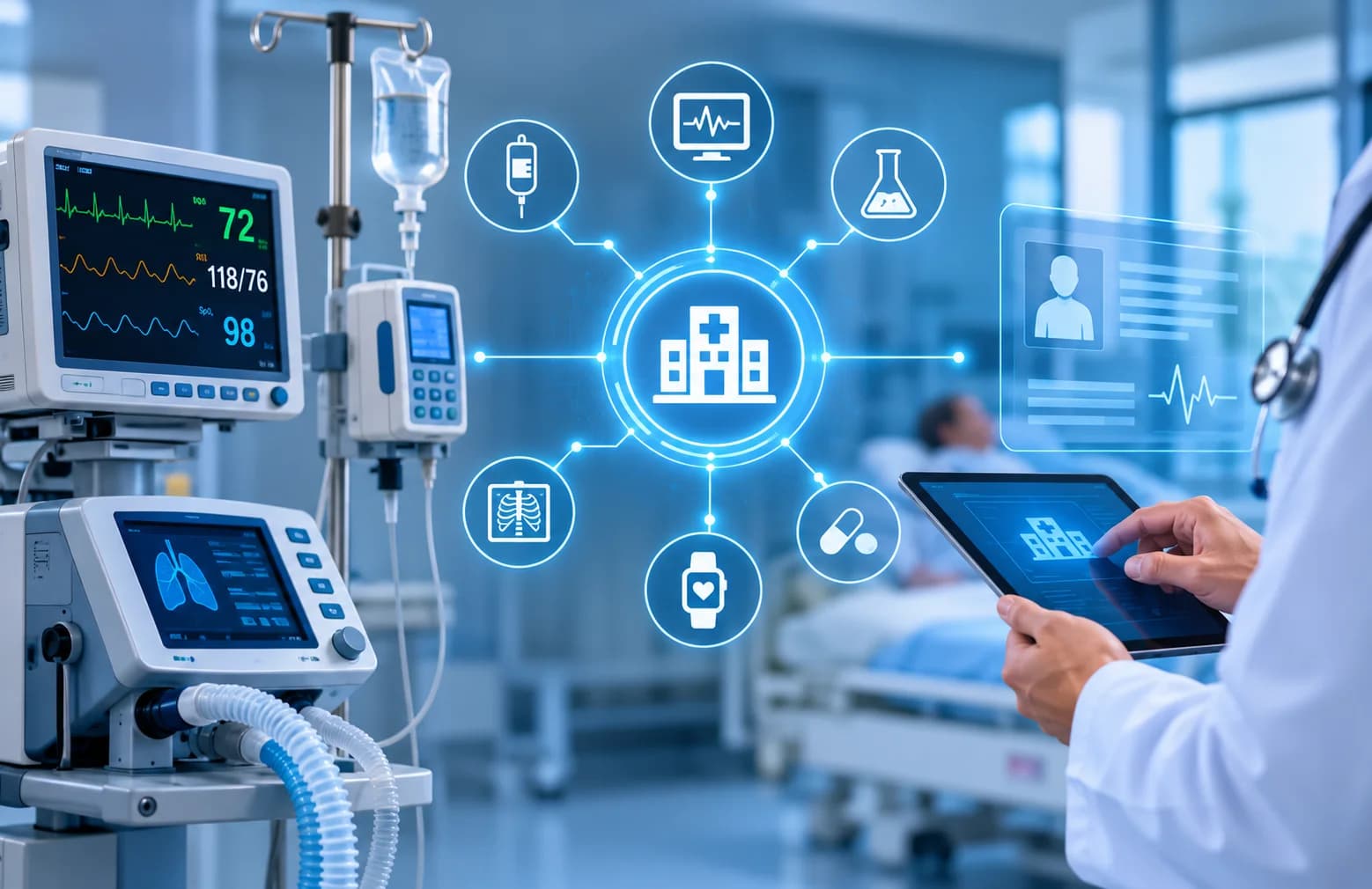
A bedside monitor records heart rate every few seconds. An infusion pump tracks medication delivery. A laboratory analyzer generates test results. An imaging system creates diagnostic files. A wearable continues collecting patient data after discharge.
The challenge is no longer generating data.
It is getting the right data into the right clinical system, attached to the right patient, in a format clinicians can trust and use.
That is the core purpose of medical device integration.
In a connected healthcare environment, devices cannot remain isolated endpoints. Their data may need to flow into an EHR, monitoring dashboard, alarm-management platform, remote patient monitoring application, data warehouse, or analytics system.
Doing that reliably requires more than connecting one API to another. A production-grade integration must account for device connectivity, data normalization, patient identity, interoperability standards, workflow rules, security, failure handling, and end-to-end validation.
What Is Medical Device Integration?
Medical device integration is the process of connecting medical devices and related software with healthcare information systems so that device-generated data can be captured, standardized, exchanged, and used within clinical workflows.
These devices can include:
patient monitors, infusion pumps, ventilators, imaging equipment, laboratory systems, point-of-care devices, diagnostic platforms, implantable devices, and remote monitoring tools.
The destination may be an EHR/EMR, clinical decision-support platform, care-management system, cloud application, or custom healthcare platform.
The important point is that integration is not simply about moving a number from one system to another.
A reading such as:
Heart rate = 118
has limited value on its own.
The receiving system may also need to know:
which patient generated it,
which device produced it,
when it was recorded,
which encounter it belongs to,
which unit of measurement applies,
and whether the reading is current, validated, corrected, or delayed.
This context is what turns raw device output into clinically meaningful information.
A Typical Medical Device Integration Architecture
There is no single architecture for every implementation, but most follow a similar pattern:
Medical Device → Gateway/Connectivity Layer → Integration Engine → Clinical Data Model → EHR/Clinical Application
Each layer solves a different problem.
1. Device Layer
The device is the source of the data.
Some modern devices support standardized interfaces. Others rely on proprietary protocols, serial connections, TCP sockets, Bluetooth, Wi-Fi, USB, or vendor-specific middleware.
Older medical equipment may never have been designed for modern API-based healthcare environments.
That is why integration work typically starts with a basic engineering question:
What can the device actually send?
Teams need to understand its interface, output format, transmission frequency, connectivity behavior, supported commands, and failure modes before designing the downstream architecture.
2. Gateway and Connectivity Layer
A gateway often sits between devices and enterprise systems.
Its responsibilities may include:
receiving device data,
normalizing proprietary formats,
buffering messages,
timestamping events,
maintaining connectivity,
translating protocols,
and forwarding data downstream.
This layer becomes especially important in environments where hospitals use equipment from several manufacturers.
Without normalization, every downstream application would need custom logic for every device type.
The gateway creates an abstraction between hardware behavior and enterprise software.
3. Integration and Interoperability Layer
This is where medical device data integration becomes an enterprise interoperability problem.
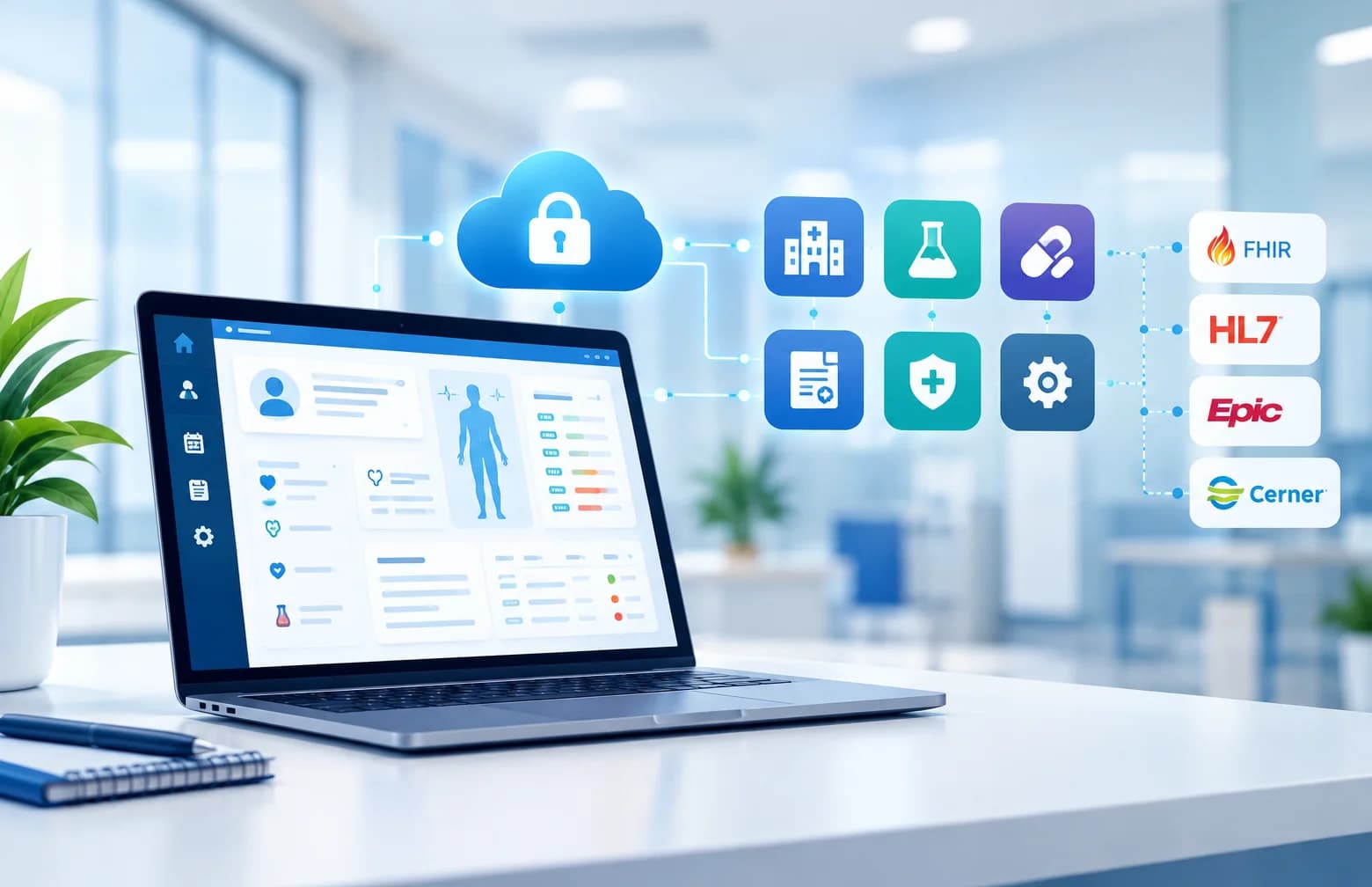
An integration engine may transform incoming data into HL7 v2 messages, FHIR resources, or another format understood by the receiving clinical system.
It may also handle:
routing, validation, patient matching, terminology mapping, duplicate detection, unit conversion, transformation, error handling, and retry logic.
This is where HL7 integration services and FHIR integration services often come together.
Many hospitals still depend heavily on HL7 v2, while newer platforms increasingly expose FHIR APIs.
In practice, real-world environments often need to support both.
HL7 v2 Still Matters
FHIR receives most of the attention in modern interoperability discussions, but HL7 v2 remains deeply embedded in hospital infrastructure.
Device observations may ultimately be transformed into messages such as ORU results and routed through interface engines into an EHR or clinical platform.
ADT messages also remain important because they establish patient and encounter context.
That introduces one of the hardest integration problems:
the device and the patient identity often come from different systems.
A monitor may know it is assigned to bed 12.
The hospital system knows which patient is currently in bed 12.
The integration layer must reliably connect those two pieces of information before data enters the clinical record.
A technically valid message associated with the wrong patient is still a serious clinical failure.
Where FHIR Fits
FHIR provides a more modular, API-oriented approach to healthcare data exchange.
Instead of exchanging one large message, FHIR represents clinical concepts as resources such as:
Patient, Encounter, Device, Observation, DiagnosticReport, and Practitioner.
For medical devices, this can make integrations easier to structure.
A typical relationship might look like:
Patient → Encounter → Device → Observation
The device identifies the equipment responsible for the measurement, while Observation records the actual clinical value.
This approach is useful for modern healthcare platforms, remote monitoring systems, mobile applications, and cloud-based architectures.
However, FHIR does not automatically replace every existing interface.
A realistic architecture may look like:
Device/proprietary protocol → Gateway → HL7 v2 → Integration Engine → FHIR/API Layer → Downstream Application
The correct approach depends on the existing technology estate.
Other Standards Also Matter
Medical device interoperability goes beyond HL7 and FHIR.
IEEE 11073 standards address communication and information models for medical and personal health devices.
DICOM remains central to medical imaging workflows.
At the transport level, implementations may rely on TCP/IP, Bluetooth Low Energy, Wi-Fi, USB, serial communication, or vendor-specific protocols.
That is why integration is rarely solved by selecting one standard.
A robust architecture often has to bridge:
hardware protocols + transport protocols + healthcare messaging + clinical semantics + enterprise APIs.
Patient-Device Association Is a Critical Risk
A device can transmit a perfectly formatted measurement and still create a dangerous problem if it belongs to the wrong patient.
Patient-device association may rely on bed assignment, barcode scanning, manual selection, device registration, EHR context, or middleware configuration.
Each approach introduces failure scenarios.
What happens when a patient changes beds?
What if a previous patient remains assigned to the device?
What happens during a temporary network failure?
What if an identifier exists in one system but not another?
These cases need to be designed and tested deliberately.
The integration layer should preserve clear relationships between the device, patient, encounter, timestamp, and observation.
Data Volume Creates Another Design Challenge
Medical devices can generate far more data than clinicians need to see.
A bedside monitor may produce high-frequency physiological values continuously. Sending every raw measurement directly into the EHR can create unnecessary volume and make the record harder to use.
Integration teams therefore need to decide:
What should be captured?
What should be stored?
What should enter the EHR?
What should remain in a high-frequency data platform?
When should data trigger an alert?
Should the system store every reading, interval-based values, validated observations, or only clinically relevant events?
These decisions should be based on clinical workflow rather than technical capability alone.
This becomes particularly important when device data will also support analytics or AI-powered healthcare solutions.
AI models may benefit from granular data, while clinicians may require a more curated record.
That can lead to separate operational, analytical, and clinical data paths.
Security Has to Extend to the Device
Connected devices expand the healthcare attack surface.
Security architecture needs to cover more than the EHR API.
It must include device firmware, networks, gateways, middleware, credentials, cloud components, and software dependencies.
Practical controls typically include:
encryption in transit and at rest,
strong authentication,
least-privilege access,
secure API credentials,
network segmentation,
audit logging,
patch management,
abnormal communication monitoring,
and recovery planning.
Security cannot be added only at the final application layer.
It has to exist throughout the data path.
Silent Integration Failures Are Often the Most Dangerous
A complete outage is easy to detect.
Silent data corruption is much harder.
Examples include:
incorrect units,
duplicate observations,
delayed timestamps,
truncated messages,
dropped data,
incorrect transformations,
and wrong patient association.
This is why validation cannot stop at:
“Did the interface return a successful response?”
Testing needs to confirm:
Did the correct clinical value travel from the device through every transformation and arrive at the intended destination unchanged and with the correct context?
What Seasia's Medical Device Work Shows
This distinction is visible in Seasia's software assurance work with BD across multiple medical technology platforms.
One system, XrayTransfer, had to ingest X-ray data from several sources, convert it into the required format, and transmit it over TCP to an internal adapter.
Seasia designed and validated the three-stage pipeline:
ingest → convert → transmit
Testing included malformed inputs and interrupted transfers to verify that the receiving system obtained exactly what had been ingested, without silent corruption or truncation.
The broader engagement also covered software controlling controlled-substance dispensing hardware, medication-alert workflows, mobile clinical applications, APIs, and databases.
The key lesson is straightforward:
Medical device integration has to be tested as a complete clinical workflow, not as a set of isolated interfaces.
A Practical Implementation Approach
The safest approach is to begin with the workflow rather than the protocol.
First, map the entire data path:
Device → Patient Association → Gateway → Integration Engine → Transformation → EHR/EMR → Clinical Workflow
Then define:
what data should move,
how frequently,
where it should go,
what system owns each identifier,
what happens if the connection fails,
and which errors require human intervention.
Next, identify the protocols supported by both the device and the destination platform.
That will determine whether the solution requires HL7, FHIR, DICOM, IEEE 11073, proprietary middleware, or a combination.
The architecture should then define:
normalization, identity matching, terminology mapping, security, retry logic, monitoring, auditability, and validation.
Only after these decisions are clear should development begin.
This is where custom healthcare software development often becomes necessary.
Off-the-shelf connectors may work for common scenarios, but proprietary devices, legacy platforms, specialized clinical workflows, or high-frequency data often require custom engineering.
Medical Device Integration Is Ultimately a Workflow Problem
Healthcare interoperability discussions can quickly become conversations about standards:
HL7.
FHIR.
DICOM.
IEEE 11073.
APIs.
Those standards matter, but none of them guarantees a successful implementation.
The real objective is to make device-generated information available where healthcare teams need it, accurately, securely, and with enough context to trust.
That requires engineering across hardware, interoperability, software architecture, cybersecurity, and quality assurance.
For organizations evaluating healthcare software development services, the right partner therefore needs more than API development experience.
It needs to understand how clinical data moves, how connected systems fail, how devices behave, and how integrations should be validated from end to end.
As a software development company with experience across healthcare platforms, EHR integrations, connected applications, and medical device software assurance, Seasia approaches these projects as complete integration ecosystems rather than isolated interfaces.
Because the real measure of successful integration is not:
“Did the device send the data?”
It is:
“Did the right clinical information reach the right system, for the right patient, at the right time, and can we prove it?”