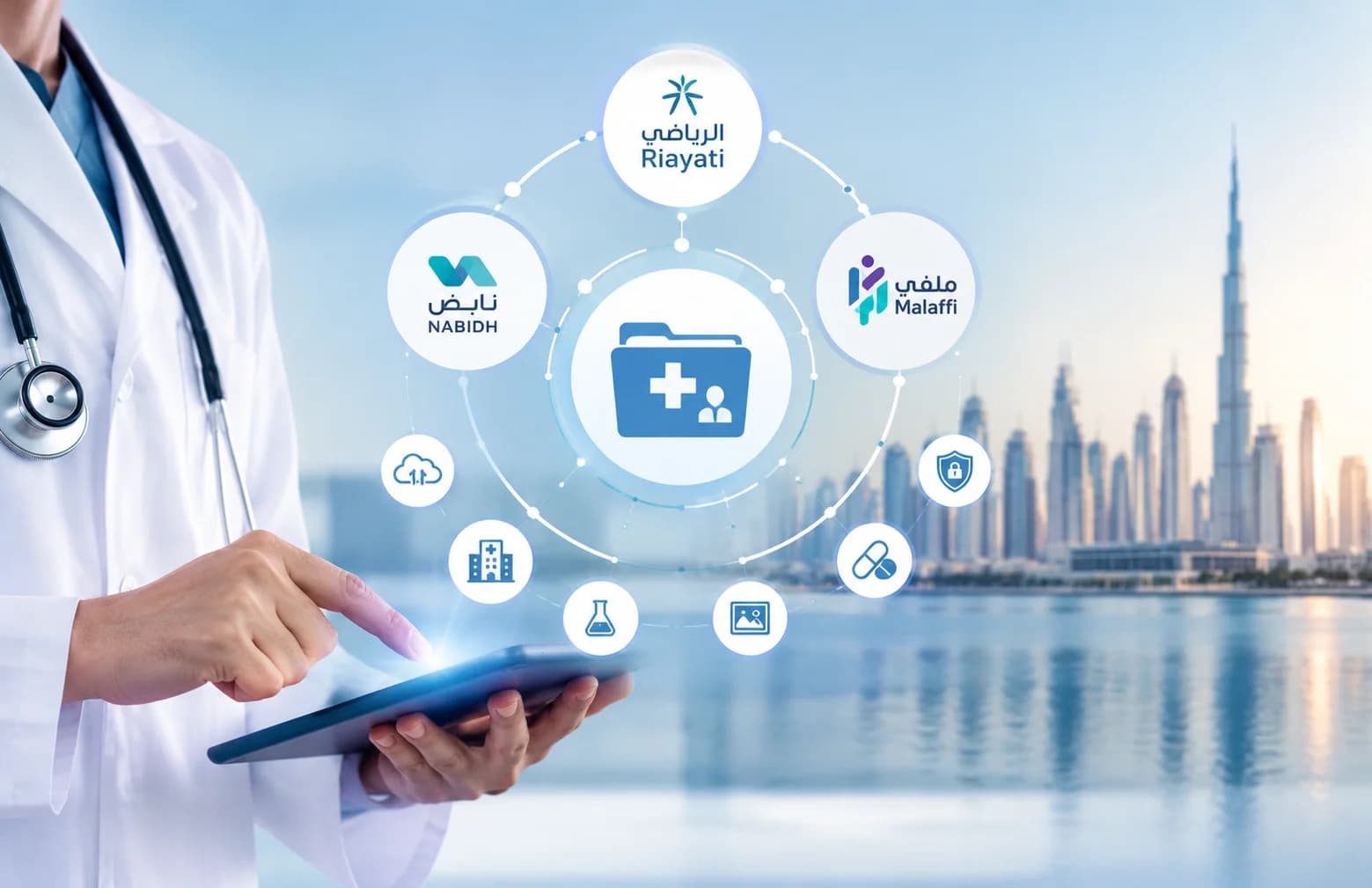
A patient may receive primary care in Dubai, undergo a specialist consultation in Abu Dhabi, and later visit another provider elsewhere in the UAE. Clinically, these encounters belong to one healthcare journey. Technically, however, they may originate in completely different EMRs, laboratory systems, radiology platforms, and hospital applications.
The UAE has been steadily closing this information gap through NABIDH, Malaffi, and Riayati.
NABIDH provides Dubai’s Health Information Exchange (HIE), Malaffi connects healthcare providers across Abu Dhabi, while Riayati delivers the National Unified Medical Record (NUMR). In 2023, UAE health authorities announced the successful integration of Riayati, Malaffi, and NABIDH, creating the foundation for health information to move beyond individual facilities and emirate-level systems.
For healthcare organizations, however, being part of this connected ecosystem requires more than installing a connector. NABIDH Malaffi Riayati integration depends on standardized data, interoperable applications, terminology mapping, secure exchange, patient identity matching, and an EMR architecture capable of supporting increasingly API-driven healthcare.
That is where EMR modernization becomes central to healthcare interoperability in the UAE.
The UAE Is Building Healthcare Around Connected Records
The scale of the country's health information infrastructure illustrates why interoperability is becoming a core technology requirement rather than a standalone IT initiative.
According to the Ministry of Health and Prevention, Riayati's National Unified Medical Record environment has connected approximately 4 billion medical records, 14 million unique patients, 116,071 clinicians, and 4,952 healthcare facilities, based on the figures currently published by MoHAP. Riayati is integrated with both NABIDH and Malaffi to support a more unified national healthcare information environment.
Dubai has been expanding its infrastructure as well. DHA reported that, by the end of June 2025, NABIDH included more than 10.41 million medical records, 1,888 licensed healthcare facilities, 53,659 healthcare professionals, and 91 EMR systems.
This changes what healthcare organizations should expect from an EMR.
An EMR can no longer function purely as an internal clinical database. It must increasingly operate as part of a wider ecosystem involving HIEs, laboratories, pharmacies, imaging systems, patient applications, insurance platforms, government systems, and other digital health services.
Understanding NABIDH, Malaffi, and Riayati
Although the three platforms contribute to the UAE's connected-healthcare strategy, they serve different scopes.
Platform | Primary Scope | Role |
|---|---|---|
NABIDH | Dubai | DHA's Health Information Exchange for securely exchanging patient health information between public and private healthcare facilities |
Malaffi | Abu Dhabi | Abu Dhabi's HIE, connecting healthcare facilities and creating longitudinal patient records |
Riayati / NUMR | National / Northern Emirates | MoHAP's platform for the National Unified Medical Record and broader national health information exchange |
Malaffi, for example, consolidates data including encounters, diagnoses, allergies, medications, laboratory results, radiology reports and images, procedures, clinical documents, appointments, and other clinical information. It is also integrated with Riayati and NABIDH as part of the wider national ecosystem.
Riayati provides the national layer. Its architecture includes capabilities such as a Unified Care Record, patient identity services, gateways, clinical viewing, an operational data store, and a FHIR gateway for health-data access.
For providers, the practical challenge is ensuring their underlying systems can generate, receive, interpret, and secure the data these environments require.
Why Legacy EMRs Become the Integration Bottleneck
Many healthcare organizations already have digital systems. The problem is that "digital" does not necessarily mean "interoperable."
A legacy EMR may use proprietary database schemas, locally created laboratory codes, point-to-point interfaces, outdated HL7 implementations, or workflows that were designed long before nationwide HIE connectivity became a requirement.
The result is often technically valid data that cannot easily be exchanged or interpreted outside its original system.
For example, one application might record a laboratory test using an internal code while an HIE expects a standardized LOINC identifier. Patient demographics may be stored differently between systems. Diagnoses, procedures, medications, and observations may use inconsistent terminology. Older applications may also lack modern REST APIs or FHIR resources entirely.
Therefore, EMR modernization in the UAE should not simply mean replacing the user interface or migrating an old database to the cloud. Modernization must address how information is structured, identified, exchanged, secured, and governed.
HL7, FHIR, and the Reality of UAE Healthcare Integration
There is a tendency to discuss modern healthcare interoperability as though everything has moved to FHIR. The actual environment is more nuanced.
NABIDH documentation supports established healthcare messaging mechanisms including HL7 v2.5 and C-CDA, while DHA's updated interoperability standards also define FHIR-based interfaces and APIs for areas such as patients, encounters, allergies, conditions, procedures, and medications.
Riayati similarly defines interoperability and terminology standards, and its architecture includes a FHIR Gateway.
This means an effective HL7 FHIR integration UAE strategy may need to support several generations of healthcare technology simultaneously.
A modern application may expose FHIR APIs while an existing laboratory system continues transmitting HL7 v2 messages. Another clinical system might supply documents through C-CDA. Integration middleware then needs to validate, transform, normalize, route, and monitor these different information flows.
The objective is not to force every system onto the newest protocol immediately. It is to create an architecture in which legacy and modern systems can exchange clinically meaningful data reliably.
From Legacy EMR to HIE-Ready Architecture
A practical modernization program usually begins with an interoperability assessment rather than a wholesale EMR replacement.
1. Assess the Existing EMR and Data Model
The first step is understanding what the system can already produce.
Teams should evaluate existing HL7 interfaces, APIs, clinical databases, patient identifiers, coding systems, security controls, integration engines, and workflows. The assessment should also identify where proprietary formats or manually maintained mappings create interoperability risk.
This helps determine whether the organization requires complete EMR replacement or a more targeted modernization layer.
2. Build an Interoperability Layer
Legacy clinical logic does not always need to be rewritten.
An integration layer can sit between the EMR and external platforms, handling protocol conversion, API management, message routing, validation, retries, and transformations.
This approach can reduce disruption to frontline clinical workflows while allowing the organization to progressively modernize its technology stack.
For organizations running multiple hospitals or clinics, the integration layer can also create a more consistent interface between their internal applications and external HIE requirements.
3. Standardize Clinical Data
Transporting data is only half the problem. The receiving system must understand what that data means.
That requires terminology mapping and data normalization.
DHA's NABIDH guidance, for example, specifies the use of LOINC for relevant laboratory results, while clinical interoperability environments also rely on established coding systems such as SNOMED CT. Malaffi has reported large-scale adoption of SNOMED CT and LOINC to improve semantic interoperability across connected systems.
Without this semantic layer, two connected applications can technically exchange information while still interpreting it differently.
4. Resolve Patient Identity
Incorrect patient matching represents both a clinical and privacy risk.
Connected healthcare architectures therefore require dependable patient identity management across different facilities and applications. Demographic validation, identifier reconciliation, duplicate detection, and enterprise patient matching become critical when records originate from multiple systems.
Riayati's architecture, for example, includes an enterprise patient index capability specifically supporting patient identity matching.
5. Engineer Security into the Integration
Healthcare interoperability expands the number of systems, endpoints, and users interacting with sensitive information.
Security therefore has to exist across the entire integration lifecycle: authentication, authorization, encryption, auditability, API security, access controls, logging, and secure transport.
The requirements also extend beyond the HIE connector itself. Every participating EMR, mobile application, integration service, cloud component, and administrative portal can affect the overall security posture.
6. Validate Before Production
An interface working in a developer environment does not automatically mean it is HIE-ready.
Testing should cover message structure, required fields, terminology mappings, patient matching, duplicate messages, failed transactions, API responses, authentication, authorization, performance, and recovery scenarios.
Clinical workflows need additional validation because technically successful data exchange can still produce unsafe outcomes if information is incomplete, delayed, duplicated, or associated with the wrong patient.
Interoperability Is Bigger Than the EMR
Healthcare organizations should also avoid treating HIE connectivity as an isolated EMR project.
A modern provider ecosystem may include LIS and RIS/PACS platforms, telemedicine applications, pharmacy systems, patient portals, remote patient monitoring, billing and claims platforms, claim management and Adjudication software, mobile applications, analytics environments, and AI-enabled clinical tools.
Each system can generate information that eventually needs to participate in a patient's longitudinal health record.
This is why custom healthcare software development increasingly requires interoperability to be considered at the architecture stage. Systems designed around documented APIs, standardized clinical models, modular services, consistent identity management, and strong governance are significantly easier to connect and evolve than applications that depend on tightly coupled databases and proprietary interfaces.
What Healthcare Providers Gain from Connected Systems
The value of healthcare interoperability in the UAE ultimately appears at the point of care.
Malaffi notes that access to longitudinal patient information can help clinicians make better-informed decisions, coordinate care, reduce unnecessary duplication of tests and procedures, and reduce the risk of medical errors. Riayati identifies similar benefits around coordinated care, patient safety, accessibility of health information, and reduced duplicate procedures.
The technology implications extend further.
Clean, standardized, connected clinical data creates a stronger foundation for clinical decision support, population health management, predictive analytics, automation, and eventually responsible healthcare AI.
Interoperability is therefore not just an integration objective. It is infrastructure for the next generation of digital health services.
Where Seasia Fits into the Modernization Journey
Organizations often approach HIE integration as a connector project only to discover that the real work sits deeper inside their existing applications.
Legacy architecture may need refactoring. APIs may have to be introduced. Local clinical codes may need mapping. Integration middleware may need to be developed. Security controls may require modernization, while downstream applications must continue operating throughout the transition.
Seasia Infotech supports healthcare organizations across this broader engineering lifecycle through healthcare IT solutions, system integration, API engineering, cloud modernization, interoperability architecture, quality engineering, and custom healthcare application development.
Rather than forcing a complete rip-and-replace strategy, modernization can be phased around the provider's existing systems, operational constraints, and interoperability requirements.
When evaluating a software development company in Dubai or a technology partner for an UAE healthcare project, providers should therefore look beyond experience building healthcare screens and workflows. The more important question is whether the engineering team understands data standards, legacy integration, security, clinical workflows, regulatory requirements, and production-grade interoperability.
Because connecting an EMR to NABIDH, Malaffi, or Riayati is not simply about moving data.
It is about making that data usable across the healthcare journey.