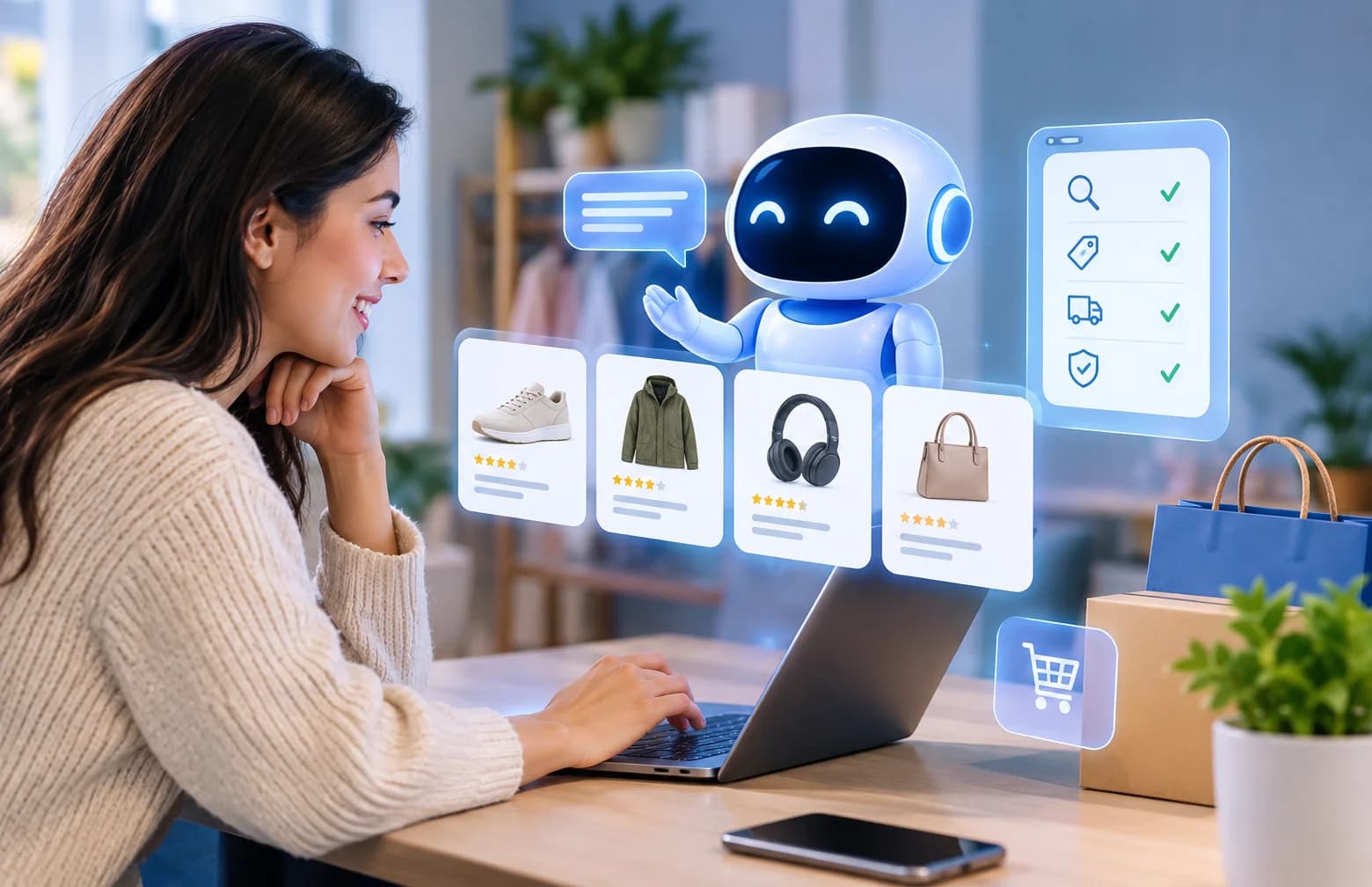
E-commerce personalization has traditionally been built around recommendation engines: customers view a product, the system analyzes behavior, and the storefront recommends something similar.
AI shopping agents take that model considerably further.
Instead of simply suggesting products, an AI shopping agent can interpret what a customer wants, search a catalog, evaluate alternatives, compare specifications, check availability, apply business rules, create a cart, initiate checkout, and support the customer after the transaction.
That shift is already changing digital commerce. Shopify reported that AI-driven traffic to its stores increased eightfold year over year in Q1 2026, while orders originating from AI-powered searches grew nearly thirteenfold.
For retailers, marketplaces, and D2C businesses, AI shopping agent development therefore involves more than connecting an LLM to a product database. It requires a reliable architecture connecting AI reasoning with catalog, pricing, inventory, customer, order, payment, and fulfillment systems.
Here is what that architecture looks like in practice.
What Is an AI Shopping Agent?
An AI shopping agent is an autonomous or semi-autonomous software system that helps customers complete shopping tasks through natural-language interaction.
A user could tell the agent:
“I need waterproof running shoes under $150 for trail running, preferably something available for delivery before Friday.”
A properly designed shopping agent can convert that request into structured constraints, search relevant inventory, compare appropriate products, validate delivery availability, explain the differences, and guide the user toward checkout.
More advanced AI agents for ecommerce can perform actions as well as answer questions. Depending on the permissions provided, they may:
Add or remove products from a cart
Apply eligible offers
Check real-time stock
Compare variants
Retrieve previous purchases
Create an order
Initiate returns
Track shipments
Recommend complementary products
This makes the AI agent fundamentally different from a conventional chatbot.
A chatbot primarily responds. A shopping agent reasons, uses tools, maintains context, and takes controlled actions.
How Does an AI Shopping Agent Work?
At a technical level, the process is usually an agentic workflow rather than a single model request.
Consider a customer asking:
“I need a laptop for video editing under $1,500 with at least 32 GB RAM.”
The system may execute the following sequence:
1. Intent understanding
The language model identifies product category, budget, memory requirement, and intended use.
2. Catalog retrieval
The agent queries structured catalog data, search services, or vector indexes to retrieve suitable products.
3. Business-rule validation
Candidate products are validated against current price, inventory, region, promotions, and other commerce rules.
4. Product reasoning
The model compares shortlisted products against the customer's requirements.
5. Recommendation
The agent explains why particular products fit rather than merely listing search results.
6. Action execution
If the customer asks to proceed, the agent can invoke authorized tools for cart creation, checkout, payment, or order processing.
Modern AI platforms support tool or function calling specifically so models can interact with application functions and external systems rather than relying purely on information encoded in the model.
That tool layer is critical. Inventory, price, tax, shipping, and order status should come from authoritative commerce services, not from the LLM's memory.
Key Features of an AI Shopping Agent
The exact feature set depends on the business model, but most production systems require capabilities across several areas.
1. Conversational Product Discovery
Users should be able to search through intent rather than rigid keywords.
Queries such as “formal shoes for an outdoor summer wedding” contain contextual requirements that conventional site search may struggle to interpret.
An agent can translate this intent into attributes and retrieve suitable products.
2. Personalized Recommendations
Personalization can incorporate:
Browsing history
Previous purchases
Stated preferences
Budget
Size or fit
Brand preferences
Location
Loyalty status
Personal data should only be used with appropriate consent and access controls.
3. Product Comparison
Customers frequently want trade-offs rather than recommendations.
A good agent should be capable of comparing price, dimensions, specifications, reviews, availability, delivery time, warranties, or other structured attributes without inventing missing information.
4. Real-Time Inventory and Pricing
The agent should retrieve availability directly from inventory, ERP, POS, or e-commerce order management software.
Price validation is equally important because promotions, regional pricing, and inventory can change between discovery and checkout.
5. Cart and Checkout Assistance
Higher-autonomy agents can:
Create carts
Update quantities
Select variants
Calculate shipping
Apply eligible coupons
Prepare checkout
For sensitive actions, human confirmation should remain part of the workflow.
6. Order and Post-Purchase Support
The same interface can continue supporting customers after purchase by checking orders, tracking delivery, explaining return policies, or initiating authorized return workflows.
The result is a continuous commerce assistant rather than a pre-purchase chatbot.
Recommended AI Shopping Agent Architecture
Reliable AI shopping agent development usually requires several architectural layers.
Experience Layer
This is where the customer interacts with the agent:
Website
Mobile application
Messaging application
Voice interface
Marketplace
AI-native commerce channel
The interface sends conversational requests to the agent backend and renders recommendations, products, confirmations, and transactional actions.
Agent Orchestration Layer
This layer controls the reasoning workflow.
It typically includes:
LLM
System instructions
Tool registry
Conversation state
Planning logic
Approval checkpoints
Agent memory
Guardrails
The model should not directly manipulate databases or payments. It should request operations through controlled APIs.
Commerce Intelligence Layer
This layer provides the information required to make useful decisions.
Possible sources include:
Product information management systems
Product catalogs
CMS platforms
CRM
Customer profiles
Knowledge bases
Reviews
Policies
Product documentation
Hybrid retrieval is often preferable here. Structured filtering handles exact constraints such as price, size, and inventory, while semantic or vector search can help interpret subjective intent.
Commerce Integration Layer
The agent needs APIs connecting it with operational systems such as:
Shopify
Adobe Commerce/Magento
Salesforce Commerce Cloud
Custom commerce platforms
ERP
CRM
Warehouse management systems
OMS
Shipping providers
Businesses investing in ecommerce software development may expose these capabilities through a dedicated commerce API layer, so the agent is not tightly coupled to individual systems.
Transaction Layer
Transaction services manage high-risk operations including:
Cart creation
Checkout
Payment
Refunds
Order creation
Returns
These operations should be deterministic, auditable, and permission-controlled.
Emerging standards are also making agent-to-commerce integration more interoperable. Shopify and Google, for example, have developed the Universal Commerce Protocol to support transactions between AI agents and merchant systems.
Security and Observability Layer
Every agent action should generate enough telemetry to determine:
What the customer requested
Which tools the agent called
Which data was retrieved
What decision was made
Whether an action succeeded
What the model returned
This becomes especially important once an agent can modify carts, create orders, or interact with customer accounts.
Technology Stack for AI Shopping Agent Development
There is no mandatory stack, but a typical implementation may combine:
Frontend: React, Next.js, Angular, Flutter or native mobile frameworks
Backend: Node.js, Python, Java or .NET
AI layer: LLM APIs or privately hosted models
Agent framework: Custom orchestration or agent frameworks depending on complexity
Search: Elasticsearch, OpenSearch or another search engine
Vector retrieval: Pinecone, Weaviate, Qdrant, pgvector or similar technologies
Databases: PostgreSQL, MySQL, MongoDB, Redis
Commerce integrations: Shopify, Magento, Salesforce Commerce Cloud or custom APIs
Cloud: AWS, Microsoft Azure or Google Cloud
The right technology choices depend more on latency, transaction volume, product complexity, governance, and existing infrastructure than on any single AI framework.
How to Build an AI Shopping Agent
A successful implementation normally starts with the workflow.
Step 1: Define the Jobs the Agent Will Perform
Decide whether the initial agent will handle:
Discovery
Comparison
Recommendations
Cart management
Checkout
Order tracking
Returns
Giving an agent broad autonomy before defining boundaries increases both development complexity and operational risk.
Step 2: Prepare Commerce Data
Product information needs consistent attributes, descriptions, categories, pricing, inventory identifiers, and variant relationships.
An intelligent model cannot reliably compensate for poor product data.
Step 3: Build the Commerce APIs
Expose product search, inventory, customer, cart, order, and fulfillment functions through secure APIs.
For companies with legacy systems, this integration work can represent a significant part of e-commerce applications software development.
Step 4: Build the Agent and Tool Layer
Define the agent's instructions, available tools, tool schemas, memory policies, and execution constraints.
Sensitive functions should incorporate validation and explicit customer confirmation.
Step 5: Add Retrieval and Recommendation Logic
Combine semantic understanding with deterministic filters and business rules.
The AI should reason over validated commerce data rather than generate product facts independently.
Step 6: Test Agent Behavior
Testing should include more than response quality.
Teams should evaluate:
Hallucinations
Incorrect tool selection
Invalid product recommendations
Prompt injection
Unauthorized actions
Pricing discrepancies
Stock inconsistencies
Multi-turn conversation failures
Checkout edge cases
Step 7: Deploy With Monitoring
Production monitoring should measure task completion, conversion, tool errors, response latency, escalation rates, token consumption, and failed transactions.
These metrics make it possible to continuously improve both customer experience and operational economics.
How Much Does AI Shopping Agent Development Cost?
The cost depends heavily on how much of the commerce journey the agent controls.
A useful indicative range is:
Scope | Approximate Development Cost |
|---|---|
Shopping agent MVP | $25,000–$50,000 |
Production-grade single-store agent | $50,000–$100,000 |
Advanced multi-system commerce agent | $100,000–$200,000 |
Enterprise/multi-market agentic commerce platform | $200,000+ |
Note: These are directional estimates rather than fixed market prices.
A recommendation assistant connected to one catalog is substantially easier to build than an enterprise agent coordinating inventory, CRM, pricing, checkout, payments, fulfillment, and returns across multiple markets.
The biggest cost drivers generally include system integrations, catalog size, recommendation complexity, personalization, agent autonomy, payment workflows, custom UX, security requirements, multilingual support, and production-scale infrastructure.
Businesses should also account for ongoing model inference, cloud infrastructure, monitoring, search infrastructure, and maintenance costs after launch.
Building AI Shopping Agents for Production, Not Just Demonstrations
The easiest part of an AI commerce project is usually getting a model to recommend a product.
The difficult part is making the system reliably understand customer intent, retrieve accurate commerce data, respect operational rules, use enterprise systems safely, recover from failed actions, and complete transactions without creating new risk.
That is why AI e-commerce development increasingly overlaps with API engineering, data architecture, commerce modernization, AI agent development, security engineering, and platform integration.
For organizations evaluating AI in e-commerce, the best starting point is rarely a fully autonomous purchasing agent. A more practical approach is to identify one high-value shopping workflow, connect the agent to authoritative commerce systems, introduce controlled actions, measure performance, and expand autonomy once the foundation is proven.
At Seasia Infotech, we approach AI shopping agents as commerce systems first and AI interfaces second to combine digital commerce services, custom software engineering, AI integration, and enterprise architecture to build agents that can operate safely inside real-world commerce workflows.