Building in-house machine learning capacity is currently one of the slowest, most expensive bets in corporate technology. A typical recruitment pipeline for specialized roles, such as distributed systems architects, MLOps practitioners, and senior data engineers, stretches past six months, often only to stall over compensation bidding wars or sudden attrition.
Meanwhile, fallback staffing approaches fall flat. Generalist IT staff augmentation invoices for open-ended hours while spending 90 days learning your business context. These delays stall multi-million-dollar modernization roadmaps.
To move past this capacity bottleneck, engineering leaders are shifting toward a more disciplined delivery model: AI Pods as a Service.
Defining AI Pods as a Service: Team, Tooling, and Governance
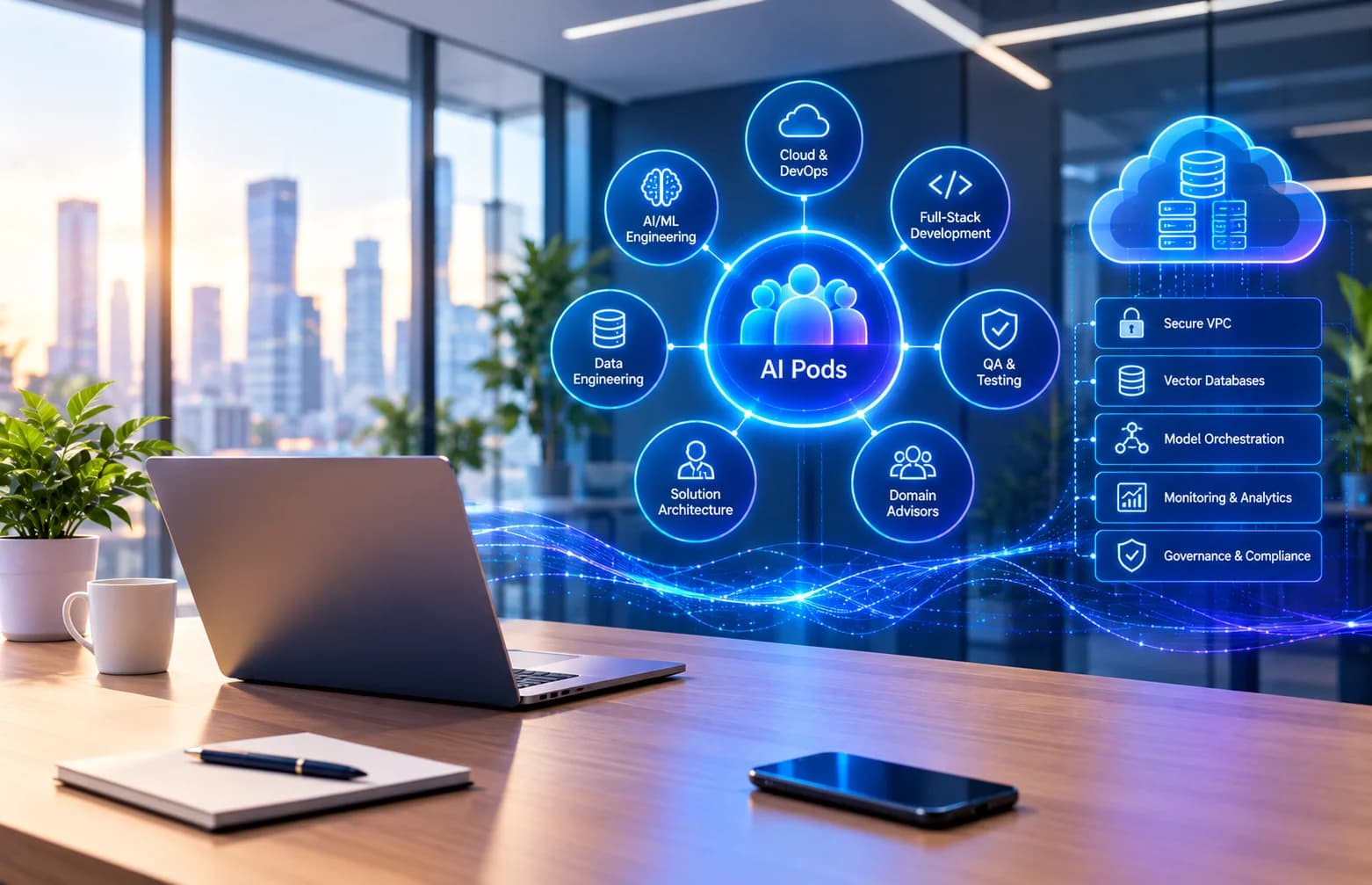
An AI Pod is not a collection of disconnected contractors assembled on short notice. It is a self-contained, multi-disciplinary engineering unit: solution architects, AI/ML engineers, full-stack developers, QA specialists, and domain advisors contracted as a turnkey capacity service with outcome-based milestones.
Unlike conventional software squads, these teams are AI-enabled by design. From day one, the pod operates with embedded engineering automation: automated pull-request reviews, synthetic test generators, and runtime deployment intelligence. They run on structured delivery rhythms, cutting out the typical organizational setup time.
Delivery Dimension | Traditional In-House Hiring | Standard Staff Augmentation | AI Pods as a Service |
|---|---|---|---|
Time To Execution | 4 to 6 months of recruiting, hiring, and onboarding | 4 to 8 weeks; loses 2–3 months learning business context. | Day 1 deployment via pre-configured stacks and workflows. |
Tooling & Accelerators | Built from scratch internally using trial-and-error budgets. | Relies on whatever disparate tools individual contractors know. | Pre-integrated delivery toolchains and AI copilots. |
Core Accountability | Rests solely on internal engineering management. | Headcount delivery with zero outcome accountability. | Governed milestone delivery backed by release intelligence. |
Operational Elasticity | Rigid overhead; painful and expensive to restructure. | Headcount scales up or down, but project knowledge is lost instantly. | Scalable squad capacity aligned directly to roadmap phases. |
Core Capabilities: From Private Retrieval to Multi-Agent Workflows
Modern enterprise AI development demands far more than basic API wrappers around public foundational models. Pods build deep architectural plumbing that keeps corporate IP secure while solving real business problems.
Generative AI and Private Retrieval
Building reliable Generative AI development services starts with protecting company information. Pods set up Retrieval-Augmented Generation (RAG) pipelines that run against isolated vector stores and private network boundaries.
They structure document parsing routines, implement semantic chunking models, and enforce role-based access controls. This ensures an internal operations engine answers queries using verified enterprise documentation without exposing private financial tables or HR records to public models.
Autonomous Agentic Workflows
Enterprise systems are moving past single-prompt conversational interfaces. AI Agentic Development focuses on coordinated, multi-step execution. Instead of merely generating text, autonomous agents interpret goals, break down workflows, call internal microservice APIs, parse responses, and handle errors.
Engineering pods design these agent networks with deterministic fallback boundaries. If an agent encounters an edge case during automated policy evaluations, it routes the entire transaction history to a senior underwriter rather than guessing.
Data Plumbing and Legacy Decoupling
AI algorithms are only as dependable as the pipelines feeding them. Engineering pods build the data plumbing needed to connect dirty, distributed corporate data to production models.
They build streaming event ingestion, eliminate duplicate records, transform proprietary schemas into modern formats, and wrap legacy databases in clean REST or GraphQL endpoints. This foundation gives inference models steady access to live operational context without crashing underlying transactional systems.
The Governance Engine: Release Intelligence Over Gut Feel
The biggest risk in deploying AI software development services is not technical capability; it is lack of governance. Unchecked automated code generation frequently leads to unvetted open-source dependencies, subtle security holes, and severe technical debt.
Reliable delivery frameworks replace subjective developer status updates with hard telemetry. Production readiness should depend on measurable thresholds: automated test coverage percentages, dependency health scores, and pipeline rollback stability.
At the same time, software automation must never outrun human judgment. Machines accelerate code drafting, run test suites, and monitor runtime telemetry. Experienced human architects retain sole sign-off over system design, data boundaries, and final production deployments.
When to Deploy an AI Pod: Enterprise Scenarios
Not every software project requires a dedicated, multidisciplinary pod. However, this delivery model fits distinct high-friction enterprise scenarios:
1. Accelerating Core Product Roadmaps
When an internal engineering department spends all its time maintaining legacy infrastructure, strategic AI initiatives stall. A dedicated pod acts as an independent capacity arm. It designs, builds, and deploys specialized capabilities such as an automated risk-scoring pipeline without pulling your existing staff away from core day-to-day operations.
2. Refactoring Monolithic Applications
Ripping out decades-old legacy code all at once carries massive operational risk. Pods handle modernization incrementally. Using automated code parsing and synthetic test generation, the pod maps legacy dependencies, extracts hidden business logic, and wraps old databases in secure microservices. Everyday operations continue uninterrupted while the background codebase modernizes.
3. Deploying Custom Decision Platforms
Many organizations want to combine disparate data streams ERP inventories, IoT telemetry, and live order records into unified operational intelligence. An AI pod builds end-to-end platforms that run forward-looking simulations, helping operations directors route shipments, allocate inventory, or identify anomalies before downtime hits the factory floor.
Governed AI Engineering with Seasia Infotech
For years, Seasia Infotech has designed, built, and shipped software across every layer of the enterprise stack. That deep experience powers our AI development team-as-a-service model: cross-functional squads structured around governance, velocity, and measurable outcomes.
Human Accountability Governs AI Speed
Every Seasia Pod follows a clear rule: expert humans own architecture, quality, and outcomes, while AI copilots accelerate execution. Automated agents speed up boilerplate code generation, unit test coverage, and pipeline telemetry. Meanwhile, our senior solution architects retain sole authority over technical design patterns, regulatory compliance, and live production cutovers.
Data-Backed Release Confidence
Instead of relying on subjective developer standups, technical decision-makers receive objective Release Confidence Scores. Evaluated against test coverage, code health signals, and infrastructure readiness, this telemetry provides concrete go/no-go recommendations that minimize deployment risks.
Proven Industry Depth
Seasia deploys pre-configured engineering pods for compliance-heavy environments. Whether architecting HIPAA-aligned health record processing, building immutable transaction logs for FinTech platforms, or parsing complex legal documents, our squads ship software that meets strict regulatory standards.
Deep Technical Capabilities and Architecture Patterns
Enterprise organizations operating at scale cannot rely on simplistic proof-of-concept scripts. Moving models into mission-critical pipelines requires specialized engineering patterns designed for high concurrency, zero data leakage, and low latency:
Model Orchestration and Routing
Enterprise systems rarely depend on a single model. Pods build intelligent gateway routers that evaluate user intent, cost, and latency budgets before directing requests to small specialized models, domain fine-tuned checkpoints, or larger general models.
Vector Database Lifecycle Management
Unstructured documents undergo continuous updates, revisions, and deprecations. Engineering pods design automated embedding re-indexing routines, metadata filtering layers, and semantic caching layers (like Redis or Qdrant) to reduce vector query overhead and cut external API costs.
Private Virtual Cloud (VPC) Model Isolation
Regulated organizations mandate that proprietary datasets never traverse third-party inference endpoints. Pods provision dedicated GPU instances (e.g., via AWS SageMaker or Azure ML) behind strict private endpoints, enforcing encryption in transit (mTLS) and encryption at rest (KMS-managed keys).
Continuous Evaluation and Regression Suites
AI behavior drifts as inputs shift. Pods implement automated evaluation harnesses that continuously test production outputs against curated benchmark datasets, scoring response factuality, coherence, and safety before releases enter production pipelines.
Operational Mechanics: Pod Lifecycle and Squad Dynamics
An AI Pod delivers velocity because its internal roles and communication cadences are engineered specifically for machine learning lifecycles rather than generic web development sprints:
Architecture & Alignment: Squads review milestone objectives, evaluate model drift logs, and prioritize technical debt backlogs before coding begins.
Governed Sprints: Pod engineers build streaming data pipelines, generate synthetic test suites, and conduct automated code reviews in parallel.
Telemetry Monitoring: InfraLens and Bugbot track continuous integration changes in real time, validating dependencies against infrastructure limits.
Release Gates: Weekly cycles culminate in calculating objective Release Confidence Scores, giving human architects verifiable data for go/no-go decisions.
Dedicated Squad Roles
Rather than assigning a developer to double as an MLOps engineer, an AI Pod provides clear operational divisions:
Lead AI Architect: Owns overall system topology, model selection, interface contracts, and security architecture.
Data & Pipeline Engineer: Builds high-throughput ingestion jobs, data cleaning transforms, and automated vector store updates.
AI/ML Full-Stack Developer: Implements application logic, connects REST/gRPC endpoints, and manages agentic tool-use loops.
Quality & Validation Engineer: Writes regression test suites, validates synthetic data benchmarks, and audits model outputs for edge-case errors.
MLOps/DevOps Specialist: Oversees container orchestration, manages CI/CD automation via DevOpsGenie, and monitors live runtime telemetry.
Comparison: Economic and Resource Allocation Impact
Deciding how to source enterprise AI talent requires examining the total cost of ownership across hiring cycles, software tooling licenses, and operational ramp times:
Operational Variable | Direct Headcount Hiring | Commodity Staffing | AI Pods as a Service |
|---|---|---|---|
Initial Recruiting Expense | 20% to 30% recruiter fees per senior hire; massive executive search costs. | Low initial placement cost, but variable contractor markups. | Zero recruiter fees; turnkey operational subscription model. |
Tooling & Infrastructure Sunk Costs | Months spent buying and configuring disparate monitoring and CI/CD tools. | Client must purchase and provision all developer environments. | Pre-bundled platforms (Bugbot, DevOpsGenie, InfraLens) ready on Day 1. |
Knowledge Retention & Continuity | Individual attrition wipes out core institutional memory. | Contractor turnover resets technical understanding to zero. | Squad-level continuity; documentation and workflows remain in the pod. |
Time to First Production Release | 6 to 9 months typical ramp time across multiple hiring waves. | 3 to 4 months due to unmanaged onboarding and lack of governance. | 2 to 4 weeks to initial governed staging release. |
Implementation Roadmap: Deploying an Enterprise AI Pod
Adopting an AI Pod model does not mean overhauling your entire development department overnight. It works best through an iterative, phased rollout:
Phase 1: Architecture and Boundary Alignment
Define business goals, outline API connectors, set privacy controls, and determine quantifiable milestones.
Phase 2: Pod Provisioning and Stack Setup
The squad deploys with pre-configured container environments, embedded testing agents, and telemetry frameworks ready to integrate with your existing codebase.
Phase 3: Governed Execution and Scaling
The pod works through defined sprint cycles. Progress is tracked through automated test coverage and Release Confidence Scores, giving leadership the flexibility to adjust squad capacity as the roadmap matures.
Enterprise technology moves too quickly to let open job requisitions or multi-month vendor onboardings hold back your strategy. Adopting AI Pods as a Service gives you immediate access to seasoned engineering capacity, proven automation tools, and the architectural governance needed to deliver production-grade software.
Review your current project backlog to identify where delivery is stalling. Connect with our software architects to review your technical requirements and discuss how an AI-native engineering pod can help you ship with confidence.