
The global education industry is in the midst of a digital transformation driven by EdTech trends at a very foundational level. EdTech trends are shaping how learners experience education every day. With technology evolving rapidly, education is becoming more accessible, personalized, and immersive through EdTech trends. According to Grand View Research, the EdTech market was valued at approximately $163.49 billion in 2024 and is projected to reach $348.41 billion by 2030, growing at a CAGR of 13.3%. These numbers highlight the growing adoption and impact of educational technologies. EdTech trends are driving this transformation.
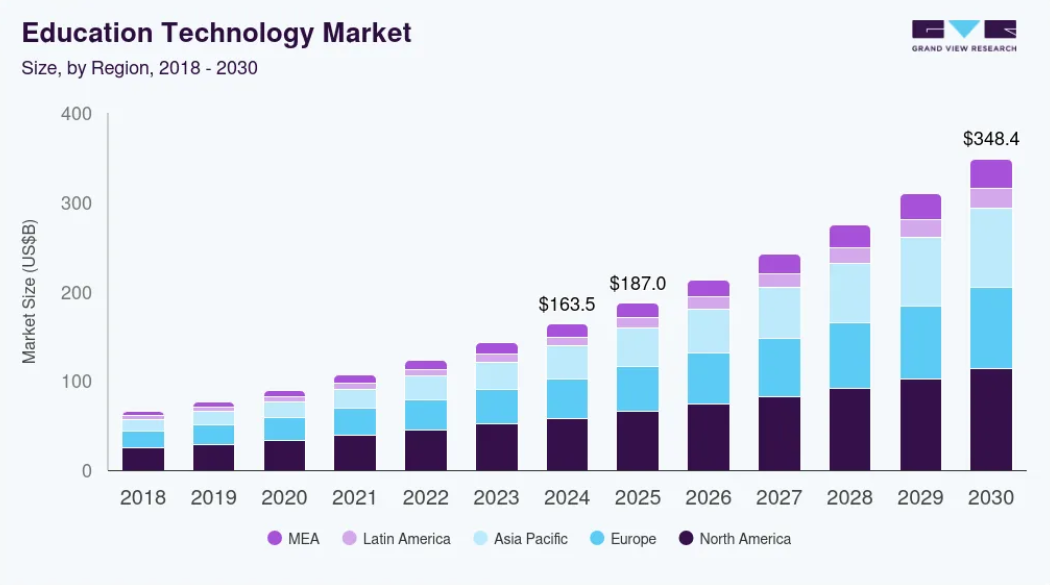
From AI-powered platforms to immersive virtual classrooms, let's take a look at the key EdTech trends redefining the future of learning.
Key EdTech Trends Redefining the Education Industry
1. AI and ML in Education
AI and ML are revolutionizing education through automation, real-time personalization, and intelligent decision-making as part of key EdTech trends. These EdTech trends help institutions personalize learning effectively. The AI in the education technology software market is projected to grow at a CAGR of 38.4%, reaching $7.57 billion by the end of 2025. AI-powered tools such as intelligent tutoring systems, automated grading, chatbots, and predictive analytics are optimizing the teaching-learning process by adapting to each learner's pace and style. Institutions are also using AI to streamline administrative processes to help reduce workload for staff, enhance communication, and improve decision-making.
Moreover, generative AI, as a leading EdTech industry trend, is now acting as a virtual teaching assistant capable of creating dynamic assessments, summaries, and even helping students with assignments in real-time. Developed by Seasia Infotech, SpellQuiz is an EdTech software that leverages AI/ML to offer personalized and adaptive learning to users.
2. VR and AR in Learning
Immersive technologies like VR and AR are redefining experiential learning and are among leading EdTech trends. VR and AR are among the most exciting EdTech trends today. The AR/VR education market is expected to grow to $28.70 billion by 2030. These tools simulate real-life scenarios, enabling students to explore environments such as ancient civilizations, human anatomy, or virtual chemistry labs without the risks or resource constraints of physical experiments. In addition to that, education mobile app development services allow instructors to create interactive content for deeper engagement and greater retention.
For instance, several medical schools around the world are using VR to train students in complex surgical procedures, while AR apps like Google Expeditions allow virtual field trips almost everywhere on the planet.
3. Blockchain Technology for Secure Education Records
Blockchain brings transparency, trust, and security to academic credentials as one of the emerging EdTech trends. Blockchain adoption is a key EdTech trend enhancing security. With the blockchain in the education market forecasted to reach $9.39 billion by 2033, institutions are adopting decentralized systems to issue tamper-proof degrees, certificates, and transcripts. This eliminates the need for intermediaries and reduces fraud. Additionally, blockchain allows lifelong learners to maintain a verifiable digital portfolio of their skills, certifications, and credentials, completely altering the way employers assess qualifications. One of the education technology software we developed is Knowledger, a blockchain-based LMS designed to combat academic fraud and ensure secure record-keeping.
4. IoT in Smart Classrooms
The Internet of Things is transforming traditional classrooms into responsive, connected ecosystems. The market for this education technology trend is expected to grow to $61.10 billion by 2034. Smart boards, IoT-enabled sensors, facial recognition systems, and wearable devices allow educators to monitor engagement, attendance, and emotional well-being in real time.
Besides, IoT in the education industry enhances classroom safety, energy efficiency, and interactivity. Teachers can leverage analytics to tailor their instructional approach, while students benefit from customized experiences and on-the-spot assistance.
5. Gamification and Game-Based Learning
Gamification is transforming how students engage with educational content and is a growing EdTech trend. The gamification of the education industry market is projected to reach $18.63 billion by 2033.

From point-based quizzes and leaderboards to interactive simulations, game-based learning in the education industry promotes motivation, competition, and problem-solving. Popular tools like Kahoot!, Quizizz, and Duolingo demonstrate the effectiveness of this trend. Gamified learning is also being integrated into corporate training programs to boost employee engagement and retention.
6. Adaptive Learning Technologies
Adaptive learning education app development services use AI algorithms to deliver content that evolves based on a student's performance and learning patterns. This adaptive learning edtech software market is set to reach $28.36 billion by 2033. By analyzing real-time data, adaptive systems create unique pathways for each learner to help them master concepts at their own pace. This reduces frustration, accelerates learning, and boosts confidence. Platforms like DreamBox, Smart Sparrow, and Knewton are pioneering this approach in K-12, higher education, and test prep sectors. This highlights how EdTech trends are transforming personalized learning.
7. Cloud Computing in Education
Cloud computing is the backbone of remote and hybrid learning environments. Projected to hit $316.7 billion by 2034, cloud-based solutions enable students and teachers to access resources from anywhere, anytime. Learning Management Systems (LMS) like Moodle, Canvas, and Google Classroom leverage the cloud to deliver assignments, track progress, and facilitate collaboration. Cloud platforms also support content storage, video streaming, and integration with third-party apps to enhance scalability and cost-efficiency for institutions.
8. Mobile Learning and BYOD (Bring Your Own Device)
Mobile learning empowers users to learn on the go. With the mobile learning market expected to reach $110.42 billion in 2025, smartphones and tablets have become indispensable educational tools. Educational mobile apps support microlearning, flashcards, language training, and test preparation. Institutions embracing BYOD policies benefit from reduced infrastructure costs and increased student comfort, as learners use familiar devices to engage with content.
9. Learning Analytics and Big Data
The use of data analytics in the education industry is expanding rapidly, with the market projected to reach $42.7 billion by 2032. Learning analytics provide actionable insights into student behavior, participation, and performance. Teachers can identify at-risk students early, adapt content delivery, and personalize support. At the same time, administrators can evaluate curriculum effectiveness and allocate resources efficiently. Big data also drives continuous improvement in digital learning platforms.
10. Social Media in Learning
Social media is evolving into a vital tool for education, supporting communication, collaboration, and knowledge sharing. Platforms like YouTube, LinkedIn Learning, Discord, and Edmodo offer learners a space to connect, ask questions, and exchange resources. Teachers use these platforms to create discussion forums, broadcast live lectures, and post educational content. Social media promotes community-driven learning too and helps break the barriers of conventional classrooms.
However, it also raises concerns about screen time and distraction - areas that educators must navigate wisely.
11. Microlearning and Nano Learning
Bite-sized, focused content delivery meets the needs of modern learners. Microlearning, expected to reach $25.36 billion by 2032, is perfect for fast-paced learning environments. Short videos, infographics, podcasts, quizzes, and other forms of bite-sized, focused content help learners retain information better. Nano learning takes this a step further by focusing on single-objective learning units, ideal for just-in-time training in corporate settings. These methods are increasingly being used for onboarding, compliance training, and soft skill development.
12. Collaborative Learning Platforms
Collaborative platforms encourage students to work together, share ideas, and solve problems collectively. With a projected market value of $270.85 billion by 2031, platforms like Microsoft Teams, Google Workspace, and Zoom are central to modern learning environments. These tools support virtual group projects, breakout sessions, peer assessments, and real-time co-editing. Collaborative learning nurtures critical 21st-century skills like communication, empathy, and leadership.
Bonus Edtech Trend: Lifelong Learning and Upskilling

The rise of online certifications, MOOCs (Massive Open Online Courses), and professional learning platforms has made lifelong learning more attainable than ever, making it one of the fastest-growing EdTech trends today. EdTech platforms like Coursera, Udemy, and edX offer flexible, industry-aligned courses that help professionals stay competitive in an evolving job market. Governments and companies are investing in reskilling programs to bridge talent gaps and empower employees to transition into new roles.

Partnering for the Future of Learning
At Seasia Infotech, we’ve been heavily invested in education mobile application development, helping institutions and edtech innovators harness the full power of technology to stay ahead of emerging EdTech trends. From AI-driven learning platforms and SEL-focused digital platforms such as the Inner Explorer mindfulness app to gamified mobile apps and secure blockchain integrations, our custom software solutions are designed to align with emerging trends and solve real-world challenges in education.
Our work spans across K-12, higher education, vocational training, and corporate learning to ensure scalability, compliance, and user engagement every step of the way. Whether you're looking to build a smart classroom ecosystem, enable adaptive learning, or create a cross-platform mobile app for your institute, our team brings deep domain expertise to every project.
Final Thoughts
These numbers highlight the growing adoption and impact of educational technologies. EdTech trends are driving this transformation. Monitoring EdTech trends helps schools adopt innovative learning solutions. Staying aware of these trends helps institutions stay competitive.The convergence of AI, data, immersive experiences, and mobile access is creating personalized, scalable, and impactful learning ecosystems. As educational institutions, governments, and businesses continue to invest in these technologies, the benefits will extend far beyond the education industry to fuel economic growth, workforce development, and social mobility.
To remain relevant and competitive, stakeholders across the education landscape must embrace these trends, keep track of emerging EdTech trends, adapt to the changing digital environment, and prioritize innovation in teaching methods and delivery models.