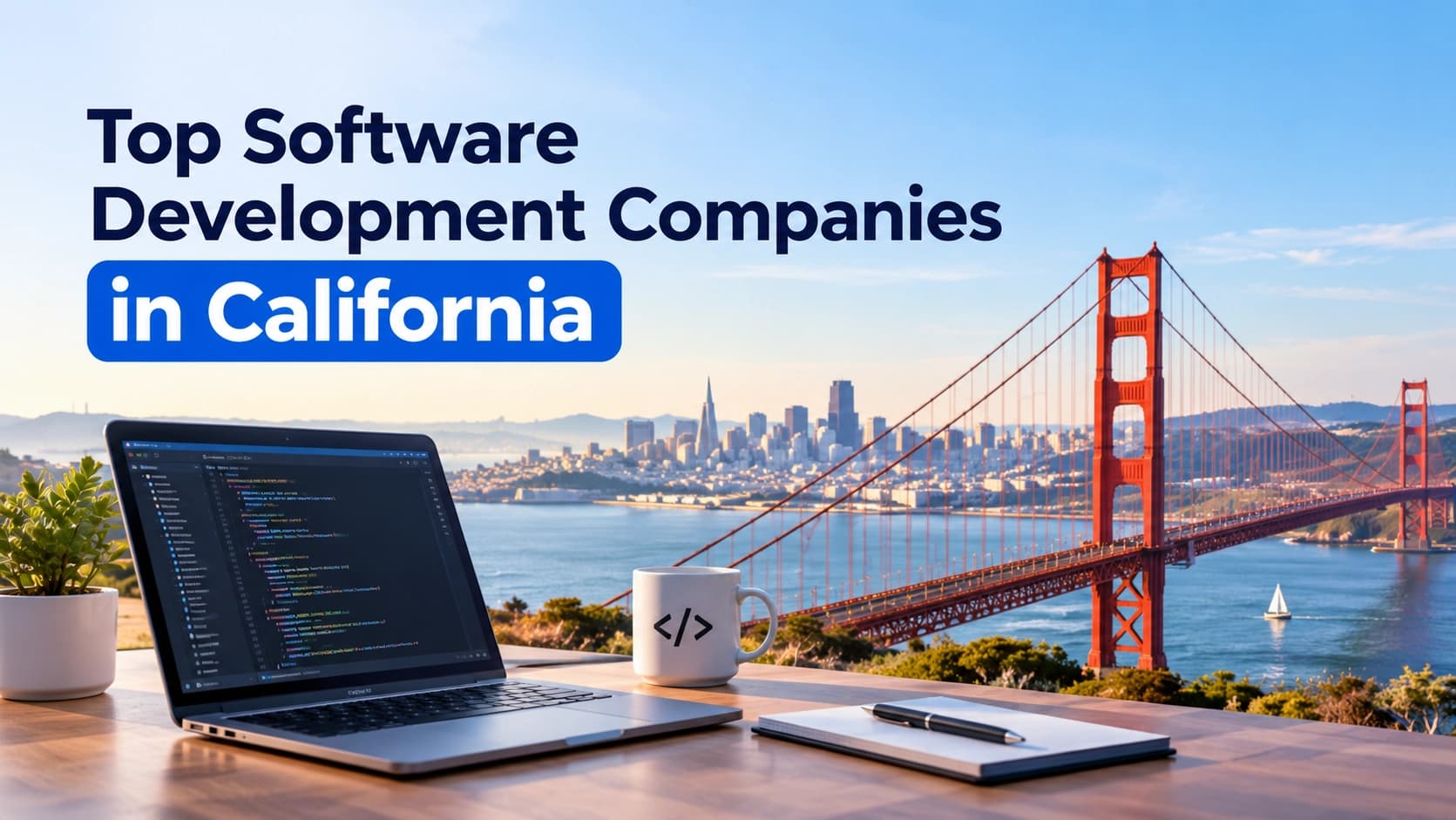
Building production software in California comes with a distinct operational paradox. The state sets the global pace for product velocity, cloud infrastructure, and artificial intelligence, yet hiring locally in San Francisco, Silicon Valley, or Los Angeles often means six-month recruiting cycles, $250,000+ senior engineer base salaries, and heavy equity dilution before a single feature ships.
Whether you are a seed-stage founder racing toward product-market fit or a VP of Engineering modernizing a twenty-year-old enterprise core, expanding internal headcount alone rarely solves the delivery bottleneck. That reality drives technical buyers to evaluate the top software development companies in California, partners that combine local product alignment with scalable engineering capacity.
Not every West Coast vendor solves the same problem. Some operate as rapid UX prototyping studios for early-stage founders, while others run global engineering pods built for regulated enterprise workloads. Selecting among California software development firms requires looking past polished pitch decks and auditing how each partner actually architects, tests, and ships code.
The Four-Axis Vendor Audit Framework
Before comparing individual firms, engineering leaders should evaluate prospective software development services in California across four operational dimensions:
Delivery Topology and Unit Economics
Pure onshore agencies offer effortless timezone overlap but carry steep hourly rates that can exhaust startup runway or enterprise departmental budgets. Hybrid models pairing California-based technical leadership with dedicated offshore or nearshore engineering pods deliver round-the-clock velocity without Bay Area overhead.
Production AI Readiness
Anyone can wire an open-source wrapper to a public API. Mature partners build enterprise AI and custom software solutions featuring tenant-isolated retrieval pipelines (RAG), zero-retention inference endpoints, deterministic guardrails, and human-in-the-loop review gates.
Greenfield Speed vs. Legacy Decoupling
A shop built to launch a consumer mobile MVP in ten weeks rarely possesses the architectural rigor to refactor a monolithic ERP using the strangler-fig pattern without disrupting live transactions. Match the vendor's core muscle memory to your codebase's actual lifecycle stage.
IP Governance and Code Ownership
Confirm clean repository ownership from day one, auditable CI/CD pipelines, SOC 2 Type II or HIPAA compliance readiness, and zero reliance on proprietary black-box frameworks that trap your internal team post-handoff.
Top 10 Software Development Companies in California
Rather than lumping ten fundamentally different agencies into a generic list, the roster below is organized into three functional procurement tiers. Each profile pairs a brief operational overview with a structured technical dossier so engineering leaders can compare delivery models side by side.
1. Seasia Infotech
Based in Emeryville in the San Francisco Bay Area and supported by global delivery centers, Seasia Infotech brings 25+ years of engineering execution to mid-market and Fortune 500 roadmaps. Rather than dropping generic contractors into an unorganized backlog, this custom software development company in California deploys pre-structured, cross-functional AI Pods combining solution architects, full-stack developers, data engineers, and QA specialists under unified technical governance from day one.
Each release is supported by objective Release Confidence scores, not subjective status updates. So, you can rely on Seasia as a partner in regulated sectors such as HealthTech, FinTech, Logistics, and LegalTech.
Delivery Model: Hybrid Onshore-Lead + Global Cross-Functional AI Pods
Core Engineering Stack: Enterprise AI/RAG pipelines, cloud-native modernization, custom web/mobile platforms, and legacy ERP orchestration
Best Fit For: Mid-market and Fortune 500 teams modernizing core systems or deploying governed AI without Bay Area engineering overhead
Key Differentiator: Eliminates multi-month onboarding lag using proprietary accelerators DevOpsGenie (CI/CD automation), Bugbot (early defect detection), and InfraLens (dependency auditing) to ship audit-ready production code.
2. Intellectsoft
Intellectsoft is a premier enterprise software development company focused on complex digital transformation, enterprise mobile ecosystems, and connected hardware software. We are headquartered in Palo Alto and San Francisco. The firm partners with healthcare, construction, hospitality, and financial services organizations to replace fragmented legacy workflows with modular, cloud-native platforms.
Delivery Model: Onshore Technical Consulting + Global Delivery Centers
Core Engineering Stack: Enterprise mobile ecosystems, custom API middleware, connected hardware/IoMT, and cloud migration.
Best Fit For: Regulated enterprises in healthcare, construction, and financial services replacing fragmented legacy workflows
Key Differentiator: Focus on strict role-based control of access, end-to-end encryption, and custom integration layers for connecting modern frontends to legacy back-office databases.
3. Simform
Maintaining client-facing hubs in San Francisco and Los Angeles, Simform focuses on cloud-native product engineering, DevOps automation, and large-scale data engineering. Ranked among leading enterprise software development companies, Simform helps growing technology businesses and established enterprises re-architect monolithic applications into microservices on AWS, Azure, and GCP.
Delivery Model: US-Led Co-Engineering + Distributed Product Pods
Core Engineering Stack: Cloud-native microservices (AWS/Azure/GCP), DevOps automation, and large-scale data engineering
Best Fit For: Growth-stage tech firms and enterprises re-architecting monolithic applications for high-concurrency throughput
Key Differentiator: Pairs dedicated delivery leads with cloud architects to improve system throughput, optimize cloud spend, and automate deployment pipelines.
4. BairesDev
Operating out of San Francisco and Campbell, BairesDev has built one of the largest nearshore engineering networks aligned with Pacific Time. For CTOs with strong internal product management and architectural leadership, this custom software development company in California provides rapid staff augmentation and dedicated software teams across web, backend, and mobile stacks.
Delivery Model: Nearshore Staff Augmentation & Dedicated Squads
Core Engineering Stack: Full-stack JavaScript, Python, Java, .NET, and native mobile frameworks
Best Fit For: CTOs with established internal product leadership who need rapid, Pacific-aligned engineering headcount
Key Differentiator: Operates a large nearshore talent network working within US business hours, bypassing six-month California recruiting cycles.
5. Azumo
Headquartered in San Francisco, Azumo specializes in nearshore software development with a concentrated focus on data engineering, cloud applications, and intelligent automation. Positioned among practical AI software development companies in California, Azumo builds custom conversational interfaces, predictive analytics pipelines, and Python-based backend architectures.
Delivery Model: Nearshore Dedicated Engineering Teams
Core Engineering Stack: Python backends, data engineering pipelines, conversational AI, and cloud applications
Best Fit For: Companies building intelligent applications and predictive analytics tools that require synchronous daily collaboration
Key Differentiator: Aligns data engineers and AI specialists directly with Pacific Time sprints, live architecture reviews, and continuous code collaboration.
6. Closeloop Technologies
Based in Mountain View in the heart of Silicon Valley, Closeloop Technologies operates as a custom software development company in California, delivering custom product engineering, enterprise SaaS development, and ecosystem integrations. Mid-market enterprises and scaling startups engage Closeloop when their roadmap requires both a customer-facing digital product and tight bidirectional synchronization with internal revenue and operations platforms.
Delivery Model: Hybrid Silicon Valley Management + Offshore Engineering
Core Engineering Stack: Custom SaaS platforms, Salesforce/NetSuite integrations, and cloud ERP automation
Best Fit For: Mid-market companies needing a customer-facing digital product in sync with internal revenue and operations suites.
Key Differentiator: Bridges custom web and mobile builds with deep bi-directional integration to the enterprise CRM and ERP ecosystems.
7. Goji Labs
Headquartered in Los Angeles, Goji Labs operates as one of the premier startup software development partners for venture-backed founders and non-technical entrepreneurs. Their teams focus on de-risking 0-to-1 launches, helping early-stage companies validate core user journeys, build clean web and mobile MVPs, and establish scalable technical foundations ahead of institutional funding rounds.
Delivery Model: Onshore Product Strategy + Distributed Engineering
Core Engineering Stack: Web/mobile MVPs, interactive UI/UX design systems, and scalable startup backends
Best Fit For: Venture-backed founders and non-technical entrepreneurs validating 0-to-1 digital products
Key Differentiator: De-risks early launches through intensive user research and clickable prototyping before committing engineering hours to production code.
8. Sidebench
Based in Santa Monica, Sidebench blends management consulting rigor with digital product design and custom engineering. Frequently tapped by enterprise innovation labs and funded digital health ventures, this custom software development company in California specializes in translating ambiguous business problems into structured product roadmaps and intuitive customer interfaces.
Delivery Model: Onshore Strategy, Design & Engineering Studio
Core Engineering Stack: HIPAA-compliant, mobile apps, enterprise innovation portals, and system integrations
Best Fit For: Digital health ventures and corporate innovation labs translating complex business problems into intuitive user interfaces
Key Differentiator: Combines management consulting rigor with human-centered UX architecture for heavily regulated consumer and clinical apps.
9. Saritasa
Headquartered in Newport Beach in Orange County, Saritasa functions as a full-lifecycle custom software development company in California, building across web, mobile, IoT firmware, and AR/VR platforms. Unlike pure design studios, Saritasa maintains deep systems-integration capabilities for mid-market operations in manufacturing, logistics, field services, and life sciences.
Delivery Model: US-Managed Full-Lifecycle Engineering Teams
Core Engineering Stack: Custom web/mobile software, IoT firmware, and AR/VR operational tools
Best Fit For: Mid-market operations in manufacturing, logistics, and field services stabilizing or expanding custom software
Key Differentiator: Routinely takes over aging, under-documented codebases to audit and stabilize performance before building net-new operational modules.
10. Airdev
Headquartered in San Francisco, Airdev occupies a distinct niche on this list as a specialized no-code and low-code custom software development company in California built around the Bubble platform. While complex, high-concurrency enterprise workloads eventually require traditional code stacks, Airdev remains a practical launchpad for rapid commercial validation.
Delivery Model: Distributed No-Code Product Builders
Core Engineering Stack: Bubble visual programming, API connectors, and rapid workflow automation
Best Fit For: Early-stage founders who care more about getting ultra-fast market validation than bespoke backend code and want to preserve capital.
Key Differentiator: Provides functional SaaS MVPs and internal tools in weeks, not months, with a standardized no-code build framework.
Matching the Engagement Model to Your Company Stage
The key to finding the right partner is matching the vendor's strengths to your current operational bottleneck.
Seed to Series A Startups: Stress the importance of a modular architecture that will not require a full rewrite as customer volume increases, and also the need for fast user validation and clean UX execution. Boutique studios like Goji Labs and low-code builders like Airdev are great for early validation, and hybrid pods help funded startups extend their runway without sacrificing the quality of their code.
Mid-market and growth stage companies: Showcase cloud scalability, automated QA pipelines, and collaboration at the speed of the Pacific. Nearshore squads or hybrid pods work off feature backlogs, and internal architects own core domain logic.
Regulated and Enterprise Organizations: Need robust SOC 2/HIPAA perimeter controls, extensive legacy ERP integration capabilities, and governed AI Pods with measurable milestones and transparent release metrics.
If your roadmap includes accelerating product delivery, modernizing legacy systems, or deploying governed AI workflows without the engineering overhead of the Bay Area, reach out to Seasia Infotech’s architecture team to discuss a dedicated engagement tailored to your technical environment.