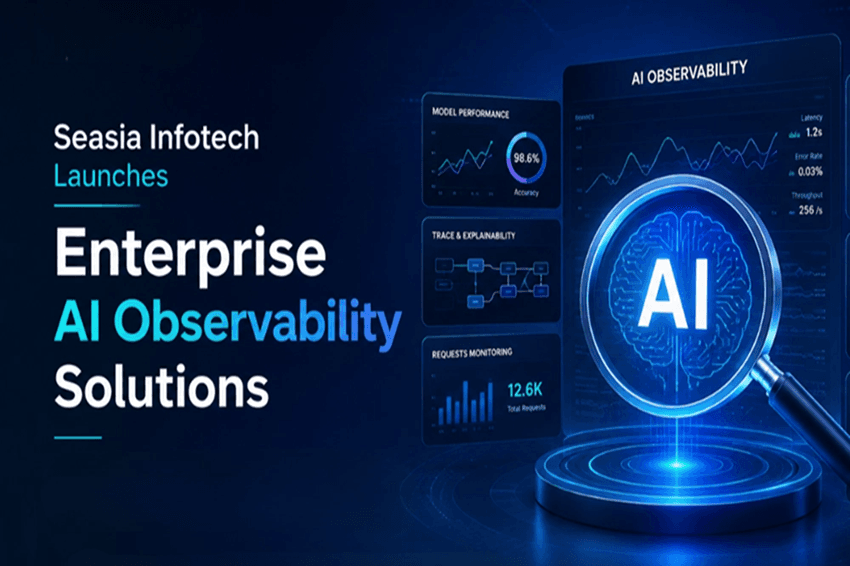
Seasia Infotech, a global technology consulting and software engineering firm, today announced the launch of its proprietary AI agent evaluation framework. The standardized testing architecture is built specifically to address the non-deterministic behaviors, reasoning drifts, and security vulnerabilities that currently prevent enterprise autonomous systems from operating reliably at scale.
As organizations transition from single-prompt large language models to multi-step autonomous workflows, operational failure modes have shifted.
Research from Gartner reveals that while nearly 40% of enterprise applications will embed task-specific AI agents by late 2026, over 40% of agentic AI projects risk cancellation by 2027 due to inadequate risk controls and unquantifiable execution risks.
Systematizing Reliability in Non-Deterministic AI
Unlike legacy software testing, which relies on predictable inputs and static binary assertions, autonomous agents execute multi-turn reasoning chains, dynamically call external APIs, and select software tools autonomously. Standard unit testing cannot identify when an agent selects an incorrect tool parameter sequence or encounters silent drift over repeated interactions.
The new framework integrates directly into broader AI quality engineering services to conduct thorough enterprise AI evaluation across four core operational dimensions:
Trajectory and Tool-Use Verification: Monitors every step in an agent’s execution path to verify API call parameter accuracy, logical step order, and task completion.
Non-Deterministic Regression Testing: Runs multi-trial benchmark scenarios across identical tasks to isolate variance, catching performance drops before software updates reach production.
Policy and Governance Adherence: Evaluates strict boundary compliance, verifying that agents maintain authorized data access limits, deflect prompt injections, and prevent policy violations.
Cost and Latency Optimization: Tracks token utilization, step efficiency, and system response times to prevent infinite execution loops and unmanaged cloud spend.
Key Capabilities Supporting Enterprise AI Deployments
The framework combines robust AI quality engineering services with automated testing environments to provide deep visibility into agent performance:
AI Response Quality Assessment
Measures context retention, factual precision, response consistency, and hallucination rates across complex multi-turn interactions.
Workflow & Action Validation
Verifies API execution accuracy, tool selection correctness, and autonomous decision logic before external actions occur.
Performance Benchmarking
Tracks latency, resource utilization, task completion rates, and system stability under variable transactional loads.
Safety and Risk Analysis
Tests prompt-injection resilience, data privacy boundary controls, compliance adherence, and fail-safe fallback behaviors.
Executive Perspective on Enterprise AI Scalability
"Deploying AI agents into enterprise workflows without continuous evaluation is like launching critical software without continuous integration," said senior spokesperson at Seasia Infotech.
"The challenge in enterprise AI is no longer capability - it is trust and repeatability. Our evaluation framework provides organizations with the quantitative metrics, safety boundary checks, and workflow validation required to move autonomous agents into mission-critical operations with complete confidence."
Bridging the Gap from Strategy to Production Scale
The framework expands the company’s comprehensive portfolio of AI reliability testing and specialized AI agent testing methodologies. By combining continuous trajectory logging with rubric-based scoring, the system enables technical teams to isolate whether workflow failures stem from instruction prompts, integration points, or underlying base model updates.
Designed to operate alongside existing generative AI development services and enterprise AI testing services, the methodology establishes a repeatable release loop. Engineering teams can run automated regression suites after every prompt adjustment or model update, ensuring enhancements do not degrade existing business logic.
For organizations investing in AI agent development services and enterprise AI testing services, this announcement provides a structured path to transition autonomous workloads out of experimental sandboxes and into governed, high-impact business applications.
Supporting Diverse Enterprise AI Use Cases
The evaluation architecture caters to regulated and high-stakes operational environments:
Healthcare AI Applications: Validating automated prior authorizations, clinical documentation summarization, and claims processing accuracy.
Financial Services Automation: Testing autonomous fraud verification, credit risk analysis tools, and regulatory reporting bots.
Enterprise Copilots: Benchmark-testing internal knowledge assistants, automated IT service desk agents, and enterprise ERP co-pilots.
AI-Powered Business Workflows: Verifying multi-agent orchestration across supply chain forecasting and customer support operations.
About Seasia Infotech
Seasia Infotech is a global software and digital transformation partner with over 25 years of experience delivering high-impact solutions. By combining deep domain expertise, Seasia helps complex organizations modernize their technology stacks and deploy AI systems that hold up under real-world enterprise conditions.