After 25+ years of watching healthcare technology evolve, one pattern remains painfully consistent: hospital systems and ambulatory groups keep buying commercial software that works against the clinicians who use it. In the early days of the HITECH Act, health networks rushed to adopt whatever certified platform was available just to qualify for meaningful use subsidies.
The result was a generation of bloated, rigid interfaces built for administrative billing departments rather than bedside doctors and nurses. Today, the operational landscape is radically different. Clinicians are exhausted from clicking through dozens of disjointed screens to sign routine orders, and technology leaders face severe vendor lock-in.
As a result, forward-thinking medical organizations are shifting away from commercial templates. Custom EHR development in USA healthcare ecosystems has shifted from an experimental endeavor to an urgent operational strategy for providers seeking workflow control, data sovereignty, and lasting clinical agility.
The Practical Breakdown of Monolithic Off-the-Shelf Platforms
The primary flaw of boxed commercial software is its architectural premise: it must cater to everyone, which means it satisfies almost no one. These systems prioritize reimbursement rules and payer billing checklists over practical departmental workflows.
When a specialized orthopedic center, an oncology network, or a multi-site ambulatory practice tries to customize these platforms, they encounter rigid database schemas and steep change fees. Physician burnout is the most visible symptom of this architectural friction.
Every veteran healthcare architect knows that forcing doctors to spend three hours of "pajama time" charting after shifts is unsustainable. Off-the-shelf software clutters encounters with non-actionable alert fatigue and endless dropdown menus.
Data governance introduces another major barrier. Closed proprietary platforms restrict direct database access, forcing organizations to pay for limited data extracts or navigate clunky reporting modules. Developing tailored custom EHR software gives providers complete ownership over their patient data models, allowing engineering teams to design clean interfaces that match clinical intuition.
Engineering Foundations: Security, Governance, and Clinical Ontologies
Medical software that’s used in production needs to be built to a far higher standard than typical enterprise applications. Software failures in healthcare affect patient safety, regulatory standing, and clinical operations.
Zero-Trust Cloud Architecture and PHI Governance
Protected health information demands end-to-end isolation. A seasoned engineering team configures every clinical platform under zero-trust assumptions. Data must remain encrypted using AES-256 at rest and TLS 1.3 in transit.
Identity access should use fine-grained, attribute-based controls. No person reviewing treatment protocols as a physical therapist should ever be able to see historical financial balances or sensitive psychiatric evaluations. The platform must also support immutable, write-once audit trails of every chart open, edit, and export event to meet HIPAA, HITECH, and SOC 2 Type II requirements.
Standardized Clinical Coding Engines
Unstructured text blocks ruin clinical analytics and automated billing. A dependable custom records engine maps clinical observations to recognized national terminologies immediately upon chart submission:
ICD-10-CM: Formats diagnostic classifications, injuries, and chronic conditions to support compliant insurance claims.
SNOMED CT: Captures detailed clinical terminology, surgical findings, and patient symptoms during examinations.
LOINC: Standardizes diagnostic laboratory values, vital sign readings, and clinical observations across care teams.
RxNorm: Structures active pharmaceutical ingredients, brand names, and drug strengths to ensure safe prescribing.
CPT & HCPCS: Standardizes procedural tasks, surgical interventions, and equipment billing codes for payer adjudication.
Partnering with an established EHR development company in the USA ensures these clinical libraries remain continually updated. When federal regulators adjust annual terminology tables, the software ingests the revisions without breaking active clinical schedules.
Interoperability and Big-Box Integration Architecture
A clinical platform cannot function in isolation. Modern healthcare operations depend on instant data exchanges between reference laboratories, hospital networks, clearinghouses, and national pharmacy directories. Delivering resilient custom EMR development in USA clinical environments requires building standards-based interoperability engines that support bi-directional data flow.
SMART-on-FHIR and the 21st Century Cures Act
The Fast Healthcare Interoperability Resources standard fundamentally changed how clinical data is exchanged. Instead of parsing complex flat files, systems communicate via structured RESTful resources such as Patient, Encounter, Condition, and Observation.
SMART-on-FHIR layers OAuth 2.0 authorization profiles over these endpoints, enabling specialized clinical apps to launch directly inside the provider interface without secondary authentication steps. Adhering to the Office of the National Coordinator for Health IT Certification criteria and the 21st Century Cures Act Final Rule helps platforms prevent data blocking and remain compliant with federal information-sharing mandates.
Bi-Directional Connectivity with Incumbent Systems
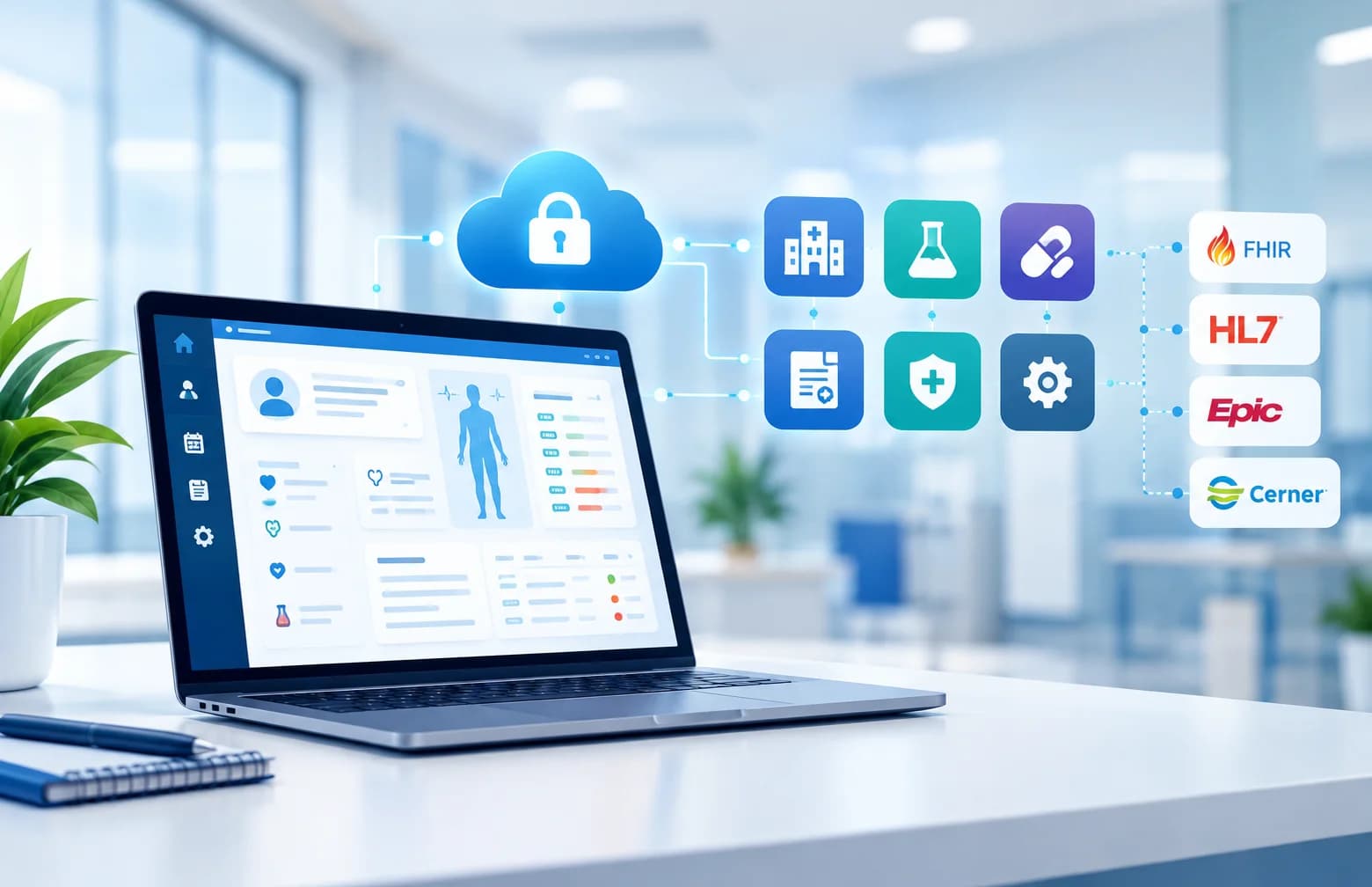
Health systems deal daily with major incumbent platforms like Epic, Oracle Health, athenahealth, and Veradigm. True integration requires deep, bi-directional connectivity rather than one-way document exports:
Incumbent Platform | Core Integration Protocols | Clinical Data Exchanged |
|---|---|---|
Epic Systems | FHIR US Core APIs, App Orchard Connectors | Patient demographics, CCDA summaries, and clinical scheduling slots. |
Oracle Health (Cerner) | Millennium APIs, FHIR R4, and HL7 v2 Messaging | Inpatient lab results, diagnostic vitals, and admission discharges. |
athenahealth | RESTful Webhooks and Partner API Gateways | Encounter summaries, eligibility checks, and billing items. |
Veradigm (Allscripts) | Unity API Gateway and FHIR Adapters | Medication histories, diagnostic orders, and clinical documentation. |
Disciplined custom EMR development in USA healthcare ecosystems involves writing resilient webhook listeners and API brokers. When a specialist completes a consultation note in your platform, that record syncs directly back into the enterprise chart without manual intervention.
Modernizing Legacy EMRs Without Operational Disruption
Replacing an aging legacy system can cause valid anxiety for healthcare executives. A total "rip-and-replace" approach introduces enormous financial risk, workflow disruption, and the potential for clinical errors. Decades of practice show that the most successful transitions rely on incremental strangler patterns rather than abrupt cutovers.
Step 1: Deploying the Modern FHIR API Facade
Instead of attempting a risky database migration on day one, engineers build a secure API wrapper around the legacy system. This facade translates proprietary database tables into modern, secure FHIR endpoints. Modern web applications and mobile tools can read and write patient data without changing the underlying database schema.
Step 2: Isolating Administrative and Outpatient Workflows
When the API broker is trustworthy, developers extract secondary workflows to modern cloud services. First up are digital intake forms, telehealth visits, and billing modules. Doctors keep on charting visits in the familiar core interface, while administrative tasks modernize in the background. This gradual change keeps staff from resisting and keeps the clinic up and running.
Step 3: Decommissioning Monolithic Infrastructure
The last step is bringing core clinical charting and diagnostic ordering into the modern cloud environment. Automated data pipelines move, validate, and transform archived charts into clean, queryable databases. With experienced custom software development services, healthcare networks can safely retire legacy servers and improve architectural stability.
The Economic Variables of Custom Clinical Engineering
Many technical buyers wonder how much custom medical software costs to build. Experienced healthcare architects don't quote flat rates without reviewing technical requirements. Cost in clinical software development is a function of technical complexity, scope of regulation, and depth of integration:
Historical Chart Scope of Data Migration Cleanliness: To pull down a decade of unstructured charts, paper scans, and inconsistent medication lists, we need to build heavy database engineering and automated validation pipelines.
Third-Party Integration Endpoints: A dedicated clinic charting portal is fairly simple. The integration of that portal with Surescripts, reference labs, state registries, and payer clearinghouses requires extensive protocol certifications and testing cycles.
Regulatory Certification Scope: Software for internal clinic operations must be made HIPAA compliant by default. Under the Cures Act, formal ONC Health IT Certification includes a lengthy set of engineering requirements for data exports, reporting tools, and security controls.
Specialty Workflow Complexity: Standard family practices have predictable processes of visits. Some fields, such as surgical ophthalmology and pediatric oncology, require specific tools, including visual anatomical mapping, custom dosage calculators, and advanced multi-phase scheduling systems.
Cloud Infrastructure Resilience: High-volume clinical operations require multi-region database failover, tenant environment isolation, and automated continuous deployment pipelines. Good cloud architecture decisions made early on save expensive engineering rewrites later.
Strategic Comparison: Commercial Software vs. Custom Platforms
The decision between buying off-the-shelf software and building a custom clinical platform shapes an organization's operational roadmap for years. Healthcare executives must weigh initial implementation investments against long-term operational autonomy.
Operational Metric | Off-the-Shelf Commercial Packages | Bespoke Clinical Platform |
|---|---|---|
Workflow Adaptability | Forces clinicians into generic, click-heavy workflows. | Built directly around specific clinical specialties and care team habits. |
Recurring Licensing | Expensive per-provider monthly seat fees and usage markups. | Fixed cloud infrastructure costs; zero per-provider licensing penalties. |
Data Sovereignty | Patient data remains locked in closed vendor ecosystems. | Direct institutional ownership of relational databases and analytics assets. |
Interoperability Reach | Gated API access; expensive custom connectors for third-party tools. | Open FHIR endpoints and custom API adapters built for any partner system. |
Feature Velocity | Dependent on external vendor release schedules and priorities. | Complete freedom to deploy new clinical features as organizational needs change. |
Healthcare organizations that treat technology as a core operational advantage favor tailored platforms. Owning the underlying software makes it far easier to adapt to changing payer rules, clinical protocols, and market expansions.
Building Your Next-Generation Clinical Architecture
To build effective clinical software, you need deep healthcare domain experience, modern interoperability standards, and rigorous regulatory oversight. Monolithic software platforms can stifle clinical productivity, trap patient records in closed systems, and saddle providers with compounding per-seat fees.
Healthcare leaders are increasingly seeing that owning their software infrastructure is the key to long-term operational independence. The first step in a successful clinical build is selecting an experienced engineering partner. In the USA healthcare ecosystem, specialized custom EHR development allows providers to build platforms that fit their exact workflows, instead of having to work within the limitations of commercial systems.
In USA operations, specialized custom EMR development gives teams the architectural agility to modernize legacy records without compromising clinical continuity. Seasia Infotech provides disciplined healthcare software development in USA environments. Our engineering teams develop secure cloud infrastructures, clean FHIR data pipelines, and bi-directional EHR integrations to optimize clinical operations.
We combine clinical expertise with enterprise-grade custom software development to help health systems build platforms that reduce physician burnout and scale to clinical demand. Talk to our healthcare software architects about your technical needs and build a modern clinical platform for your organization.