Most retail chat widgets fail the second a shopper asks a real question. Standard decision-tree bots work fine when someone clicks a button to check store hours or read a static return policy. They fall apart during Black Friday traffic spikes when a buyer asks, "Does this waterproof shell fit over a heavy fleece, and can it reach Denver by Friday?"
Scripted trees dead-end into a support queue, leaving frustrated shoppers to abandon their carts. Modern online retail cannot run on passive FAQ overlays. High-volume digital commerce requires AI chatbot development for eCommerce built as a stateful, API-connected application layer that resolves problems and completes transactions in real time.
The Widget Trap: Why Scripted Bots Break Under Real Retail Loads
Legacy chat tools treat customer conversations like isolated text threads. They match keywords against pre-written scripts without checking live inventory, regional warehouse cutoffs, or customer purchase history. When a storefront scales past a few thousand daily sessions, that disconnect creates massive operational drag.
Support teams end up drowning in repetitive "Where Is My Order?" (WISMO) tickets and manual size exchange requests. Meanwhile, AI chatbots for online shopping that lack real backend access end up hallucinating shipping timelines or promising out-of-stock variants.
Enterprise retail leaders have realized a conversational interface is only useful when wired directly into core commerce operations.
Zero Session Continuity: Basic widgets forget what a customer viewed three minutes earlier, forcing buyers to repeat item names, order numbers, and shipping zip codes.
Static Knowledge Drift: Scraped website text goes stale the moment a flash sale launches, a seasonal promo expires, or regional warehouse stock runs dry.
Dead-End Escalations: When a conversation hits an unscripted edge case, legacy tools dump a cold ticket into a helpdesk queue without passing the conversation history to the human agent.
These operational gaps are solved by AI chatbot development for eCommerce where the conversation is an active backend workflow, not a superficial browser overlay.
Inside a Production Conversational Commerce Engine
To build a production-ready retail assistant, you must move past a simple prompt wrapper to a governed software architecture. Experienced engineering teams anchor eCommerce chatbot development around three technical pillars that keep answers accurate and transactions safe under heavy traffic.
Hybrid Retrieval-Augmented Generation (RAG)
Pure vector search handles broad natural-language intent well, such as a shopper asking for "trail shoes for wet granite." However, vector embeddings alone often miss exact SKU codes, sizing matrices, or live stock flags. Production systems pair dense vector retrieval with strict metadata and keyword filtering so the assistant never recommends an item that sold out ten minutes ago.
Deterministic Policy and Pricing Guardrails
Large language models are probabilistic by nature, which creates financial risk if left unchecked. Programmatic validation layers sit between the model and the customer to block prompt injections and enforce hard business rules. These guardrails prevent the bot from inventing unauthorized discount codes, waiving freight fees outside policy, or misquoting return windows.
Agentic Tool-Calling and State Memory
Modern conversational systems do more than generate text; they execute structured function calls. Through secure APIs, the model queries an order endpoint, checks carrier scan events, and triggers a backend state change within a single session. Persistent session memory ensures the shopper never has to repeat their order number or sizing preferences mid-conversation.
Schema-Validated Function Calls: Every backend action from applying a loyalty voucher to canceling an unshipped line item runs through strict JSON schemas and role-based permission checks.
Latency-Aware Model Routing: Simple catalog lookups route to fast, lightweight models for sub-second responses, while complex multi-item exchange logic escalates to higher-reasoning models.
Automated Fallback Triggers: If confidence scores drop or an upstream API times out, the engine routes the thread to a live specialist without exposing raw error codes to the buyer.
Approaching AI chatbot development for eCommerce with this level of architectural rigor turns a fragile chat window into a dependable commercial system.
The Backend Integration Mesh: Wiring Chat to Core Operations
An intelligent interface is only as reliable as the data contracts feeding it. Purposeful eCommerce software development treats the conversational agent as a native node within the broader enterprise architecture rather than a bolt-on browser script.
Storefront and Headless Commerce APIs
Direct GraphQL and REST pipelines connect the assistant to Shopify Plus, Adobe Commerce, WooCommerce, or custom headless microservices. This allows the system to immediately read product attributes, variant pricing, regional tax rules, and active cart states. When a shopper wants to change a medium jacket to a large in their cart, the bot mutates the cart payload directly.
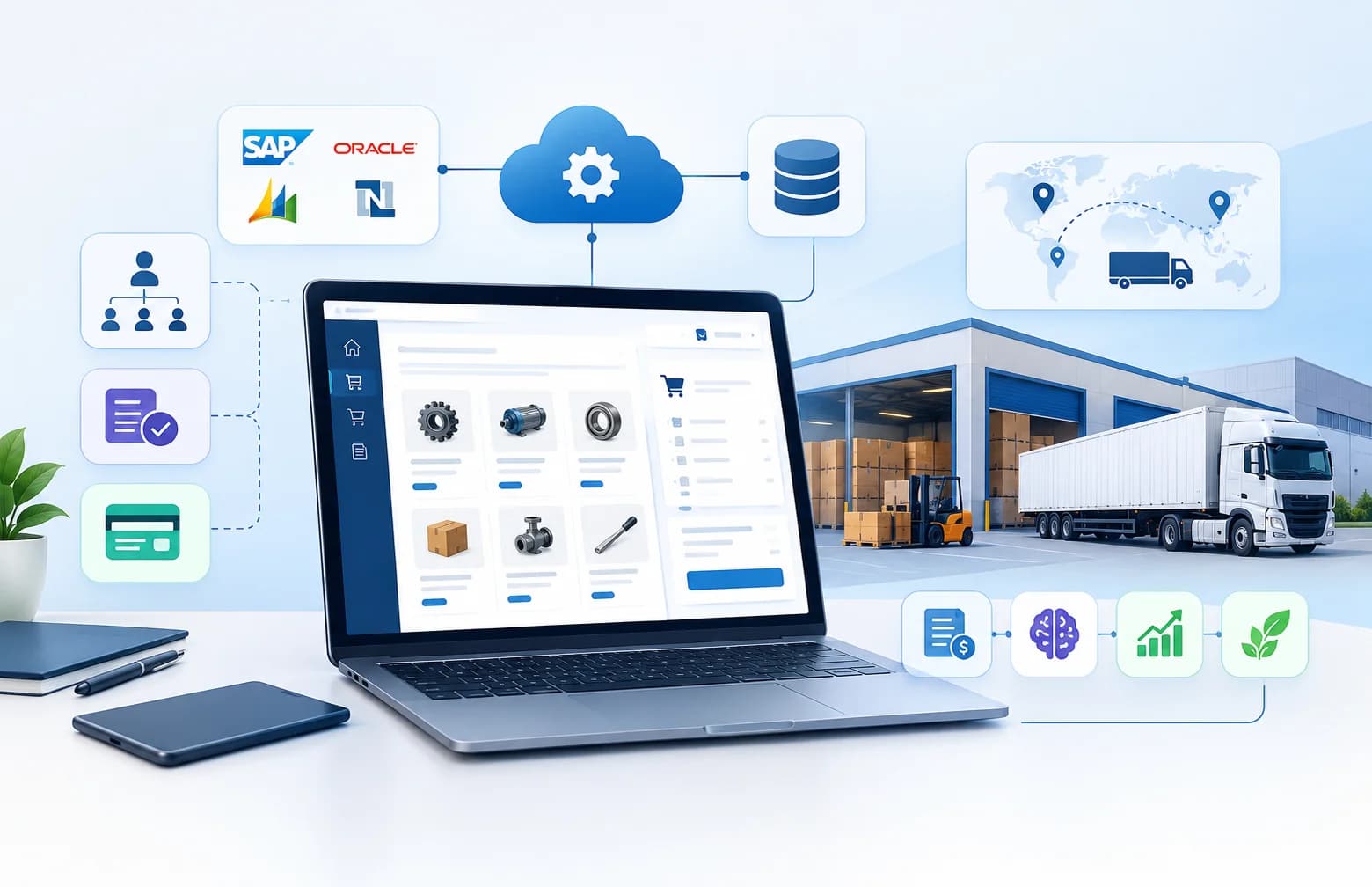
ERP, OMS, and 3PL Synchronization
Bi-directional webhooks to connect chat layer with SAP, NetSuite, or custom Order Management Systems. If the buyer requests a correction to the address prior to the warehouse beginning the pick, the agent will amend the dispatch record in the OMS directly. For returns, it verifies eligibility based on delivery timestamps and creates a prepaid carrier RMA label on the spot.
CRM and Identity Hydration
Authenticated sessions pull loyalty tier status, historical return rates, and lifetime value metrics from the CRM. High-value VIP buyers get bespoke handling, and in any edge case that needs human intervention, the system forwards the full transcript and structured order context straight to a live agent’s console.
Webhook Event Listeners: Real-time order, payment, and shipment events keep the assistant’s context window aligned with the reality of the warehouse floor.
Idempotent API Mutations: Retries on slow mobile networks never cause duplicate refunds, double-charged exchanges, or repeated cancellation requests.
Unified Customer Graph: By combining anonymous browsing sessions with logged in profiles, AI chatbots for online shopping can pick up where a mobile shopper left off on desktop.
Without clean backend plumbing, even the smartest language model remains an isolated toy. Disciplined AI chatbot development for eCommerce bridges that gap by wiring conversational intent straight into operational databases.
High-Margin Transactional Use Cases in Online Shopping
When conversational systems have secure read and write access to backend infrastructure, they shift from cost-center ticket deflectors to direct revenue drivers. Enterprise merchants focus their engineering budgets on three high-return workflows.
Complex Catalog and Compatibility Guidance
In high-SKU verticals like automotive parts, consumer electronics, industrial hardware, or clinical skincare, shoppers frequently abandon carts because they are unsure about fitment. Custom eCommerce chatbot solutions cross-reference technical specification tables and compatibility matrices in milliseconds, guiding buyers to the exact part or regimen that fits their setup.
Autonomous Post-Purchase and RMA Execution
More than half of retail support volume is made up of post-purchase inquiries. Rather than static web forms customers fill out, a connected agent can review real-time carrier telemetry, process instant size swaps against live warehouse counts, and kick off restock workflows without human intervention.
Margin-Protected Cart Recovery and Bundling
The assistant can jump in with targeted cross-sells or shipping upgrades when session telemetry signals checkout hesitation. Rather than blanket twenty-percent coupons that eat into profitability, the agent checks live item margin thresholds and issues incentives only when unit economics are preserved.
Split-Shipment Visibility: Buyers who purchase multiple items get detailed tracking on an item-by-item basis – not one convoluted status report.
Proactive Delay Alerts: If a carrier scan is delayed, we reach out to you first with updated delivery windows and self-service options.
B2B Reorder Acceleration: Wholesale buyers can type in “reorder last month’s filter shipment minus the 10-inch units” and get a pre-populated checkout link in seconds.
Anchoring AI chatbot development for eCommerce around measurable unit economics will help retail teams protect gross margins and reduce support overhead.
Strategic Evaluation: Off-the-Shelf SaaS Widgets vs. Custom Builds
Plug-and-play SaaS chat widgets make sense for early-stage stores with small catalogs and simple shipping rules. However, mid-market and enterprise merchants quickly hit structural and financial ceilings as transaction volume climbs. Investing in custom software development becomes necessary once operational complexity outgrows generic templates.
Owning the underlying orchestration layer eliminates vendor lock-in and lets engineering teams tune latency, model routing, and fallback behavior around exact retail SLAs. An AI chatbot for business built on private infrastructure also ensures sensitive customer addresses, payment metadata, and proprietary pricing tiers stay strictly inside your compliance boundary.
Zero Per-Ticket Penalties: During holiday traffic surges, your cloud compute scales linearly instead of triggering punitive SaaS overage tiers.
Custom Model Flexibility: Engineering teams can swap underlying foundation models as price-to-performance ratios improve without rebuilding frontend widgets or backend connectors.
Full Auditability: Every prompt, retrieved document chunk, and API tool call is logged inside your own observability stack for compliance and quality review.
For enterprises managing complex supply chains and multi-region storefronts, AI chatbot development for eCommerce delivers lasting operational control that rented SaaS tools cannot match.
Implementation Roadmap: From Discovery to Production Cutover
Launching a transactional retail assistant requires disciplined phased delivery rather than an all-at-once release. Experienced engineering leaders roll out conversational commerce in four controlled stages to protect live revenue.
Data and API Readiness Audit: Map every product catalog source, ERP order endpoint, and return policy rule to identify stale data or missing webhook coverage before writing model prompts.
Read-Only Retrieval Sandbox: Deploy the hybrid RAG pipeline against live catalog and order-status endpoints in an internal staging environment, testing accuracy against thousands of historical support tickets.
Scoped Write-Access Pilot: Enable controlled backend mutations such as address updates, cart additions, and standard RMA label generation for a capped percentage of live storefront traffic.
Continuous Evaluation and Scaling: Monitor deflection rates, average order value lift, and latency metrics in production, expanding into proactive cart recovery and omnichannel messaging (WhatsApp, SMS, mobile apps) once accuracy thresholds hold steady.
Treating AI chatbot development for eCommerce as an iterative engineering program keeps risk low while proving ROI at every milestone.
Engineering Execution and Delivery Governance with Seasia Infotech
Without robust engineering governance, deploying autonomous customer-facing agents can expose you to brand and financial risk. One hallucinated discount policy or broken API timeout during a product drop can cost thousands in lost orders and manual cleanup.
At Seasia Infotech, we eliminate experimental guesswork by deploying cross-functional AI Pods: dedicated squads of solutions architects, AI/ML engineers, data engineers, and QA specialists who build production-ready AI chatbot development services from day one.
Our teams use domain-grounded retrieval architectures and proprietary delivery accelerators like Bugbot and InfraLens to detect integration bottlenecks early. Automated evaluation harnesses run against every conversational workflow, measured against strict release confidence scores for accuracy, latency, and security before ever touching live customer traffic.
Ready to swap out inflexible storefront widgets for one unified conversational commerce engine? Collaborate with the software development team at Seasia Infotech to architect AI Chatbot development for eCommerce, customized to your catalog, ERP, and fulfillment processes.