Consumer shopping carts fall apart when exposed to enterprise trade.
Most off-the-shelf stores assume one buyer with a credit card picks a single item off a digital shelf. Real corporate purchasing never works like that. It involves complex procurement rules, multi-tier corporate hierarchies, line-item tax exemptions, and strict credit limits.
Scaling wholesale, manufacturing, or distribution operations requires dedicated enterprise B2B eCommerce platform development built to support deep commercial logic.
The Multi-Tier Bottleneck: Why Consumer Storefronts Fail Enterprise B2B
Enterprise buyers run on strict corporate hierarchies. A plant supervisor creates a requisition, a department manager approves the cost center budget, and accounts payable settles the balance on pre-negotiated credit terms.
Consumer grade engines treat this flow like an edge case. They force business clients into single-user profiles that cannot mirror real operational departments. When high-volume distributors try stretching off-the-shelf software to handle corporate clients, core operational systems break down:
Parent-Child Corporate Accounts: Headquarters requires complete visibility into total spend, while regional subsidiaries, field offices, and job sites require isolated order histories and separate billing profiles.
Multi-Tier Approval Routing: Any purchase over a certain dollar amount will automatically be held and routed to the appropriate department manager for sign-off before a credit card can be charged.
Contract-Specific Terms: Commercial buyers have Net 30, 60, or 90 terms, line-item tax exemptions, and dedicated purchase orders (POs) that generic checkouts can’t natively parse.
Wholesale buyers now demand the speed of digital self-service, backed by their negotiated contract terms. They want to log in, see their agreed contract pricing, check regional stock, and place bulk orders in seconds.
Standard shopping carts cannot provide this without breaking. Modern operations require purpose-built enterprise B2B eCommerce platforms designed from the ground up to support how organizations buy.
Core Architectural Pillars of Custom B2B Commerce Engines
Designing for complex account structures is part of building a serious B2B platform. The software must map multi-tier corporate relationships where a single parent enterprise owns regional subsidiaries, distinct branches, and separate delivery sites. Each entity will have its own role-based permissions, spending limits, and order history.
Enterprise trade prices never stand still. Order volume, annual commitments, and negotiated rebate tiers mean different customers pay significantly different prices for the same catalog parts. Organizations rely on custom B2B eCommerce solutions and get dedicated matrix-pricing engines:
Dynamic Matrix Pricing Calculators: Real-time comparison of line items against customer contract parameters without impacting database performance.
High-Concurrency Batch Ordering: Procurement leads don’t open individual catalog pages. They upload CSVs with multiple lines or paste in hundreds of SKUs to batch-order interfaces that can consume payloads without timing out.
Integrated Quote-to-Order Workflows: Integrated quote-to-order workflows allow buyers and account managers to counter-offer line items asynchronously, freeze agreed quotes, and turn approvals into active orders with a single click.
Dedicated B2B eCommerce software development accommodates these complex transactions, handling large batch orders and contractual nuances without system latency.
The Enterprise Integration Mesh: Connecting the Core Backend
An eCommerce storefront's reliability is only as good as the backend systems that power it. If an online order doesn’t immediately post to the corporate general ledger or warehouse queue, fulfillment stops. The successful implementation of a deep B2B eCommerce platform across your operational systems.
Modern enterprise eCommerce solutions connect transactional touchpoints to core operations directly:
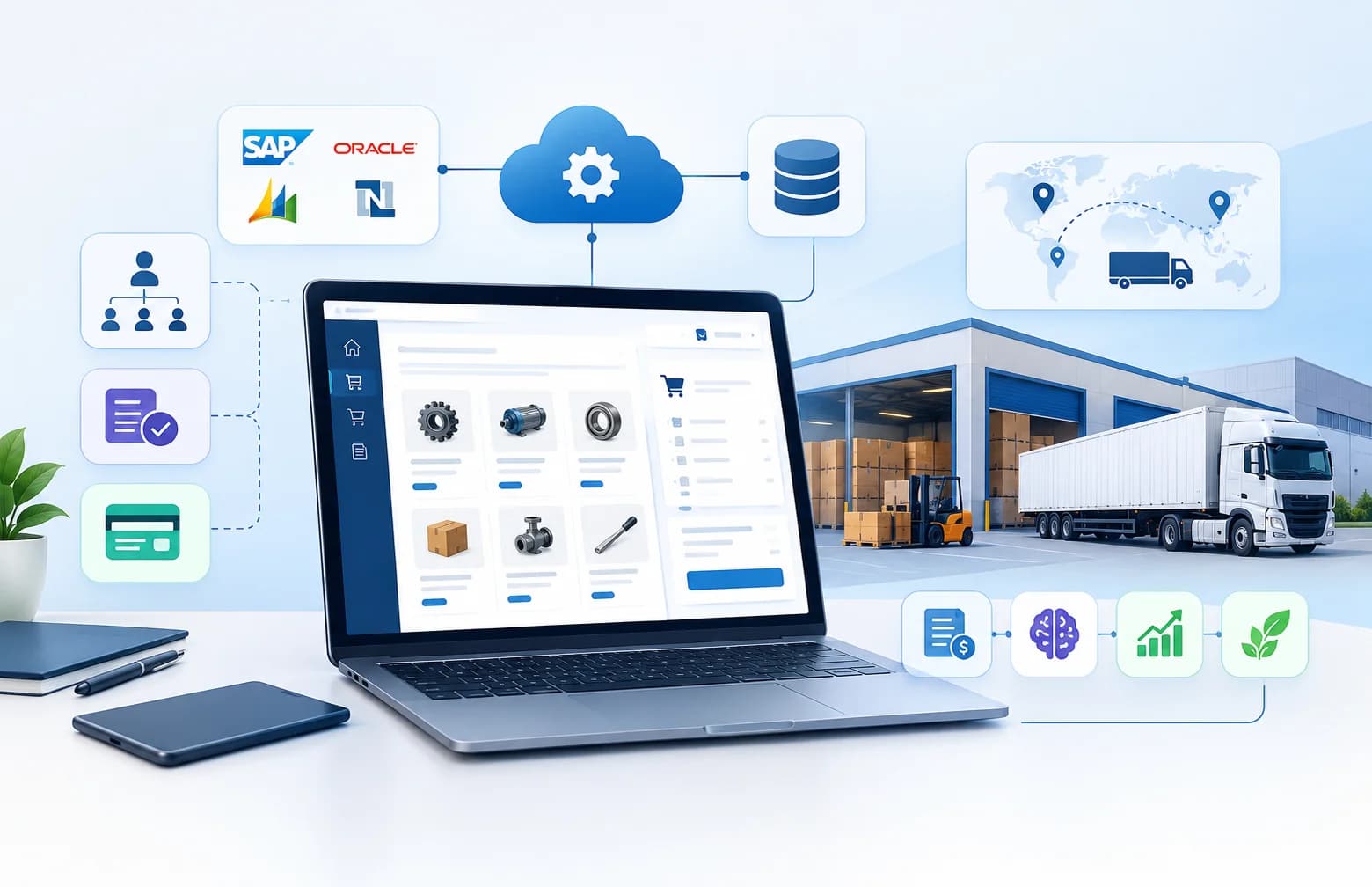
The ERP as the Single Source of Truth: Bi-directional data pipelines between the platform and systems such as SAP S/4HANA, NetSuite, or Microsoft Dynamics 365 ensure ledger accuracy. Customer credit lines, tax exemptions, and open invoices update in real time. Automation synchronizes the credit approval process to prevent clients from exceeding approved credit limits and eliminates manual data entry.
Available-to-Promise (ATP) Inventory Logic: Business buyers want to know where inventory is located before they spend their money on a purchase. Custom data layers aggregate inventory levels from regional warehouses, production facilities, and transit containers. The platform automatically splits line items and ships them to the closest fulfillment hub to minimize shipping costs.
Native e-Procurement Bridges (PunchOut): Large accounts often mandate purchasing through internal suites. Dedicated cXML and OCI protocol listeners allow corporate clients to browse your catalog directly from within SAP Ariba, Coupa, or Jaggaer, pulling line items straight into their internal requisition workflows.
The Intelligence Layer: Embedding Practical AI into B2B Workflows
Consumer storefronts use machine learning to suggest related retail items. In commercial supply chains, that logic is unhelpful. Industrial buyers don't need impulse-buy carousels; they need predictive replenishment tools that prevent warehouse stockouts.
Embedding machine intelligence into commercial commerce automates heavy administrative workflows:
Predictive Replenishment Triggers: Machine learning models analyze past purchase frequencies, seasonal cycles, and machine operating hours to track inventory burn rates. The platform flags potential part shortages weeks in advance and drafts purchase orders for procurement leads to review.
Operational Anomaly Detection: Algorithms spot abnormal order spikes, duplicate purchase orders, and unexpected address variations. If a customer accidentally keys in an order for five thousand cases instead of five thousand units, the system holds the transaction for review before it reaches the picking line.
Intelligent RFQ Routing: Rather than dumping all quote requests into a manual sales queue, models evaluate suggested discounts against inventory holding costs, supplier constraints, and goal margins. The system approves all standard requests on the spot, freeing sales teams to focus on high-value, hard contract negotiations.
Strategic Evaluation: Off-The-Shelf SaaS vs. Composable Architecture
Commercial SaaS platforms seem convenient on paper. They offer rapid initial setup and pre-built templates that help businesses launch quickly. As transaction volumes grow, vendor revenue-share fees, closed database architectures, and costly subscription tiers start to erode profitability.
Rigid platforms force companies to reshape business processes around software constraints. When a business requires non-standard payment terms or complex manufacturing integrations, hosted platforms push back. You end up trapped managing dozens of unstable third-party plugins that degrade page performance and create security vulnerabilities.
Architectural Dimension | Monolithic SaaS Storefronts | Composable & Custom B2B Engines |
|---|---|---|
System Ownership | Rented infrastructure; recurring revenue share fees. | Full intellectual property ownership; zero transaction penalties. |
ERP Connectivity | Rigid third-party connectors; slow batch updates. | Direct bi-directional event pipelines and instant data synchronization. |
Procurement Integrations | Restricted PunchOut modules with ongoing add-on licensing. | Native cXML/OCI gateways integrated into client procurement suites. |
Catalog Scalability | Database latency on multi-tier contract pricing. | Microservice-backed matrix pricing calculated at sub-second speeds. |
Modern engineering teams favor headless and composable models. Separating front-facing buyer portals from backend business logic lets companies adapt customer touchpoints without risking database integrity. Engaging specialized B2B eCommerce development services allows organizations to build modern digital architectures. You retain full ownership of your data models, business logic, and codebases.
This architectural freedom makes modern expansion straightforward. A composable core supports dedicated dealer portals, regional wholesale storefronts, and B2B online marketplace development from a single operational hub. Clean REST and GraphQL APIs let teams launch new channels without rebuilding database infrastructure from scratch.
Engineering Execution and Modernization Governance
Ripping out a legacy order system in a single cutover is a recipe for operational disaster. Distributors cannot afford days of system downtime while technicians scramble to resolve broken database connections. Experienced engineering teams use an incremental migration strategy to modernize platforms safely.
Executing complex digital commerce transformations requires disciplined engineering practices:
The Strangler-Fig Pattern: Layer modern API routing over legacy catalog cores. Gradually migrate core modules, such as customer self-service, price calculation, or order capture, to the modern architecture, keeping operations running without disruption and retiring legacy components cleanly.
Automated Data Migration Pipelines: High-volume catalogs need rigorous data scrubbing and schema normalization before they can be placed into new transactional stores. Continuous validation pipelines transform archived customer contract sheets, transaction histories, and complex SKU variants, removing the need for manual re-keying.
Dedicated Engineering Pods: Disciplined enterprise eCommerce development practices are necessary for high-throughput systems. Mobilize engineering teams and cross-functional AI Pods that are domain experts. Integrate procurement workflows tightly with enterprise resource software. Enforce strict governance and testing before release.
Resilient software architecture is essential for wholesale and distribution companies with fragile, manual ordering processes. If you build your next-gen platform around trusted data contracts, custom business rules, and deep ERP integration, then your digital channels will scale cleanly as you scale operationally.