
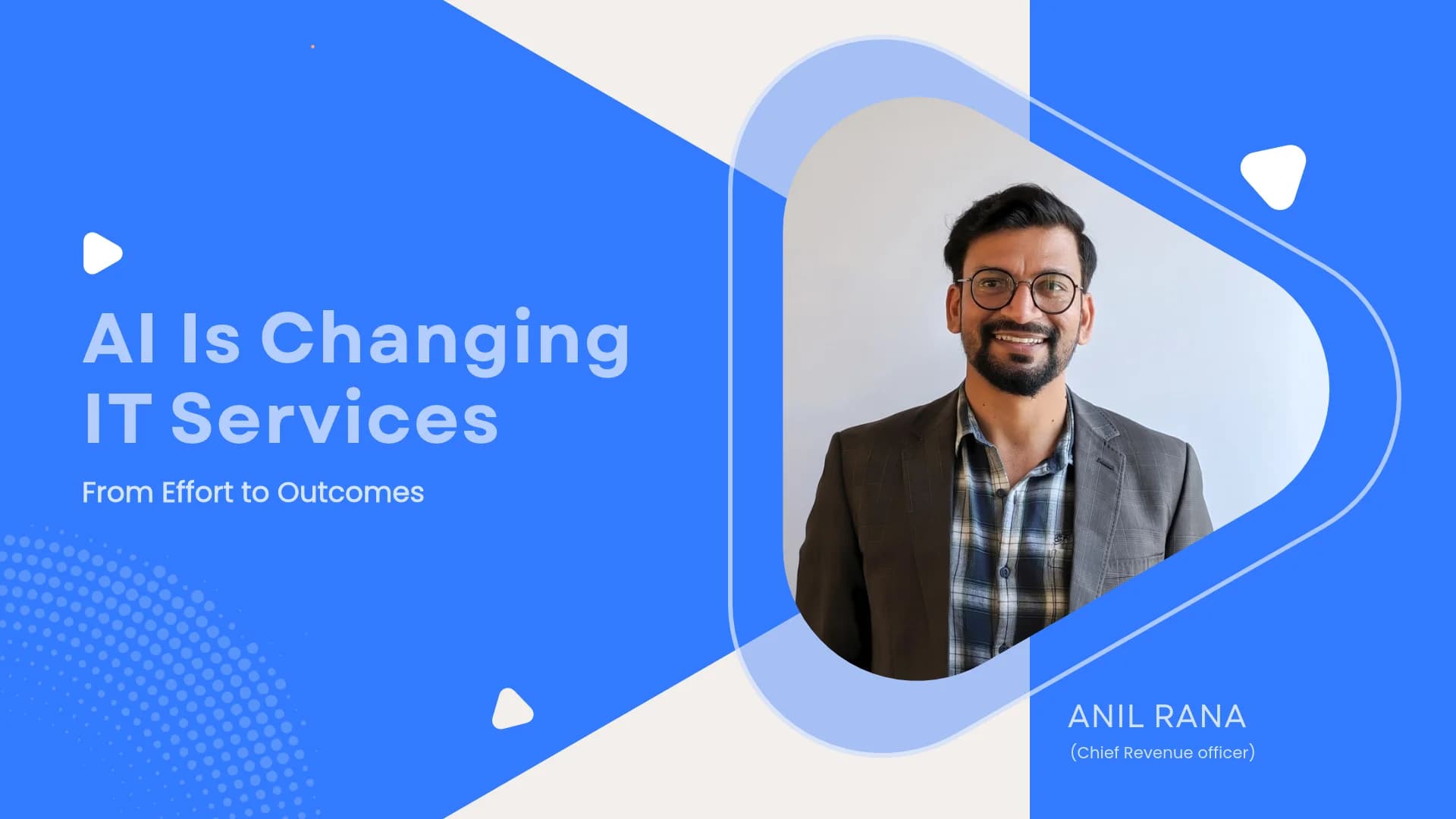
 AI Strategy
What Clients Value in IT Services in the AI Era
As AI improves delivery productivity, enterprise buyers are shifting attention from effort and capacity to outcomes, modernization, and measurable business impact.
AI isn’t killing IT services. It is changing what clients are willing to pay for.
For much of the past year, the technology services industry has been debating a difficult question: if AI can make engineers and delivery teams significantly more productive, what happens to the traditional IT services model?
Accenture’s latest results offer an interesting signal.
The company closed FY2026 with $74 billion in revenue, up approximately 5% in local currency, and has guided for 3%–6% revenue growth in FY2027. More tellingly, over 65% of its bookings are now fixed-price work, including outcome-based engagements. Accenture also reported that bookings with a group of emerging AI and data partners more than tripled year over year.
Markets noticed. Indian IT stocks moved higher following Accenture’s outlook, as concerns around AI-led disruption eased somewhat.
But I don't think the takeaway is that the traditional IT services model is simply "safe."
The more important change is what enterprises are prepared to pay for.
Clients are increasingly less interested in buying capacity for capacity's sake. The value conversation is shifting toward:
Can you modernize the application without disrupting the business?
Can you make fragmented enterprise data usable for AI?
Can you integrate AI into existing workflows securely?
Can you automate delivery while maintaining quality and governance?
And, most importantly, can you connect the technology investment to a measurable business outcome?
That puts pressure on models built primarily around billable effort. Reuters has also reported AI-related pricing pressure across Indian IT, with clients expecting productivity gains to translate into economics.
At the same time, AI creates an entirely new layer of engineering work.
Legacy applications still need to be modernized. Data needs to be prepared. Agents need access to enterprise systems. Models need guardrails. Integrations need to be reliable. AI systems need testing, observability, security, and continuous optimization.
So perhaps the next phase of IT services is not about doing the same work faster.
It is about taking greater responsibility for the outcome of the work.
For technology partners, that means deeper engineering capability, stronger domain understanding, and a willingness to rethink how value is delivered and measured.
How are you seeing this shift?
Are clients already moving from effort-based engagements toward outcome-led technology partnerships, or is the change still more discussed than experienced?
Related Articles

The Hidden Environmental Cost of Artificial Intelligence
AI may feel effortless to users, but every query depends on energy, cooling and infrastructure. This article explores why the AI industry must make sustainability part of innovation.

The Rise of Autonomous SDLC: How AI Agents Are Redefining Software Delivery
Discover how Autonomous SDLC is reshaping software engineering with AI agents that automate development, testing, deployment, and governance while empowering teams to build better software faster.
Leading in the Age of AI: Strategies for Scalable Innovation
Learn how enterprise leaders can scale AI responsibly, transform operating models, and turn intelligent automation into measurable business value.