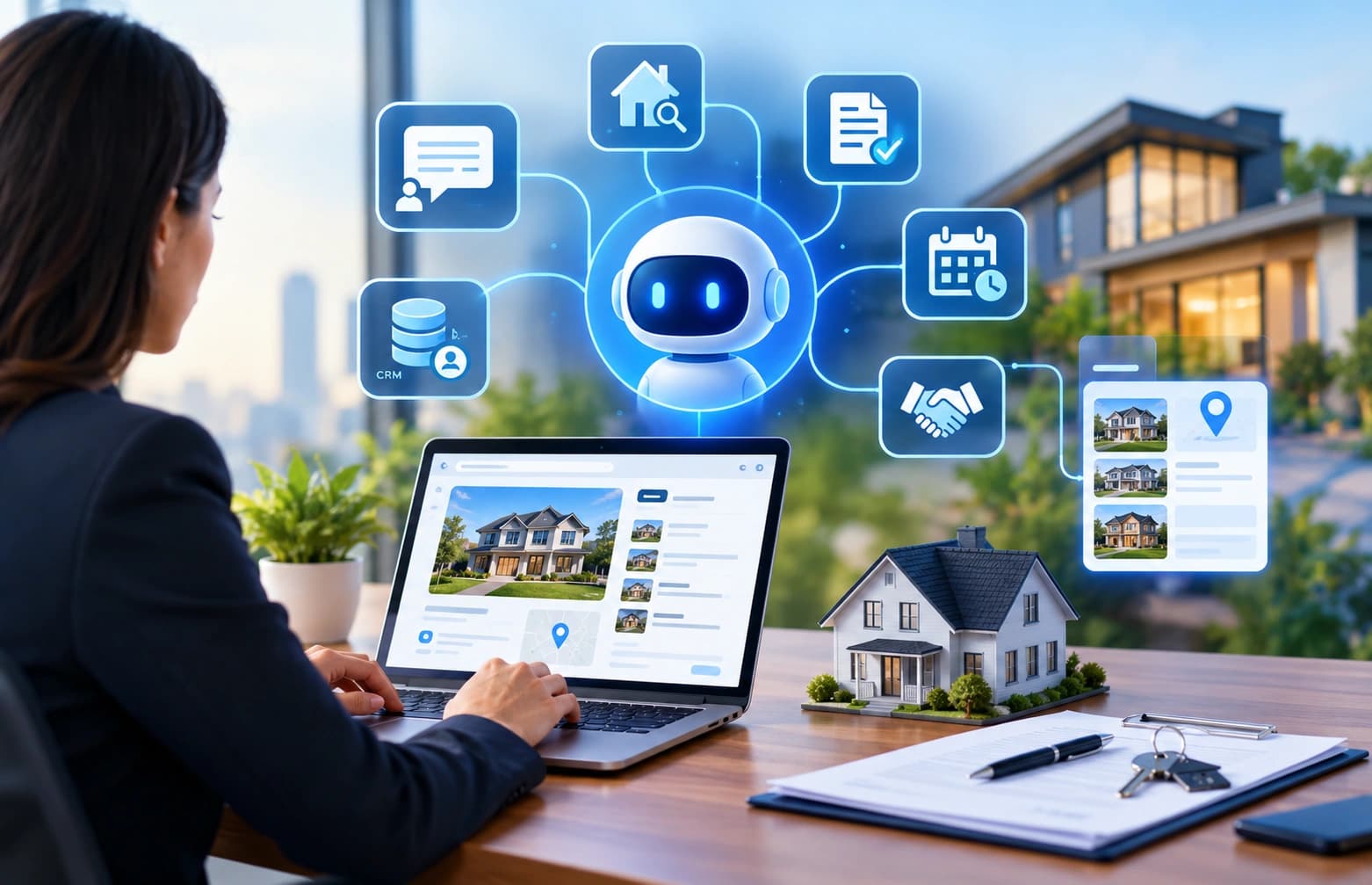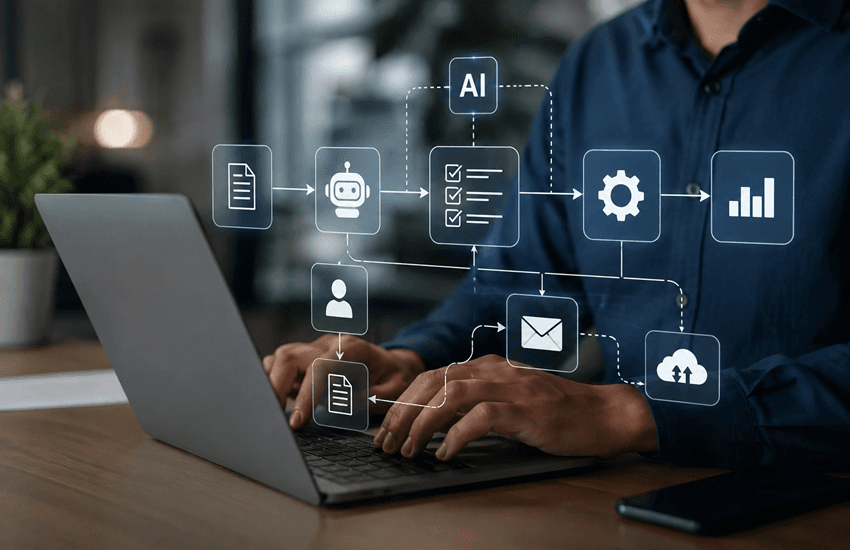
Enterprise workflow automation is shifting from rule-based scripts to dynamic systems capable of reasoning and executing complex goals. Traditional workflow engines rely on rigid conditions, while agentic workflow development enables systems to assess outcomes, select appropriate tools, and adapt to changing data environments while reducing manual intervention at every step.
For modern enterprises, moving beyond basic prompt engineering toward autonomous orchestration is no longer experimental - it is a core strategy for operational scale.
Understanding Agentic Workflows: How Autonomous Execution Outpaces Static Rules
For decades, software development has been focused on predetermined business process automation, with code routes meticulously specified by human engineers. While rule-based systems can swiftly handle normal relational database entries, they stop or raise exceptions when they meet unstructured language, incorrect form fields, or unforeseen operational edge situations.
Agentic workflows evolve this approach by replacing static pipelines with dynamic, validation-driven execution loops. An agentic workflow does not merely execute a pre-written sequence of steps - it continuously runs a perception-reasoning-action loop:
Perceive
The system ingests structured metrics, unstructured documents, or real-time event triggers.
Evaluate & Plan
The underlying model analyzes the primary goal, evaluates current environmental state parameters, and breaks the overarching objective into dependent sub-tasks.
Execute & Tool Selection
The engine calls specific system APIs, queries vector databases, or runs computational scripts to complete the current sub-task.
Observe & Reflect
The engine inspects the tool output. If an API returns an error or an intermediate result violates logical constraints, the workflow adjusts its plan and attempts an alternative execution path autonomously.
Workflow Dimension | Traditional Automation (RPA) | First-Gen Generative AI | Agentic Workflow Systems |
Execution Model | Hardcoded conditional scripts | Single-shot text generation | Dynamic perceive-reason-act loops |
Data Handling | Breaks on unstructured formats | Synthesizes text - cannot alter state | Ingests unstructured data & executes system calls |
Exception Recovery | Escalates errors immediately | Requires manual re-prompting | Self-corrects via dynamic retry logic |
System Scope | Isolated single-system tasks | Information assistance | Interconnected cross-platform operations |
This dynamic planning capability allows autonomous workflows to navigate unpredictable corporate processes, transforming enterprise software development from reactive data repositories into proactive execution systems.
Architectural Pillars of Agentic Workflow Development
Developing production-ready agentic workflows requires a multi-layered software architecture built for fault tolerance, deterministic control boundaries, and contextual awareness.
Reasoning Engines and Prompt Decomposition
At the foundation of enterprise AI agent development is a cognitive reasoning engine capable of breaking vague business objectives into structured execution plans. Software architects utilize structured output formats (such as JSON Schema) to force models into generating predictable, machine-readable action steps rather than free-form text response.
State Management and Dynamic Tool Routing
Agentic workflows require explicit state machines to track execution progress across asynchronous systems. The orchestration layer maintains a central state object containing historical execution logs, intermediate variables, and tool invocation limits. Tool routers validate parameters against strict schemas before executing API endpoints across enterprise resource planning (ERP) or customer relationship management (CRM) backends.
Memory Systems and RAG Architecture
To stay focused and handle large operational datasets smoothly, workflows rely on a dual-memory approach:
Short-Term Memory
Ephemeral context windows tracking current task iterations and immediate tool outputs.
Long-Term Memory
Vector database connections backed by retrieval-augmented generation, allowing the workflow to query internal policy manuals, contract databases, and compliance guidelines on demand.
Multi-Agent Orchestration Frameworks
When managing multi-step operations across departments, software architects deploy multi-agent AI systems coordinated by a central supervisor node. Rather than burdening a single model with every operational step, sub-agents specialize in dedicated domains such as document extraction, validation, or financial reconciliation passing verified outputs back to the supervisor to drive the end-to-end workflow automation forward.
Step-by-Step Engineering Roadmap for Developing Enterprise Agentic Workflows
Engineering an enterprise-grade agentic workflow development requires transitioning from open-ended prompt experiments to a disciplined software delivery pipeline.
Step 1: Objective Mapping and Action Graph Design
Define clear success state criteria, input boundary conditions, and resource limits for the operational goal.
Deconstruct manual workflows into functional execution graphs, establishing clear boundaries where deterministic code handles standard logic, and agentic loops handle ambiguous decisions.
Define Human-in-the-Loop (HITL) checkpoints for high-impact actions, such as financial disbursements or external communications.
Step 2: Data Pipeline Integration and Schema Binding
Connect enterprise data repositories to fast vector stores for real-time document retrieval and context hydration.
Building robust middleware for custom AI integration allows agents to read state parameters and trigger API calls securely across legacy backends.
Adopting disciplined agentic workflow development requires establishing rigid schema definitions for every tool integration, preventing hallucinated parameters from reaching external production APIs.
Engineering frameworks developed by Seasia Infotech emphasize schema validation, API middleware wrappers, and vector indexing to maintain operational stability.
Step 3: Loop Guardrails and Error Handling Mechanics
Implement explicit recursion limits and token usage caps to halt runaway agent loops.
Build dynamic reflection handlers that force the agent to evaluate tool error messages and attempt alternative parameters up to a defined threshold.
Establish fallback routes that gracefully escalate unresolvable execution states to human operations teams with full audit logs attached.
Step 4: Evaluation and Continuous Deployment
Implement offline evaluation suites (evals) to measure decision accuracy, schema adherence, and planning efficiency across hundreds of historical edge cases.
Deploy workflows using blue/green deployment models, running new agentic logic in shadow execution mode alongside existing human workflows to baseline decision quality.
Continuously track latency, cost-per-execution, and success rates across production execution paths.
Enterprise ROI, Market Data, and Readiness Gaps
As enterprises transition from initial generative experimentation to operational agentic workflow development, recent industry studies highlight both immense financial opportunities and critical foundational hurdles.
The Strategy-Execution Divide
According to a Harvard Business Review Analytic Services study, 84% of enterprise leaders believe agentic AI will transform their business, yet only 13% report having a data architecture well-equipped for agentic deployments.
The Autonomous Trust Deficit
Research from Harvard Business Review revealed that while 86% of companies plan to increase investments in agentic capabilities, only 6% currently trust autonomous agents to run core business processes without human supervision.
In the end, closing these crucial data and trust gaps is necessary to fully realize the corporate value of agentic AI. Organizations can accomplish quick time-to-value while preserving the human oversight required for essential business activities by implementing structured frameworks.
Overcoming Deployment Hurdles in Agentic Workflow Engineering
While the benefits of agentic workflows are substantial, enterprise engineering teams must address significant operational risks prior to production deployment:
State Space Explosion
In complex multi-step tasks, agentic reasoning loops can drift into unproductive planning branches. Mitigate this by breaking broad workflows into tightly bounded sub-agents with narrow operational scopes.
Security and Access Control
Granting an autonomous agent execution access across corporate databases risks unintended data deletion or unauthorized privilege escalation. Enforce Zero Trust IAM policies, scoped API keys, and dedicated execution sandboxes.
Data Quality Bottlenecks
Non-deterministic reasoning engines rely heavily on clean operational data. Ingesting poorly structured documents leads to incorrect tool parameter selection.
Partnering with an experienced custom AI solutions company like Seasia helps organizations navigate these architectural trade-offs without compromising data security or operational continuity.
Modern AI application development stresses deterministic safety wrappers over non-deterministic language models. Using specialized AI agent development services allows businesses to avoid lengthy trial-and-error cycles during initial system design, resulting in strong, audit-ready workflows that drive sustainable operational improvements.
Conclusion
The transition from static software scripts to goal-driven autonomous systems is a significant advancement in organizational technology. Companies that methodically upgrade their data pipelines, set security safeguards, and deploy comprehensive orchestration frameworks will achieve remarkable operational agility. To navigate this architectural change, companies must strike a balance between autonomous execution and strategic human oversight. Organizations can shift normal manual overhead into self-optimizing digital processes that produce long-term value by working with expert technical partners such as Seasia.