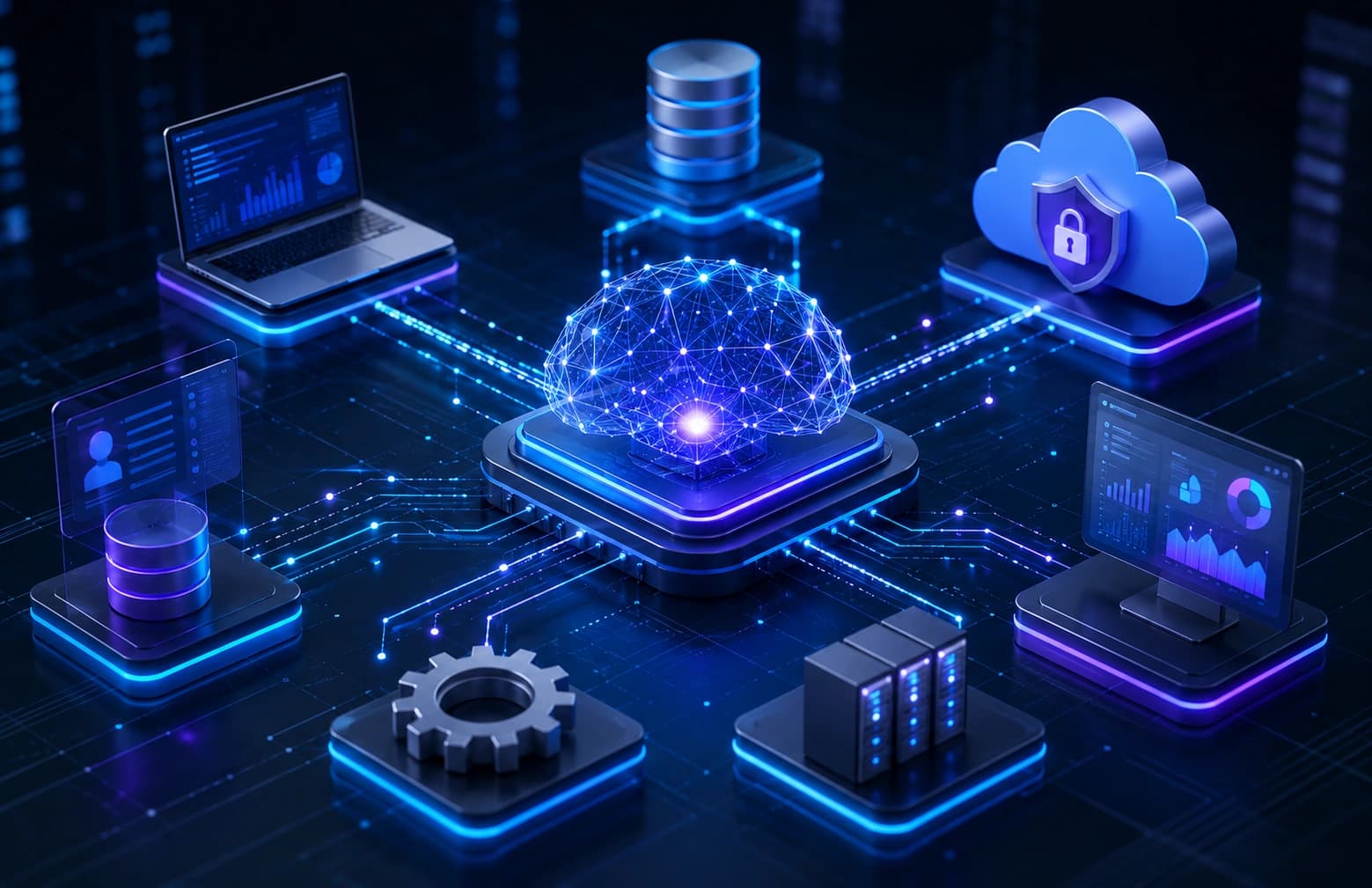
Enterprise organizations are moving away from standalone conversational portals. Operational needs now require embedding AI capabilities directly into core platforms, including CRM systems, ERP suites, internal databases, and custom workflow engines.
Modern software architectures demand direct model integration into transactional data streams, automated decision loops, and customer-facing interfaces. Connecting models directly to active data pathways enables real-time execution across everyday operations.
Total custom AI integration costs vary significantly across projects. Final pricing depends on system architectural maturity, technical complexity, target concurrency limits, security protocols, and data pipeline design. Calculating the full budget requires accounting for initial engineering fees, third-party infrastructure overhead, vector storage, and ongoing maintenance.
Custom AI Integration vs. Standalone SaaS Tools
Enterprise teams evaluate off-the-shelf SaaS subscriptions against direct system integration. Off-the-shelf platforms provide rapid deployment, fixed monthly subscription tiers, and zero custom code infrastructure. These platforms operate as isolated environments, and therefore lack deep access to proprietary relational databases, real-time transaction logs, and internal enterprise governance frameworks.
Direct integration embeds model capabilities directly within existing enterprise applications. Custom engineering links model endpoints to internal APIs, proprietary data repositories, and authentication layers. Evaluating how direct system connectivity impacts overall project budgets helps leadership teams allocate capital accurately. According to Gartner research, 70% of enterprise software implementations fail to meet their original business goals or full operational ROI when relying strictly on isolated SaaS tools stemming from data fragmentation and workflow disruption.
Feature | Off-the-Shelf SaaS Tools | Direct Custom AI Integration |
Deployment Speed | Instant / Same Day | 4 to 24 Weeks |
System Customization | Low (Pre-built interfaces) | Full (Native UI / System integration) |
Data Ownership & Governance | Third-party vendor cloud | Private tenant / On-premise control |
Legacy Compatibility | Limited via pre-built connectors | Native integration with legacy databases |
Upfront Financial Commitment | Low recurring monthly fee | Higher capital engineering expenditure |
Long-Term Operational ROI | Capped by functional limits | High through workflow automation |
Native system connectivity guarantees that algorithmic outputs directly trigger downstream business operations. A customer support ticket processed by an integrated model can automatically modify order statuses within an ERP system, trigger fulfillment updates, and adjust inventory records without manual human data entry.
Custom AI Integration Cost Matrix for 2026
When planning project budgets, teams must categorize initiatives by structural scope, model requirements, and target integration depth. Financial projections change across each tier depending on technical needs, developer labor, and infrastructure commitments. Every deployment layer has cost estimates that directly reflect these specific underlying engineering factors.
Basic AI API Integration
Simple implementations combine common commercial endpoints like LLM inference APIs into a single application. Basic technical tasks include simple endpoint wiring, basic prompt architecture, user access management, and basic error handling.
Embedded AI Feature Integration
This layer brings concentrated intelligence into operational software. These might include things such as automatic document categorization, semantic search across document repositories, automatic answer creation in help desks, etc. The project scope consists of bespoke database schema changes, intermediate data processing pipelines, rudimentary semantic caching, and UI panel creation.
Advanced AI Application Build
Multi-modal inputs, domain-specific RAG architectures, vector database integration, and refined domain models are all part of advanced builds. For systems to handle chunking pipelines, role-based data access, hybrid keyword-semantic search, and real-time data intake, bespoke middleware is needed.
Enterprise AI Integration
Large-scale corporate deployments require closely interconnected infrastructure across enterprise CRMs, legacy ERP databases, cloud storage buckets, and specialized software development environments. Success relies on strict governance frameworks, data encryption standards, specialized audit logs, fallback redundancy layers, and high-concurrency throughput design.
Multi-System AI Agent Deployment
The most sophisticated tier employs autonomous agent frameworks capable of multi-step planning, executing sub-tasks, self-correcting, and communicating with tools across several core business systems. System components include real-time telemetry, memory state preservation, multi-agent communication networks, and human-in-the-loop monitoring panels.
Cost Breakdown by Specific Solution Type
Specific technical architectures incur distinct engineering expenses based on model selection, training needs, and interface requirements. Evaluating solution types provides clarity when estimating the total custom AI integration cost for enterprise operations.
Generative AI Development
Implementing generative capabilities for automated content creation, code generation, or structured data extraction requires specialized token processing pipelines. Engineering costs stem from developing prompt management engines, temperature calibration mechanisms, content moderation layers, and response schema validators.
A comprehensive generative AI development project typically costs between $25,000 and $75,000 depending on model selection and output formatting complexity.
AI Agent Development
Autonomous agents execute sequential workflows across external APIs without direct human intervention per step. Engineering teams build state management systems, tool-calling interfaces, action verification protocols, and recovery mechanics for failed API executions. Constructing operational multi-agent networks drives an AI agent development project cost into the $60,000 to $180,000 range.
AI Copilot Development
Copilots serve as real-time assistants embedded within enterprise software Development requirements include low-latency streaming endpoints, context-window management, active workspace state tracking, and specialized UI components. Standard AI copilot development initiatives require capital outlays ranging from $35,000 to $90,000.
AI API Integration and Custom Development
Connecting third-party intelligence services requires structured wrapper engineering, rate-limiting handlers, token consumption tracking, and automated retry logic. Calculating the total AI API development cost requires factoring API token consumption fees, middleware hosting, and protocol translation layers. Standard setup projects require between $10,000 and $30,000 in direct implementation services.
The Primary Technical Drivers of Custom AI Integration Cost
A significant portion of integration expenditures goes toward foundational software engineering, data management, and security protocols rather than raw model access. These fundamental architectural factors directly shape technical expenditures across all industries.
Data Preparation and Pipeline Engineering
Data quality determines model execution efficacy. Raw corporate records contain duplicates, unstructured formatting, missing fields, and conflicting schemas. Data preparation engineering includes:
Extract, Transform, Load (ETL) pipeline construction.
Document extraction and optical character recognition (OCR) parsing.
Semantic text chunking and vector embedding generation.
Vector database configuration and index optimization.
Software Architecture and Legacy System Compatibility
Model endpoints may still be easily connected to contemporary RESTful APIs or GraphQL services. Custom middleware development is needed to connect intelligence layers to proprietary database protocols, monolithic codebases, and outdated mainframes. Specialized engineering costs range from $15,000 to $50,000 for building unique connections, translation layers, and message queuing systems.
Security, Governance, and Compliance
Strict security frameworks are necessary in enterprise settings to stop prompt injection attacks, data breaches, and illegal model access. Putting enterprise-grade security procedures into practice entails:
End-to-end data encryption in transit and at rest.
Corporate identity providers (SAML, OAuth, Active Directory) are connected to granular role-based access control (RBAC).
Automated data lineage tracking and audit logging.
Verification of compliance with regulations including ISO 27001, GDPR, HIPAA, and SOC 2 Type II.
Total Cost of Ownership: Upfront Build vs. Ongoing Infrastructure
When evaluating the cost of bespoke AI integration, a distinction must be made between one-off capital investments and ongoing operating costs. Total Cost of Ownership (TCO) estimates suggest that operational costs in year one are generally 40% to 60% of the initial engineering expenditure.
Upfront Development Stage Distribution
A standard $100,000 enterprise software integration project allocates resources across major phases:
Discovery and AI Strategy: $15,000 (Defining use cases, data audits, architecture planning).
UI/UX Design: $10,000 (Designing contextual sidebars, chat components, approval flows).
Backend Engineering and Orchestration: $35,000 (Building microservices, middleware, API connectors).
Data Engineering and Vector Setup: $20,000 (Cleansing data, embedding pipelines, vector indexing).
AI Software Testing and QA: $20,000 (Validating model accuracy, latency testing, edge-case evaluation, security penetration tests).
Recurring Infrastructure Expenditures
Once production is live, operational platforms will have ongoing use fees:
API Token Licensing: Commercial model providers charge based on the amount of input and output tokens. They handle millions of tokens every day for high-volume business applications, with monthly expenses of $500 to $10,000+.
Vector Database Hosting: Managed vector database providers often charge per memory, vector dimension, and read/write operations ($200 to $3,000+ per month).
Cloud Infrastructure: You may easily spend $500 to $5,000+ per month just running application servers, cache layers, and dedicated GPU instances on AWS, Azure, or Google Cloud.
Monitoring and Telemetry: Enterprise observability solutions for monitoring latency; token consumption, drift, and hallucination rates require specific software licenses ($300 to $2,000 per month).
Long-Term Maintenance and System Optimization Budgets
Artificial intelligence software needs constant monitoring and recalibration. Standard corporate software systems continue to run reliably once they are deployed, unless code dependencies alter. Machine learning algorithms are subject to data drift, user language changes, and deprecation of third-party APIs.
The heart of the multi-year expense of a bespoke AI integration is ongoing support. Industry norms suggest that 15 to 25 percent of the initial development cost should be allocated yearly to continuing software maintenance and optimization. Maintenance expenses are often in the $15,000 to $25,000 per year range for a $100,000 initial integration.
Key Maintenance Operational Tasks
Model Evaluation and Benchmarking: Continuously evaluating response accuracy against curated ground-truth datasets to monitor the growth of hallucination rates.
Prompt Tuning and Improvement: Changing system prompts to reflect new operational policies or new edge cases detected in production logs.
API Dependency Management: Updating code wrappers when model providers deprecate older API versions or make structural changes.
Data Refreshing: Re-indexing corporate knowledge bases to align vector stores with real-time business documents and policy updates.
Security Patching: Upgrading software libraries, access tokens, and middleware components to mitigate new vulnerability vectors.
Practical Strategies to Reduce AI Integration Costs
The financial investments need to be managed with systematic risk management in the software planning and execution phases. Organizations may successfully lower their custom AI integration cost by leveraging proven software deployment strategies.
1. Launch with a Scoped MVP
Avoid building multi-agent autonomous networks during initial deployment phases. Concentrate engineering resources on one high-impact, quantifiable use case, such as document processing or triage for tier-1 assistance. Measure performance before you add features.
2. Standardize on Commercial APIs Before Custom Training
Building bespoke models or fine-tuning open-source models requires expert data science teams and large GPU computing investment. Begin with commercial models that you access via APIs. Use fine-tuned small language models (SLMs) only when the amount of tokens justifies the expense of dedicated hosted models.
3. Implement Multi-Tiered Semantic Caching
Every time the same user query is sent straight to a foundation model, it incurs multiple token fees. Semantic caching caches frequent prompt-response combinations in memory databases. With caching layers, API charging and user latency can be significantly reduced.
4. Optimize Model Selection Routing
Leave easy data processing to low-cost tiny language models and save large reasoning models only for complicated analysis. Routing microservices for models minimizes total operating token expenses by up to 60%.
Partnering with Seasia Infotech for Enterprise Success
Seasia Infotech provides end-to-end enterprise AI development services to assist enterprises in planning, creating, and deploying intelligent capabilities within their existing application architectures. The engineering team blends current algorithmic innovation with pragmatic corporate software design to provide clear cost structures, great dependability, and demonstrable ROI.
Whether your organization requires custom AI copilot development, autonomous workflow automation, or secure enterprise AI solutions, Seasia Infotech provides the technical depth and software engineering rigor required to transform complex technical requirements into production-ready software assets.